
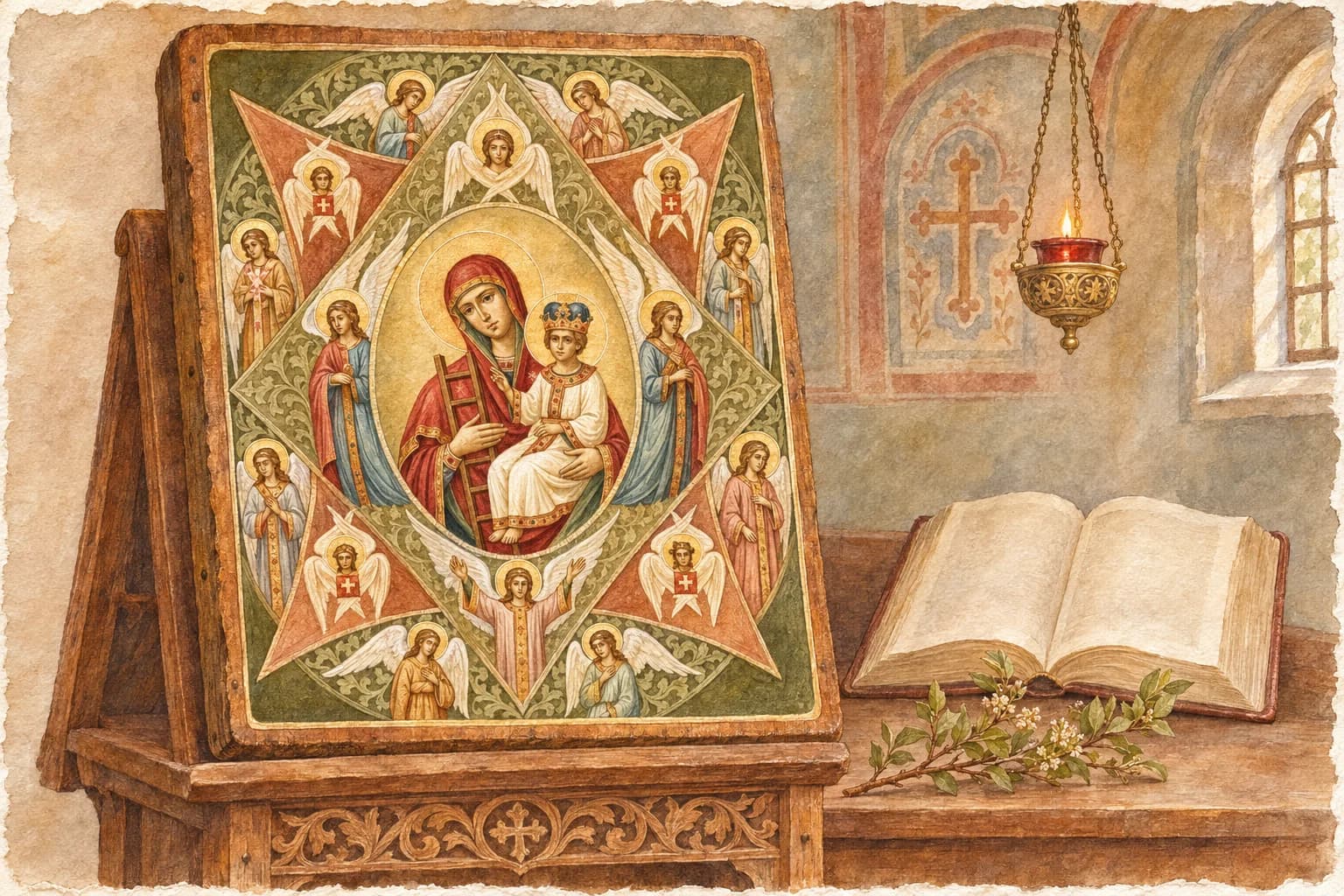
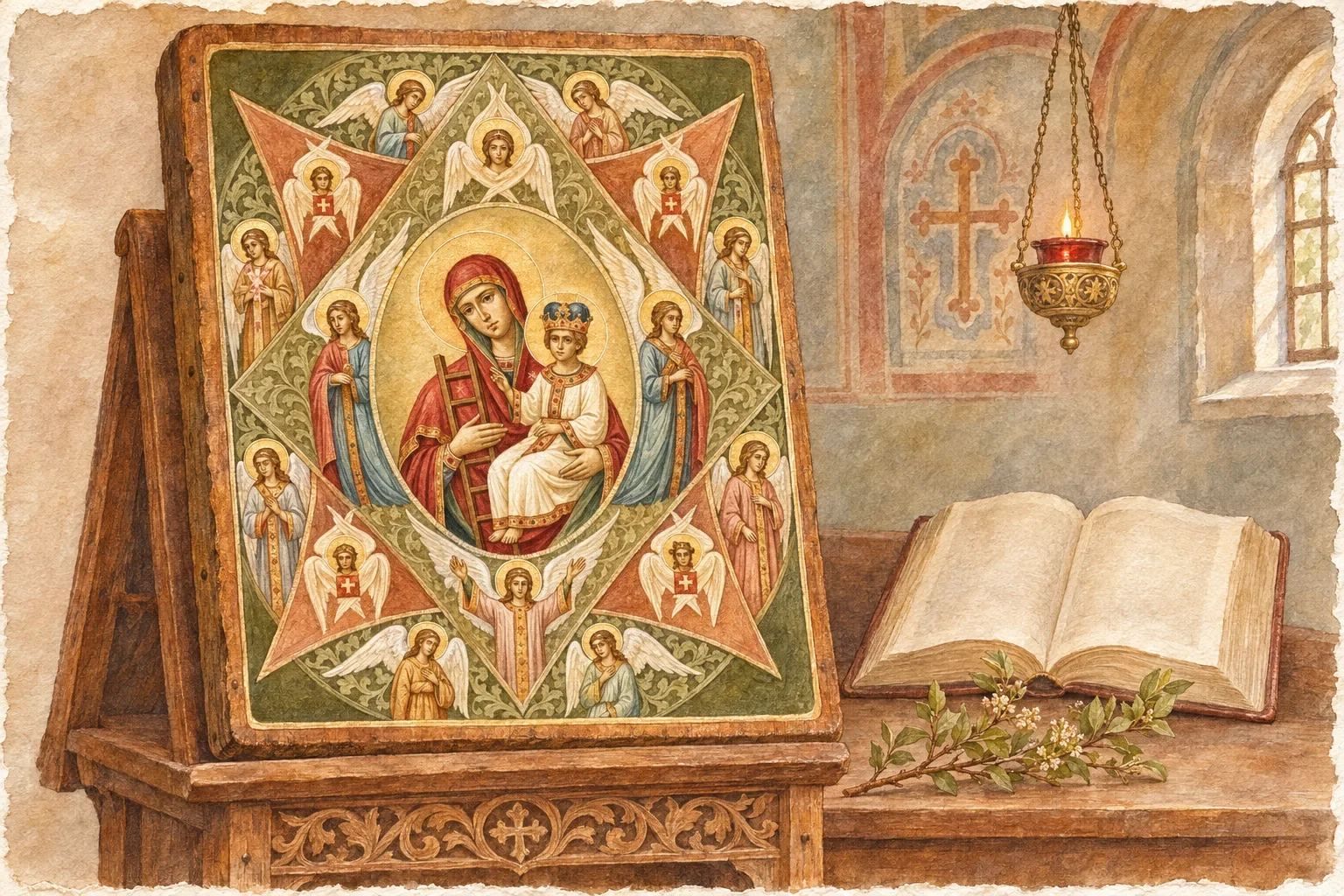
The Unburnt Bush icon refers to the burning bush in Exodus. Church interpretation connects that image with the Mother of God and the Incarnation. Its complex composition should be read through Scripture and tradition rather than as a collection of protective symbols.
Common versions arrange geometric forms, angels and symbolic imagery around the Mother of God. Details vary. Use an explanation of the particular type before you rather than assuming every version contains identical elements.
People traditionally pray before it for protection from fire, but an icon does not replace safe wiring, smoke alarms or fire precautions. Promising immunity from fire to someone who owns a copy would be superstition. Prayer and responsible household care belong together.
Read Exodus chapter three, then study the icon with a church explanation. Also check practical household safety. Learning about the image can connect prayer with care for the lives of those around you.
Begin with Exodus chapter three
Moses sees a bush burning without being consumed. In the biblical account, this encounter is connected with God addressing him and calling him to lead the people out of slavery. The bush is therefore not an incidental natural phenomenon inserted into an attractive story. The scene concerns holiness, God’s presence and a commission that changes the course of Moses’s life.
Before studying the complex icon, read the whole episode. This clarifies the importance of fire, the unconsumed bush and Moses’s presence. The icon uses the biblical image within a wider ecclesial interpretation but does not erase the original narrative. Knowing the text protects against arbitrary explanations in which the connection with Scripture disappears completely. It also provides a simple starting point before the viewer attempts to identify every small figure in a later composition.
How the bush became an image of the Mother of God
In church interpretation, the unconsumed bush became a type of the Mother of God: she received the divine presence without being destroyed and gave birth to Christ while remaining a virgin. This is the language of typology, reading an earlier event in the light of the Incarnation. It does not claim that the author of Exodus described the outward appearance of a later, many-part icon.
This way of reading connects the Old and New Testaments. It also appears in Marian imagery where buildings, a ladder or gates recall biblical passages. The principle matters: an object points towards meaning rather than becoming a separate deity. Veneration is directed towards the Mother of God and the incarnate Christ, not towards fire, a bush or a geometric shape. Understanding that relationship makes the imagery less mysterious without reducing it to mere ornament.
Why the composition resembles a many-pointed star
In the familiar elaborate composition, the Mother of God and Christ occupy the centre of intersecting polygonal forms. Red and green or blue-green fields are associated with fire and the bush. Angelic figures, symbolic creatures and biblical scenes surround them. Their arrangement organises a theological narrative rather than offering a magical diagram for controlling the world.
Not every copy contains precisely the same set of details. Explain a particular icon through its actual imagery and inscriptions. If an old image is darkened or a metal cover conceals some panels, acknowledge an unidentified figure instead of assigning meaning by guesswork. Moving from the centre towards the outer scenes is usually clearer than trying to memorise every designation immediately. The structure becomes intelligible when the central subject remains visible throughout the explanation.
Evangelist symbols and other biblical images
Such icons can include a human figure, lion, ox and eagle associated in Christian art with the evangelists. Other parts contain scenes and objects expressing Old Testament types. Each needs its own explanation; their presence does not mean Christian prayer is directed towards animals or the forces of nature.
For study at home, select one detail, identify its inscription and read the corresponding biblical passage. Then return to the central image and ask how the detail relates to the Incarnation. This turns looking into substantive reading. An online explanation based on secret numbers, astrology or promises to control fire does not follow from the ordinary church understanding of the icon. The presence of elaborate symbolism is not permission to supply any symbolic system one happens to prefer.
Prayer for protection from fire and practical responsibility
Because of the unconsumed bush, people especially pray before the icon for protection from fire. Prayer does not give anyone permission to endanger themselves or others. In a fire, leave the dangerous area, contact emergency services and follow their instructions. Do not remain in a burning building to hold an icon towards the flames or recover possessions at the risk of life.
In everyday life, veneration is compatible with checking electrical wiring, using candles safely and maintaining working alarms. A household oil lamp requires the same attention as any other source of an open flame. Responsible precautions do not demonstrate a lack of trust in God. They show that loved ones’ lives are received as a gift to be protected. The icon’s biblical meaning and sensible action belong together rather than requiring a choice between faith and care.
A question for reflection
What necessary safety measure should not be postponed under the guise of trusting an icon?