
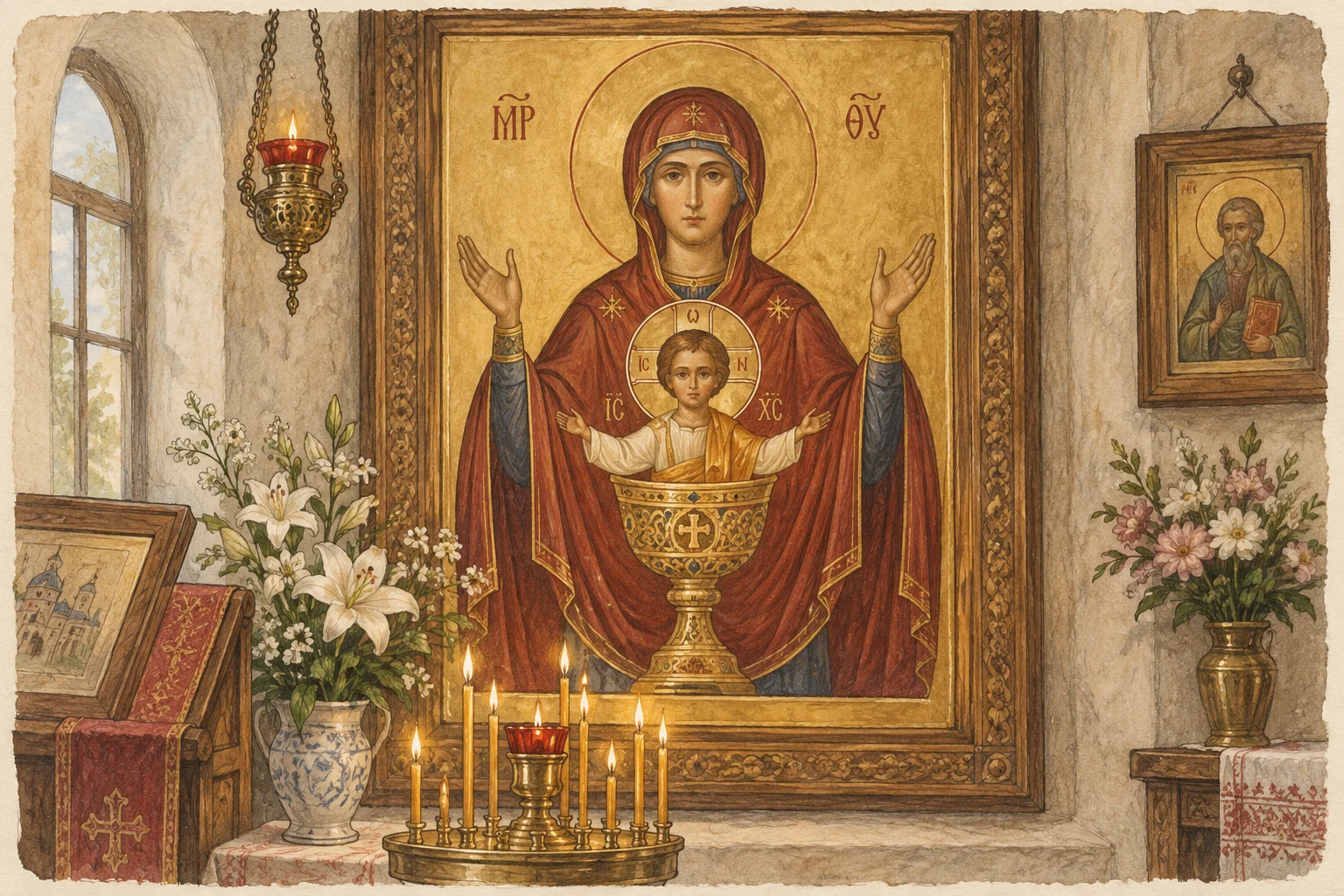
People affected by addiction, and those who love them, often pray before the Inexhaustible Chalice icon. Church support does not require abandoning a doctor, treatment, or psychological help. The image is not a means of forcing another person to change. Neither a diagnosis nor other people's judgement exhausts the identity of someone experiencing addiction.
The Serpukhov History
The recognised history of its veneration begins at the Vladychny Convent in Serpukhov in 1878. Monastic tradition tells of a man troubled by heavy drinking who travelled there after guidance received in a dream. The later history includes the loss of the older image and the creation of new venerated copies. Present-day Serpukhov icons should therefore not simply be called the same nineteenth-century panel.
Accounts of help are testimonies of believers, not clinical trial results. A personal narrative cannot establish a guaranteed recovery time, a universal number of prayer services, or an outcome independent of someone's circumstances. Accuracy matters especially when readers are desperate and vulnerable to false assurances.
Why a Chalice?
Mary is shown with her hands raised in prayer, with Christ depicted in a chalice before her. The composition refers to the Eucharist, the gift of Christ's life, and unfailing mercy. Its name is neither an invitation to drink alcohol nor a suggestion that blessed water or another sacred substance can substitute for treatment.
The Saviour, rather than the addiction itself, occupies the centre. This changes the perspective: a person needs not only to resist destructive behaviour but also to find relationships, meaning, honesty, and support. Prayer can express that need, while those nearby remain responsible for practical help and attention to safety.
Prayer Alongside Professional Care
A person can speak with a priest and also make an appointment with an addiction professional. A clinician assesses health and treatment options; a priest addresses spiritual questions. These roles are not interchangeable. Do not abandon prescribed care for a promised spiritual cure, or select a medical regimen from stories associated with an icon.
A first step may be modest: find a relevant treatment service, ask someone trustworthy to accompany you, or tell a professional honestly what has been happening. If care is already underway, prayer can accompany it. Difficulties or a return of symptoms call for reassessing support, not public humiliation or accusations of insufficient faith.
What Relatives Can Do
Ask what help is actually needed. Offering assistance with appointments or ordinary responsibilities is more concrete than insisting on an immediate akathist. Do not secretly add holy water or medication to someone's food, describe coercion as care, or promise recovery without the person's participation. Relatives may also need professional support for themselves.
Praying for someone does not require enduring violence, financing dangerous behaviour, or leaving children unprotected. Where there is an immediate threat to life, contact emergency services. At calmer moments, short prayer, participation in worship, and an achievable next step developed with appropriate professionals can belong together. Respect for human dignity and a realistic assessment of danger are compatible with hope in God. There is no requirement to choose between compassion and sensible boundaries.
When choosing a support group, ask who leads it, how confidentiality is maintained, and how medical referrals work. A guaranteed cure in exchange for a donation or abandoning treatment is a reason for caution.
Whom to Speak to First
A family may be unsure where to begin. Separate questions by their subject: health and treatment with a qualified professional, spiritual distress with a priest, and practical assistance with people able to offer it. The NIAAA guide describes mutual-support groups as an additional layer alongside professional care. A prayer gathering, a peer-support group, and a medical service do not become interchangeable because they help some of the same people.
Before contacting a service, list what you need to know: how to make an appointment, who advises on treatment, and what participation in a group involves. Ask a parish initiative about the limits of its work. An honest explanation that it provides companionship and practical support but does not prescribe treatment is more useful than a promise to address every aspect of addiction. Church participation does not require ignoring the boundaries of competence.
Hope Without Constant Surveillance
Prayer before the Inexhaustible Chalice can open a conversation, but should not become a daily interrogation about completed texts, candles, and why results are not visible yet. In a calm discussion, offer specific help and state your own boundaries. You might be willing to accompany someone to a meeting without agreeing to conceal dangerous behaviour from people directly affected by it.
Relatives also need lives that are not reduced to watching another person. Rest, support from friends, and seeking help for yourself are not betrayal. Do not promise on someone's behalf that a shared prayer service will certainly make them change. That takes responsibility away from them and makes you the guarantor of something you cannot control. Hope remains meaningful when it helps identify a real next step without requiring denial of the situation or a declaration that the person is beyond help.
Sources
- Vysotsky Monastery: history of the icon (Russian)
- OCA: veneration of the Inexhaustible Chalice
- NIAAA: finding and getting help for alcohol problems