
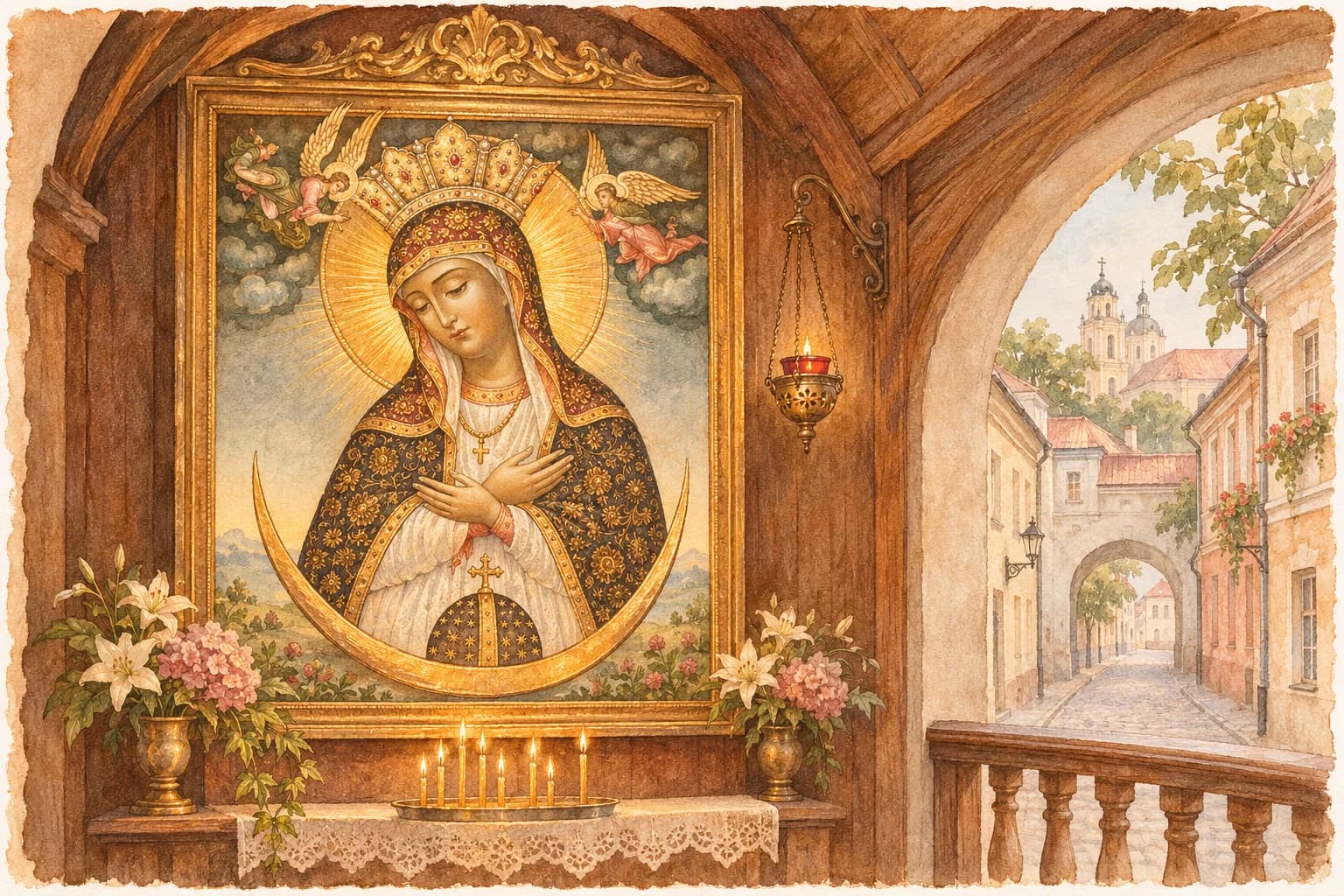
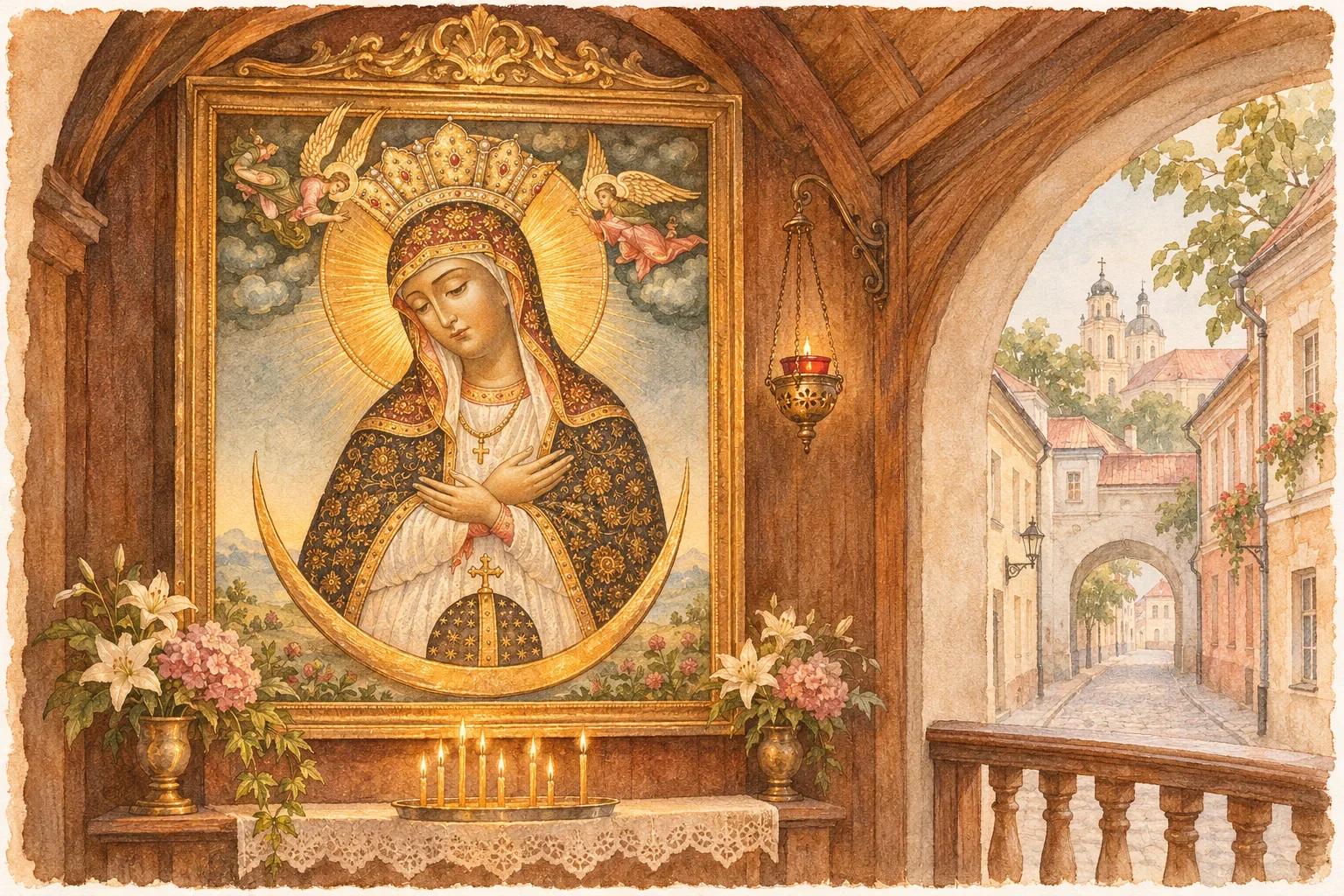
The Gate of Dawn image is associated with the city gate in Vilnius. It depicts the Mother of God without the Child, with hands crossed over her breast. The absence of the Child does not place an image outside Christian iconography.
Christians of different traditions venerate the image, whose history belongs to the city’s religious life. Distinguish the painting from later adornments. Metal coverings and crowns can conceal parts of the composition in photographs.
One visual difference does not justify declaring every copy unsuitable or attributing guaranteed protection of a home to it. If unsure about a particular image for prayer, show it to a priest rather than argue over a blurred picture.
Before visiting, check current access and conduct in an active place of prayer. Photography is not more important than others’ worship. At home, respectful placement does not require special rituals at the door.
The Gate of Dawn and the image’s name
The designation refers to the city gate in Vilnius above which the chapel housing the revered image stands. Brama means gate; in different languages the place is also known as the Gate of Dawn. Different names in guidebooks therefore do not necessarily identify different shrines. The geographical explanation helps locate the intended chapel and distinguish this image from other icons associated with Vilnius.
Its position above a passage connects the history of devotion with the city’s everyday life. People encountered the image on their way through urban space, not only inside a separate monastery. That historical association does not prescribe a compulsory place for a household reproduction. An icon can be respectfully placed where prayer is practical; the name does not require a special action at the front door or turn its position into a condition of protection.
The Mother of God without the Child
The Gate of Dawn image shows an inclined head and hands crossed over the breast. The Mother of God appears alone, without the Child. This does not place the image outside Christian art: Annunciation scenes, images of prayer and other compositions can portray Mary without her Son in her arms. Judging suitability solely by the Child’s visible presence would be an oversimplification.
The crossed hands convey reverence and inward attention. Understanding depends on the face, posture and complete composition rather than guessing a separate meaning for every fold of clothing. The image directs attention towards Mary’s personal response to God. It should not become an independent devotion to a female figure detached from Christ and the Gospel story. Her identity as Mother of God remains central even where the Son is not visibly depicted.
Painting and adornment are different historical layers
Photographs prominently display the metal covering, crowns, rays and crescent. Not all these elements belong to the original painted layer. Some adornments developed as offerings and signs of devotion, so the history of the setting can be more complex than that of the painting itself. A precise description distinguishes what is painted from what has been placed around or over the image.
A crescent visible in such photographs should not automatically be treated as a sign of another religion or as grounds for rejecting the image. Establish the particular ornament’s origin and its role within the artistic setting. The same applies to rays and stars: interpret them through Christian art and the history of the adornment, rather than through an arbitrary chart of hidden symbols. Looking at an uncovered reproduction can help distinguish the two layers.
Traditions of origin and a careful description
Different accounts describe the Gate of Dawn image’s origin. The church reference includes traditions connecting it with Chersonesus and princely gifts. These should be identified as traditions and distinguished from art-historical dating of the surviving painting. Separate versions should not be stitched into one supposedly undisputed sequence when their connection is unconfirmed.
For an introductory article, it is enough to explain that the image belongs to Vilnius’s religious history and is honoured by Christians of different traditions. Detailed questions about its date, model and original purpose require separate research. Acknowledging those limits does not diminish the shrine: respect does not depend on confidently filling every gap. Precision becomes especially important when the history is invoked in a dispute between Christian confessions rather than studied for understanding.
Visiting the chapel and devotion at home
The chapel is an active place of prayer, not merely a tourist attraction. Check access times, services and photography rules before visiting. During worship, do not push forward for a picture or discuss the image loudly. Quietly remaining and looking can be more valuable than obtaining a photograph cleared of every other visitor.
If an Orthodox Christian has a question about a particular reproduction, show the actual image to a priest and explain the concern: the inscription, provenance or its use in prayer. That makes the conversation more substantive than debating every picture without the Child. At home, place it respectfully and keep prayer connected with church life. There is no requirement to establish a doorway ritual promising automatic exclusion of every misfortune. The history of a city gate can enrich understanding without becoming a rule for household security.
A question for reflection
Which details belong to the painting, and which to its adornments and history?