
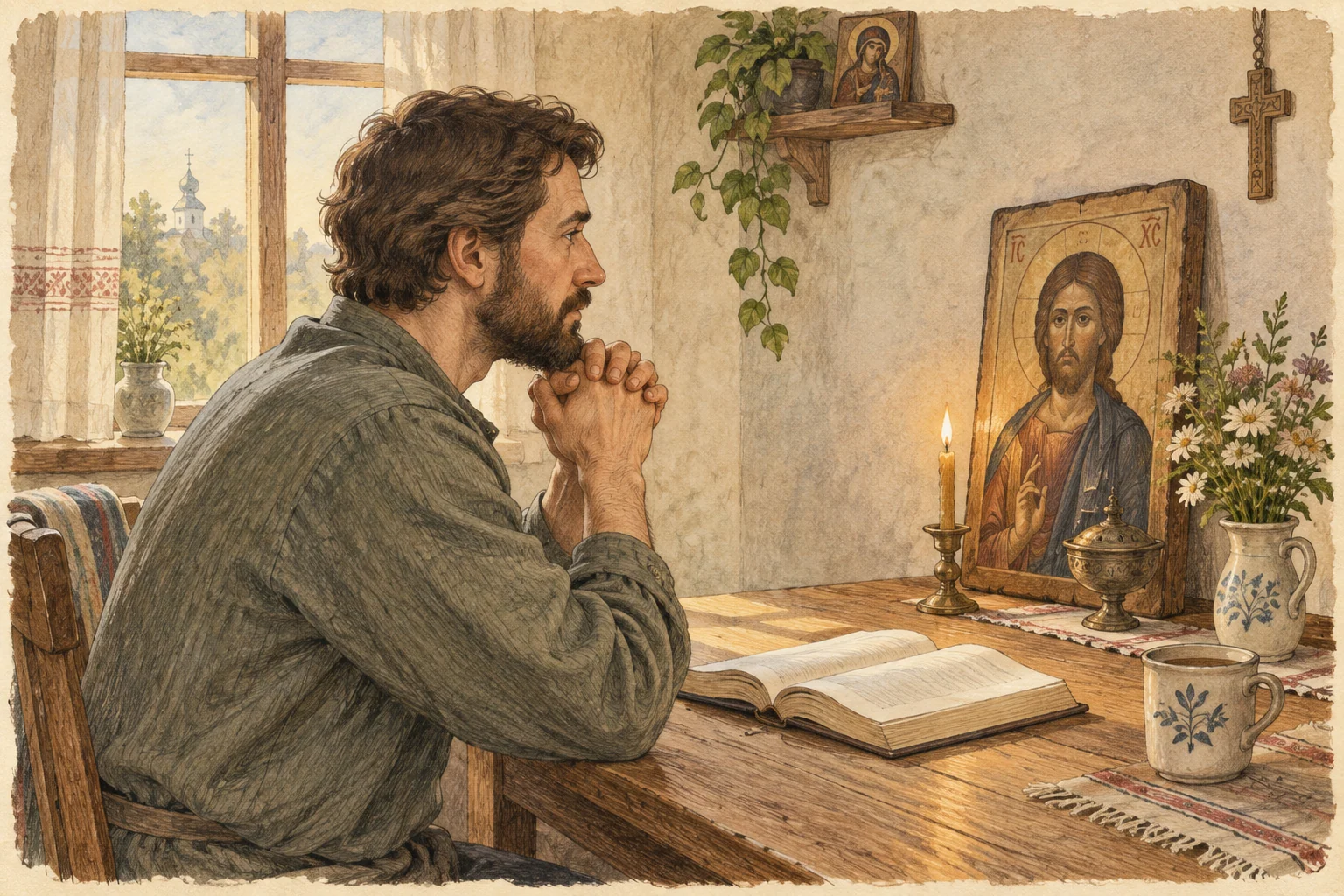
The Lord’s Prayer is the prayer Jesus taught His disciples. It is found in Matthew and Luke. It brings together worship, daily needs, forgiveness and trust in God. Learning its meaning matters more than reciting it quickly.
The prayer
Our Father which art in heaven, Hallowed be thy name. Thy kingdom come. Thy will be done in earth, as it is in heaven. Give us this day our daily bread. And forgive us our debts, as we forgive our debtors. And lead us not into temptation, but deliver us from evil.
This is the traditional wording of Matthew 6:9–13 in the King James Bible, without the concluding doxology. Orthodox prayer books may use slightly different English wording. In a service, follow the liturgical order rather than treating a priest’s concluding exclamation as an instruction for a lay reader.
Why we say “our”
Even when we pray alone, we do not approach God as though nobody else matters. Calling Him our Father joins personal prayer to concern for other people. Heaven is not a claim that God is too distant to hear us.
The first three petitions
Hallowed be Thy name
God does not become holy through our words. We ask that His name be honoured, including through conduct that does not contradict our profession of faith.
Thy kingdom come
We await the fullness of God’s Kingdom and ask to live under His truth and love now. The Kingdom is not simply the success of a political movement or earthly state.
Thy will be done
Trust is compatible with action: seeking treatment, finding work and protecting someone who is vulnerable. We ask God for help without assuming that our preferred outcome is the only good one.
Bread, forgiveness and deliverance
Daily bread includes what we need for life. Asking for it reminds us to receive ordinary things gratefully and notice those who lack them. Christian interpretation also sees spiritual nourishment in this petition.
Debts mean sins before God. Asking forgiveness commits us to turn away from vengeance. Forgiveness does not require denying harm or remaining in an unsafe situation.
God is not the author of evil. In asking not to be led into temptation, we seek His help not to fall into sin or be overcome by trial. The final petition teaches dependence on God rather than confidence in our own strength alone.
Starting with understanding
Read slowly, using a book or screen if necessary. Look up unfamiliar words outside the time of prayer. If attention wanders, return to the words without making the whole exercise a test of flawless concentration. Memorisation can grow gradually.
How the petitions belong together
The opening turns toward God before naming our needs. This does not divide the prayer into an elevated part and less important everyday requests. Ordinary life is brought to the Father too, but no longer treated as the only centre of the world. Bread cannot honestly be separated from forgiveness: people at the same table may need both food and an end to humiliating one another. The prayer holds those needs together rather than making us choose between care for the body and care for relationships.
For personal study, write one question beside each petition. Beside God's name: am I using faith to excuse harsh conduct? Beside daily bread: do I notice the work of people who make my necessities available? Beside forgiveness: am I sustaining resentment by repeatedly retelling the injury? These are questions for yourself, not a checklist for examining relatives. They need not be spoken instead of the prayer; they prepare you to attend more carefully to its words.
When calling God Father is difficult
Someone may carry painful memories of their own father. Do not demand that a single word immediately produce a feeling of safety. Human experience is not an exact measure of God's love. Acknowledge the difficulty and discuss it with an attentive priest rather than pretending to feel trust. Reading the whole prayer may be an easier beginning: it includes protection, help in trial, and room for human vulnerability. No one needs to give a public account of a painful family history in order to ask about the words.
Forgiveness without pretending
The petition concerning debtors does not mean every relationship must be repaired before you can pray. An honest beginning remains possible while the hurt is strong: turn away from the intention to take revenge and ask for help with what follows. An offender's apology and the restoration of trust do not always happen together. Reconciliation cannot be manufactured by pressuring the injured person. Where there is danger, safety and support come first; the prayer must not be used as an argument against them.
One petition during the day
Lengthy reflection need not accompany every reading. Choose one request you understand and recall it at a relevant moment. Before a purchase, it may prompt thought about what is necessary; before an argument, freedom from vengeance; before a difficult decision, recognition that your own plan is not infallible. This is not an instruction to look for hidden signs in everything that happens. It is attention to words you have already said and willingness to act consistently with them.
When praying together, avoid interrupting a relative at every unfamiliar ending. Agree on one prayer-book text beforehand so everyone can follow. Differences between translations can be explored later without interrupting prayer. Learning the language then serves, rather than obscures, the address to the Father.