
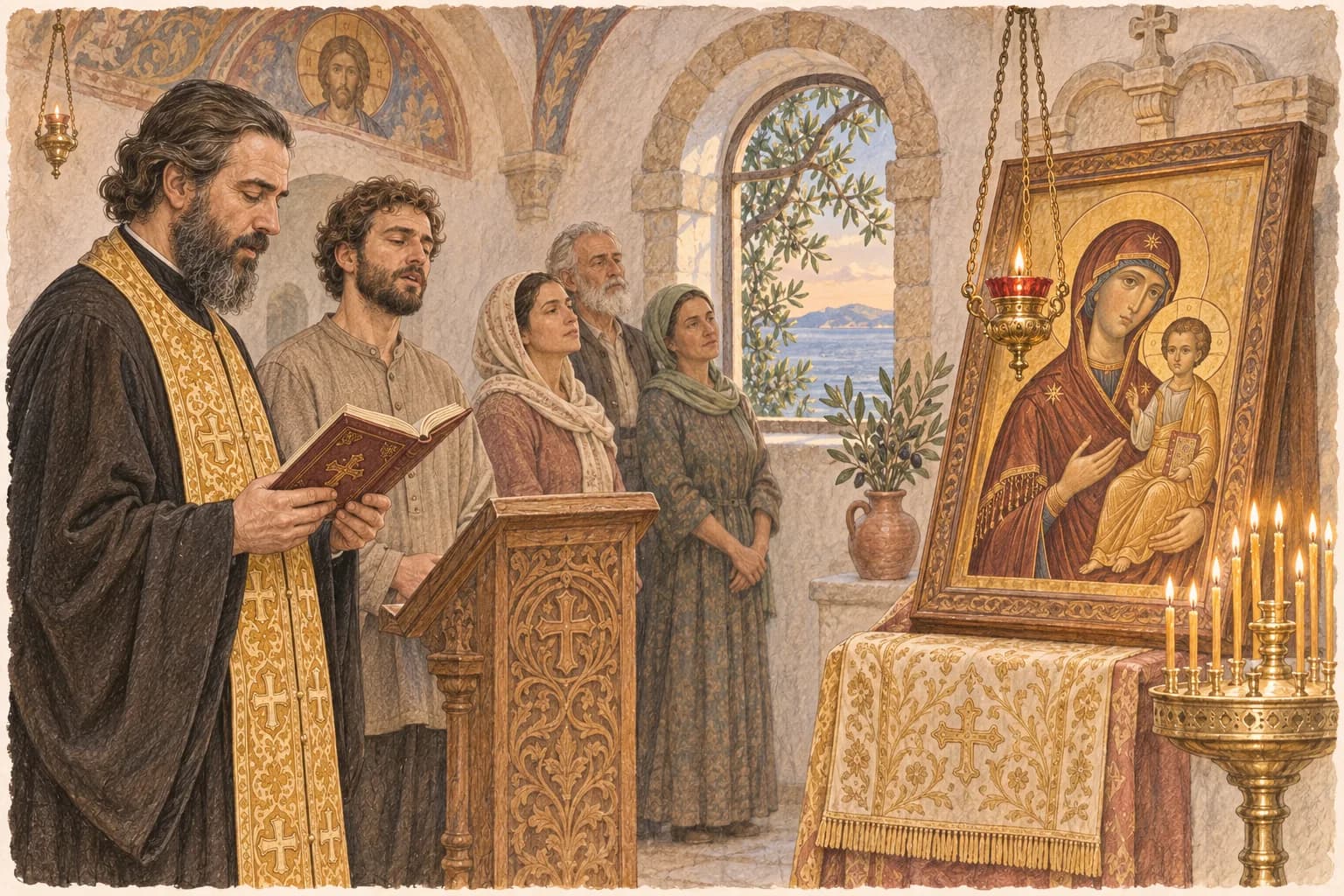
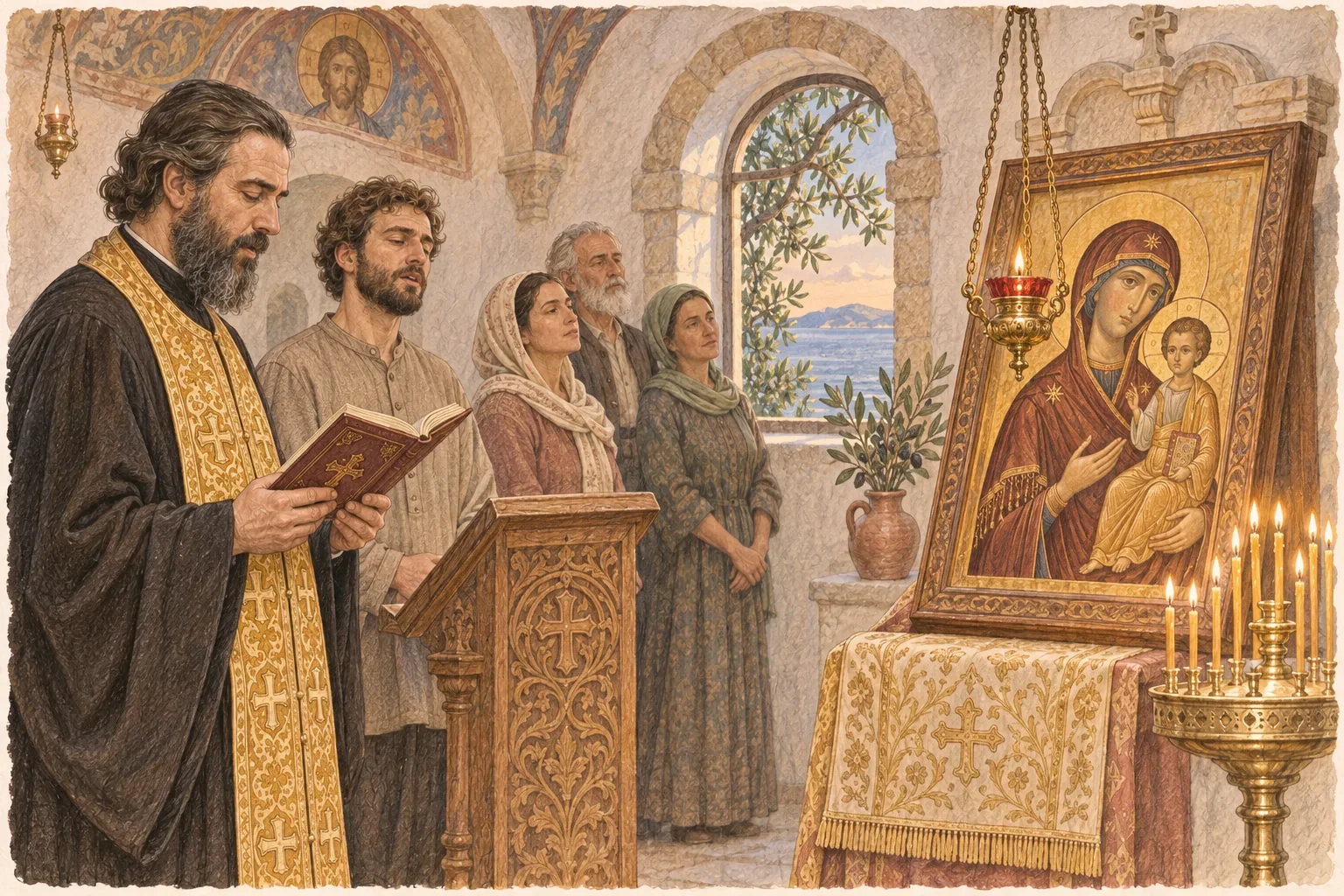
Paraklesis is the name of a service of supplication especially familiar in Greek church tradition. It frequently refers to prayer to the Mother of God. Finding the exact text requires the full name of the service rather than this general term alone.
The service includes psalms, a canon and other prayer elements. Names and usage may vary between church traditions. Comparison with a familiar service of supplication helps orientation, but does not establish that every version has identical texts.
Paraklesis is not a secret prayer obtainable only by purchasing a special collection. Promises of guaranteed relief from every problem are advertising rather than the meaning of church prayer. The Mother of God’s intercession is not opposed to turning to Christ.
To attend, find a parish announcement and check the language used. For prayer at home, choose a church edition and understand its directions. Avoid adding several unfamiliar services at once to a rule that is already difficult to maintain.
Why the service has several familiar names
The Russian form paraklis conveys a name particularly familiar in Greek liturgical settings; paraklesis is another common transliteration. Some editions describe a supplicatory canon or provide a fuller title. Two similar headings therefore do not necessarily identify different services, while an identical short label does not guarantee that every word is the same. To locate a text, identify to whom the supplication is addressed, which canon is used and which edition contains it.
Three questions should be distinguished: what the word means, which order of prayer is intended and when a particular parish celebrates it. A dictionary helps with the first, a liturgical book with the second and the community’s timetable with the third. Relying entirely on a video labelled paraklesis can confuse the recording of one hymn with the complete service.
Understanding the structure of supplication
A canon contains odes organised around heirmoi and troparia according to a particular liturgical structure. It may belong within a larger service containing psalms, litanies and concluding prayers. Consequently, reading a canon is not always equivalent to attending the complete supplication service with a priest. Directions concerning clergy and the order of reading in a printed edition are meaningful, not decorative additions.
A newcomer does not need to master every term immediately. Begin with the general purpose, then notice which petitions recur and how the sections connect. If the service is in an unfamiliar language, find a reliable translation. Musical beauty can support attention, but understanding the principal requests allows more thoughtful participation than trying to imitate sounds whose meaning remains unknown.
Why the Mother of God is addressed
In a service addressed to the Mother of God, the Church asks the Lord’s Mother for her intercession and prayerful help. This belongs within faith in Christ and does not mean seeking another, more accessible deity beside him. Elevated poetic expressions should be read within the whole service and the Church’s teaching, rather than detached as advertising promises.
When a formulation raises a question, consult an explanation and discuss it with someone familiar with liturgical language. Neither immediate rejection of an unfamiliar metaphor nor assigning it an arbitrary meaning is helpful. For example, poetic language about protection does not authorise a promise that someone who prays will never become ill, suffer loss or need practical help from other people.
Choosing a text for prayer at home
Choose an edition with clear provenance, a complete title and preserved liturgical directions. If a text has been copied from an informal message, compare it with a church source: circulating versions may omit sections, mix different canons or add conditions for obtaining results. Special promises attached to an exact number of repetitions should not be mistaken for the content of the service itself.
Check whether the edition provides an order for a layperson praying without a priest. Printed priestly exclamations and actions do not authorise a lay reader to assume that ministry. Begin with manageable reading and understanding. If you already have an established prayer rule, discuss a sensible way to include another service instead of adding it through fear of missing a compulsory spiritual opportunity.
Participation and listening to a recording
A recording can introduce the melody and sequence of sections. Yet listening at home and being present with a worshipping community are different circumstances. In church, a person prays alongside others, hears the petitions in their actual setting and participates in a common appeal. A recording may support personal prayer, but should not become background sound imagined to act automatically regardless of attention.
If you specifically wish to attend paraklesis, check the timetable and language. If your local parish does not use that name, ask about its customary services of supplication. There is no need to regard a familiar church service as inadequate because its name sounds less unusual. The significance lies in the prayer’s meaning and its place in life, rather than the rarity of the liturgical term selected.
A question for reflection
Do you know the full title of the service you want to read?