
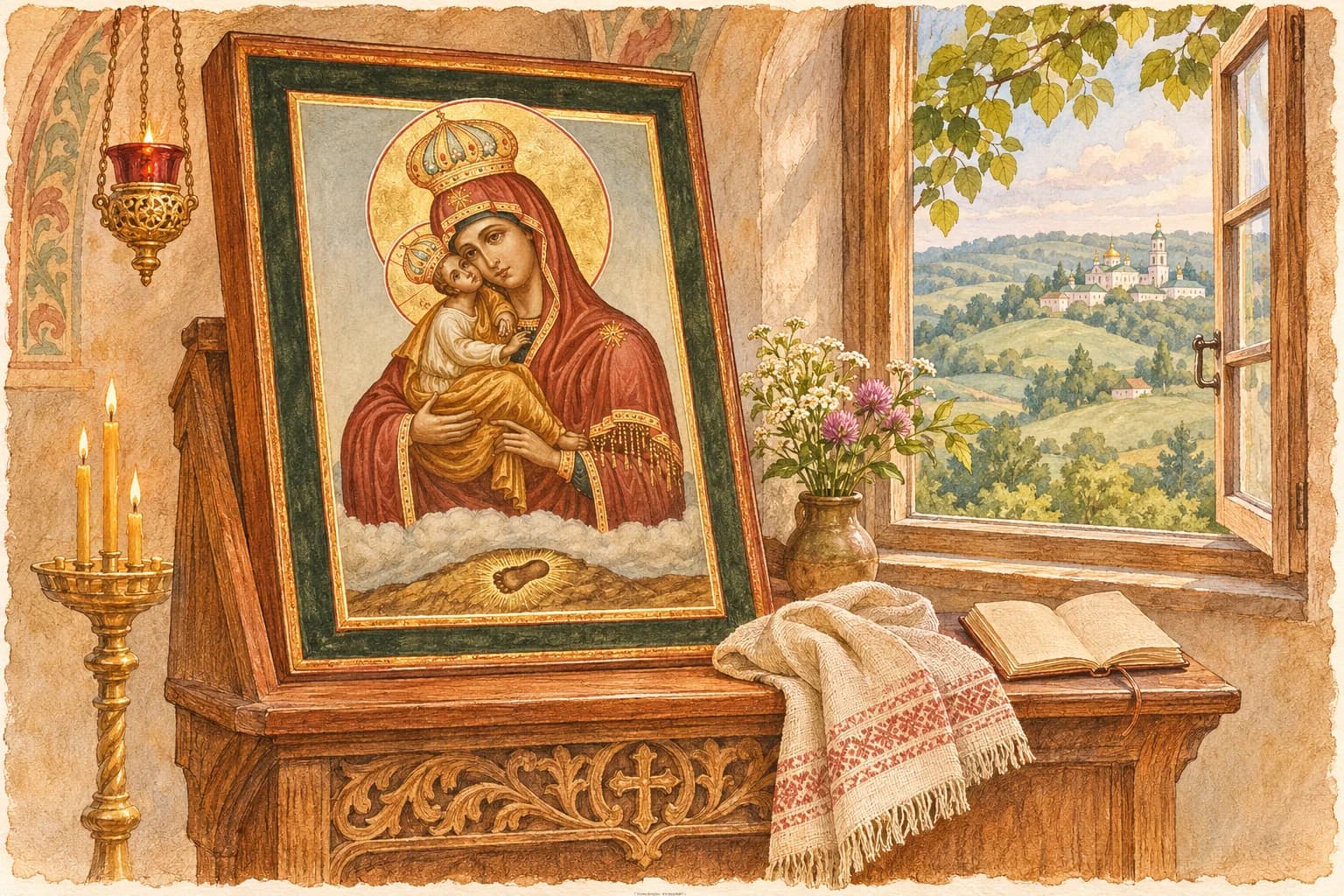
The Pochaev Icon takes its name from its veneration at the monastery in Pochaev. It depicts the Mother of God with the Christ Child. Distinguish the iconography, the monastery’s history and accounts of particular miracles when studying its meaning.
Church sources transmit the icon’s history, including traditions of help through prayer. Identify the kind of testimony when retelling them. Not every later detail can be presented as an independently verified historical fact.
Prayer does not require buying an expensive copy or travelling to the historic original. Distance does not make prayer at home less heard. Pilgrimage has meaning as a church encounter rather than a required purchase of access to help.
When planning travel, verify current access, transport and safety through up-to-date sources. An old guidebook does not establish present possibilities. If travel is impossible, read the icon’s history and pray in your own parish.
Pochaiv: place, monastery and image
The Pochaiv icon takes its name from Pochaiv Hill and the Dormition monastery in Volhynia, in present-day Ukraine. Several sacred objects and narratives should be distinguished: the image of the Mother of God itself, the tradition of her appearance and the venerated footprint. They belong to a shared local church memory, but they are not the same physical object.
This distinction is particularly helpful when examining reproductions. A rock bearing a footprint may appear beneath the Mother and Child, referring to the history of the place. The painted icon’s arrival at the monastery belongs to another episode in the tradition. Combining the stories without explanation can give the false impression that the imprint on the stone and the painted panel were discovered together. Reading the composition carefully preserves the relationship without collapsing the two accounts.
Anna Hoyská and the gift to the monastery
Anna Hoyská has an important role in the church narrative. Metropolitan Neophyte, visiting during his travels, left an icon with her as a blessing. The image was subsequently given to the monastic community. The account associates that decision with her brother’s healing and gratitude for the assistance received. These details explain how a household sacred image became an object of public ecclesiastical veneration.
The transition from private possession to communal prayer is significant. The image was no longer known only within one family: worship, pilgrimage and remembrance of reported help developed around it. Contemporary retellings should nevertheless not invent dialogue or precise motives for every participant. When a source conveys church tradition, it should be presented accordingly, allowing its devotional meaning to remain clear without pretending to possess evidence that the account does not supply.
Looking at the Pochaiv composition
At the centre are the Mother of God and the Christ Child. Their closeness connects the image with Tenderness iconography. Particular copies can include additional figures and details related to the shrine’s history. A metal cover may conceal much of the painting, so a photograph of the adorned image and a reproduction without its covering can look surprisingly different.
Identify the image through the figures’ arrangement, the inscription and associated elements rather than the richness of its ornament. A footprint on a rock, where present, refers to the Pochaiv tradition. Decorative rays and crowns should be distinguished from the painted image itself. This helps the viewer understand the icon even when a tourist photograph draws most attention to its costly surround. Material adornment expresses devotion but is not the whole content of what is depicted.
Reading accounts of the monastery’s protection
Pochaiv’s church memory includes accounts of dangers faced by the monastery and help received through prayer to the Mother of God. These reflect a community for whom church and monastery were places of shared faith. A careful retelling retains the historical setting without making opponents from the past a reason to hate present-day peoples or neighbours.
It is especially important to distinguish a devotional account from a universal guarantee of immunity. Venerating an icon does not mean believers never experience loss or that buildings require no protection and conservation. Testimonies of help can be read with gratitude without being used to calculate a guaranteed outcome. This preserves the tradition’s spiritual meaning rather than converting it into a magical formula for security or a claim that practical responsibilities have disappeared.
Pilgrimage and prayer at home
Plan a visit to an active monastery using current information about access, services and travel conditions. An older pilgrim’s account may convey the atmosphere well without confirming today’s route or visiting arrangements. Health limitations or difficult travel circumstances need not make cancelling a journey a spiritual defeat.
At home, a recognisable image and a quiet time for turning to God are sufficient. Read the shrine’s history, distinguishing the footprint tradition from the icon’s own story, and explain to children why images acquire geographical names. This offers a useful introduction to Orthodox culture: the same Christ and his Mother are honoured in different places, while the names preserve the memories of particular communities. Knowing those distinctions makes a household reproduction a starting point for understanding rather than a substitute for understanding.
A question for reflection
Are you treating travel to a shrine as a condition without which prayer seems impossible?