
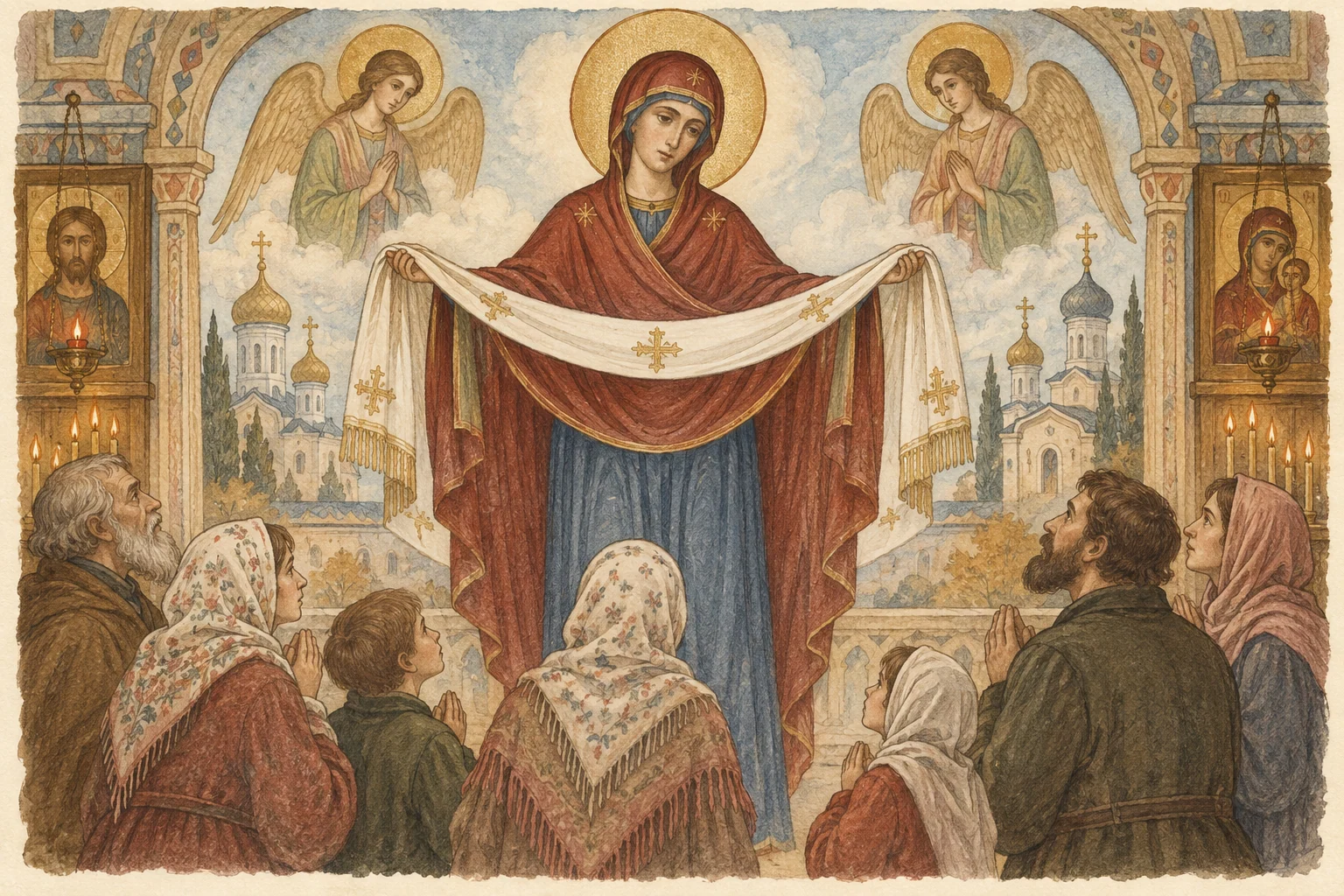
The Protection of the Mother of God celebrates her prayerful intercession. In the Russian Orthodox calendar it falls on 14 October in the civil calendar, corresponding in the twentieth and twenty-first centuries to 1 October in the Julian calendar. It is especially beloved, although it is not one of the Twelve Great Feasts.
The traditional account
The feast is associated with a vision of Saint Andrew, the Fool for Christ, and his disciple Epiphanius in the Blachernae church in Constantinople. They saw the Mother of God praying for the people and extending her veil over them.
Retellings differ in dating and historical setting. A familiar account of a military threat should therefore not be treated as an undisputed reconstruction of every detail. The feast’s centre is the Mother of God’s prayer and Christian hope in her intercession.
What does protection mean?
The literal image is a covering or veil. In prayer it expresses shelter and care. An icon makes that meaning visible; it does not teach that fabric has an independent power or that possessing an image guarantees freedom from suffering.
Asking Mary’s prayers does not replace prayer to Christ. Nor does it set a merciful Mother against an allegedly unmerciful God. Her intercession belongs within the mercy of her Son.
Keeping the feast
Attend worship where possible, read the feast’s prayers and offer concrete help to someone. Consult our parish schedule for service times. A date in the universal church calendar does not establish the same timetable in every parish.
If you hope to receive Communion, follow the preparation agreed with your parish. A feast does not remove the importance of reconciliation and attentive preparation. Illness or caring responsibilities may prevent attendance; prayer at home is not thereby worthless.
What may we pray for?
We can ask for help for a family, peace, protection for those suffering and guidance in a difficult choice. Seeking protection does not cancel practical responsibilities: contacting a lonely relative, supporting someone harmed, ending hostility or keeping a promise.
Weather omens and marriage promises
Folk predictions about snow, harvests and weddings are not the Church’s teaching about the feast. Prayer does not guarantee marriage by a particular deadline. Remaining unmarried is not evidence of having kept the feast incorrectly.
Necessary work
Honouring a feast does not require fear of every household task. Essential work, caring for a child and nursing someone sick remain responsibilities. Make room for worship where possible without shifting unavoidable burdens onto other people.
Looking at an Icon of the Protection
Begin not by counting figures but by noticing what brings them together: the Mother of God's prayer and the people gathered in church. In the icon description linked below, Andrew draws Epiphanius's attention to the vision. This detail helps distinguish a witness to intercession from a picture of an earthly battle. When viewing an unfamiliar icon, read its inscriptions: resemblance alone is not enough to identify a saint confidently.
With a child, look for the people praying and discuss caring for someone who cannot explain their own need at present. Avoid describing the veil as an impenetrable wall from a fairy tale. That image can produce a painful question when a believer suffers: why did the protection fail? It is better to distinguish trust in God's help from a promise that life will become entirely controllable and free from danger.
When Protection Has No Visible Answer
The feast can be difficult for someone who has lost a home, experienced a painful separation, or been betrayed. Speculation about insufficient prayer does not help. The outcome of a crisis cannot tell us whom the Mother of God loves more, and someone who suffered must not be blamed for failing to deserve help. The feast does not give us knowledge of the reason for every tragedy.
A prayer can name a very specific need: safe accommodation, support for a child, or courage to ask for assistance. At the same time, seek practical protection that is actually available. You could help someone contact trusted people, accompany them to an important appointment, or take responsibility for household tasks. Do not present your own preferred solution as an instruction received from heaven. Be especially considerate towards someone not yet ready to discuss what happened.
Reading at Home Without Counting Achievements
To become familiar with the feast, choose a short text from a church prayer book and first explore unfamiliar words. Who is asking, whom are they addressing, and what is the request? Then read the prayer as a whole. This is a way to practise attention, not a new compulsory rule: repetitions do not make a request more powerful. When a family is beginning to pray together, leaving space for a question may matter more than completing a long sequence in a hurry.
Those taking part may have different concerns. Adults should not make a child disclose private fears in front of everyone or require relatives to use identical words. People in need can be remembered without describing their personal circumstances. Shared prayer can then respect privacy instead of becoming an occasion to discuss someone else's distress.
Turning a Greeting Into Care
Alongside a greeting for the feast, consider offering a small, agreed act of help. Someone living alone might welcome transport to church; a household with young children might appreciate help with shopping. Check that the offer is welcome and do not promise more than you can deliver. The purpose is not to stage a miracle ourselves. It is to avoid asking for care while overlooking an evident need close to us. A specific offer also allows the other person to tell us what would genuinely be useful, rather than merely accepting our idea of what they ought to need.