
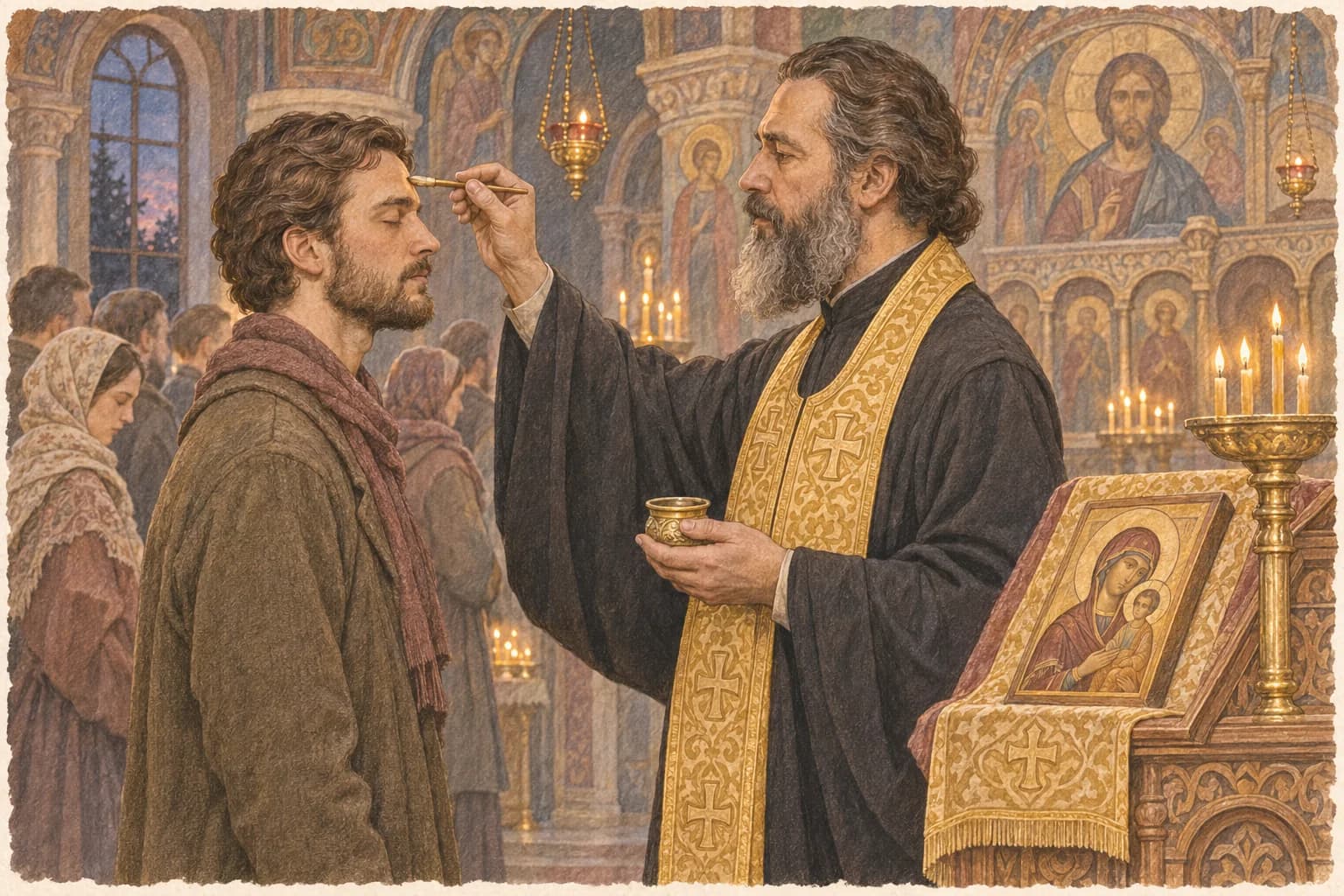
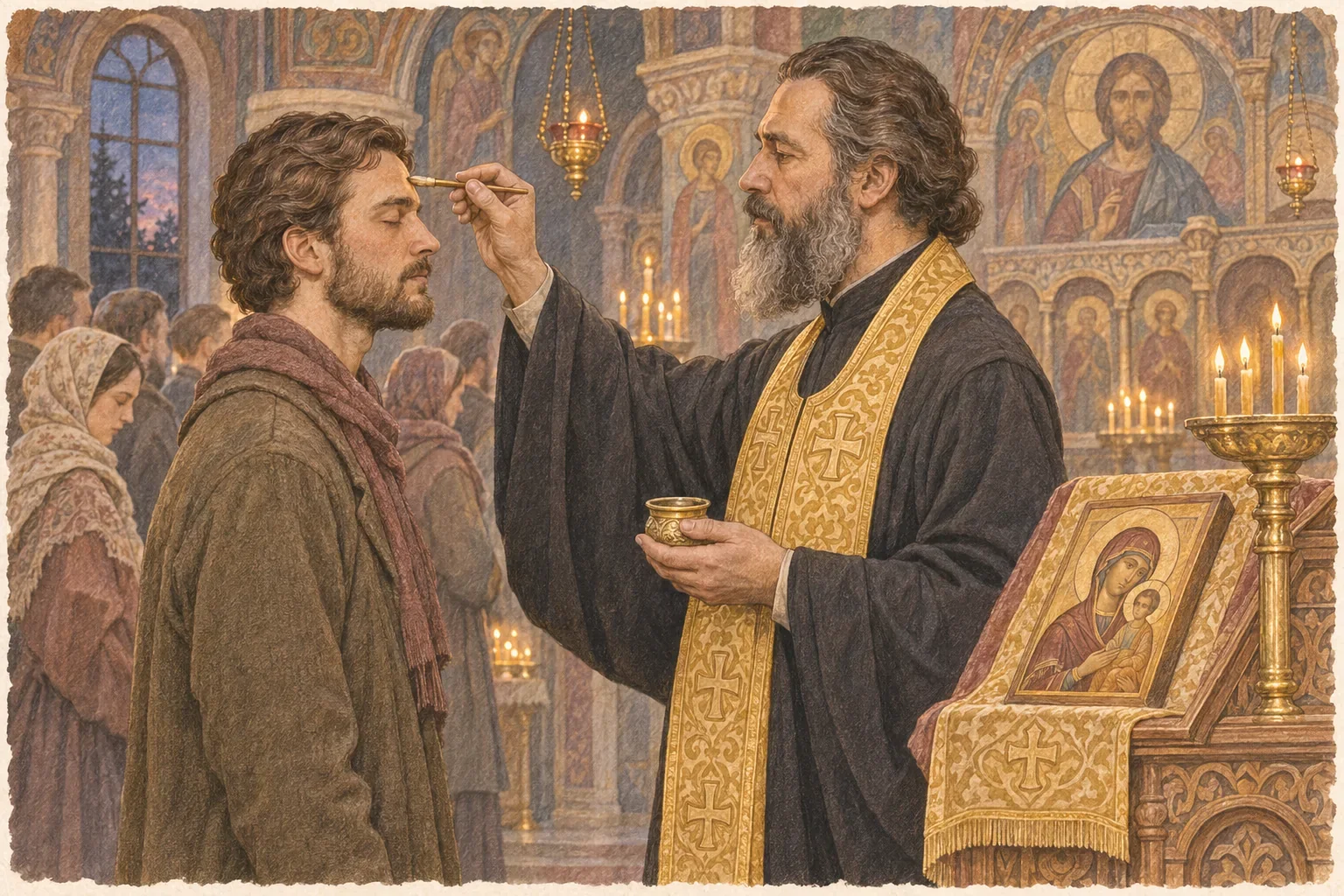
Anointing with blessed oil at the All-Night Vigil is not a repetition of the sacrament of Chrismation. The outward resemblance can be confusing, but the actions have different places in church life. The oil and the order of service help distinguish them.
Festal anointing belongs to prayer and blessing at the service. Chrismation is normally celebrated after Baptism and concerns the gift of the Holy Spirit. Holy Unction also involves anointing but is another distinct sacrament.
The queue for anointing is not a compulsory ritual for obtaining a week’s health. If you could not approach, your attendance was not wasted. The Vigil’s meaning cannot be reduced to a single action.
Follow the parish’s arrangements and do not independently reproduce the priest’s action at home. If unsure whether to approach, ask briefly. Explaining the difference between a blessing and the sacraments can be particularly helpful for a child.
Why the names are easily confused
Someone sees a priest applying oil to a forehead and naturally uses the familiar word chrismation. Yet an outward resemblance does not establish that two church actions are identical. One concerns a sacrament associated with receiving the gift of the Holy Spirit; the other is an anointing with blessed oil during worship. Understanding the action requires knowing the service and its context, not simply recognising the movement of a brush.
An inaccurate term may occur in everyday parish speech without any intention to change doctrine. It can be corrected calmly: at the Vigil, the action is ordinarily anointing with blessed oil rather than repetition of the sacrament of Chrismation. That distinction helps a newcomer understand what they are seeing instead of imagining that a part of baptism is being performed again every Saturday evening.
Blessed oil and holy chrism
Oil is used in several church rites. Holy chrism has a particular preparation and ecclesiastical consecration and is used for designated sacramental actions. A fragrant liquid cannot be identified as chrism by smell alone, and a small vessel beside a priest does not automatically mean that Chrismation is taking place. The substance must be understood together with the rite and its purpose.
Making this distinction does not belittle anointing at the Vigil. The Church is blessing a person, and the action deserves attentive reverence. Two opposite mistakes should be avoided: declaring every anointing to be the same sacrament, or treating an action that is not that sacrament as meaningless. Worship contains different forms of prayer and blessing, each with its own place.
When to approach during the Vigil
Arrangements depend on the liturgical day and local practice. Anointing is often associated with the festive part of Matins and veneration, but that general description is not enough to determine when to move. Observe the organised approach and quietly ask a parish worker if necessary. Do not walk up during an unrelated action simply because you are expecting a queue for oil.
If anointing is not offered on a particular Saturday, the Vigil is not thereby invalid. Participation in the service cannot be reduced to receiving one blessing. Notice the readings, psalms, hymns and overall movement of prayer. This makes it possible to attend the service as worship rather than trying to arrive at the one minute imagined to contain all its spiritual value.
Participating without unnecessary anxiety
Approach calmly without hurrying the people ahead. Follow the priest’s directions, and simply say if this is your first church visit. You do not need to rehearse a special facial expression or fear that awkwardness cancels the blessing. Explain the action briefly to a child, and do not forcibly hold a frightened, struggling child dangerously close to other people.
Skin conditions, allergies or other circumstances can be discussed beforehand. Avoid spreading rigid domestic rules about precisely how many hours washing is forbidden, how someone must sleep or what will supposedly happen after accidentally touching the forehead. Reverence differs from fear of every movement. If a particular custom troubles you, ask your parish to explain its meaning.
Why anointing does not replace Communion
Anointing can initially seem more understandable and accessible than participation in the sacraments. It can be part of a first encounter with church life, but blessed oil should not be assumed to fulfil the same role as the Eucharist, confession or Chrismation. Each has its own meaning. Confusing names gradually confuses expectations, until a person starts looking for interchangeable ways to obtain grace instead of entering the Church’s life.
If questions about baptism or Communion remain unresolved, request a separate conversation. Explain your situation plainly: whether you are baptised, how long you have been away and what you want to understand. That allows sensible next steps to be discussed. Attending the Vigil can itself introduce the Church’s prayer without requiring you to pretend that every theological distinction is already clear.
A question for reflection
Are you using one word for three different actions in church life?