
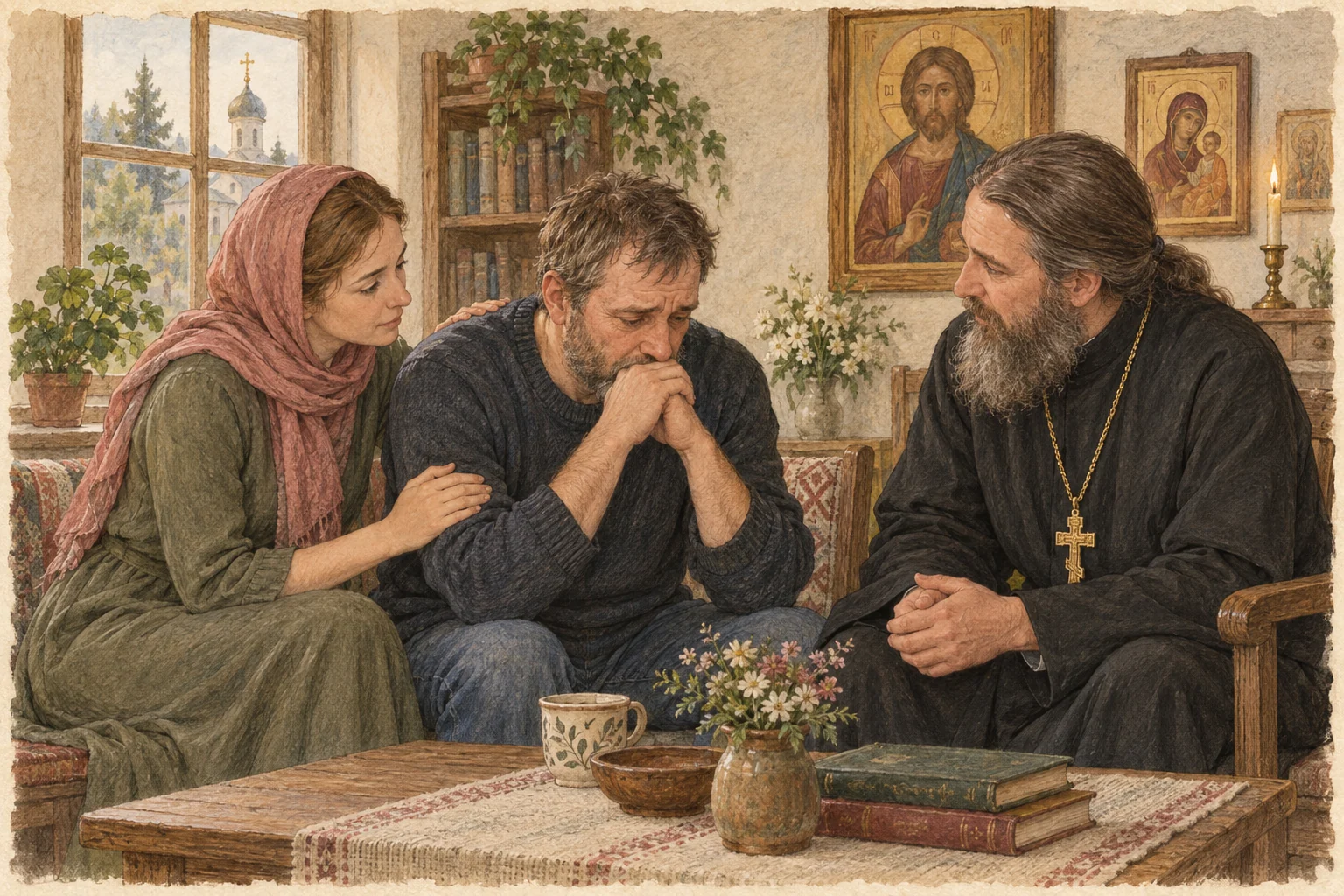
After a loved one's suicide, a family needs support and a clear conversation, not accusations. Church commemoration does require particular pastoral consideration. That does not mean bereaved people are unwelcome at church or cannot ask a priest for a meeting and explain what has happened.
Making the first contact
Contact a priest you know or a nearby Orthodox parish and ask for a private conversation. A short message is enough: a member of your family has died by suicide, and you need support and guidance about prayer. There is no need to describe the death in public comments or a group chat. Leave contact details and ask when you can speak.
If speaking feels too difficult, ask someone trusted to make the initial call or accompany you. Write down questions about the funeral, church commemoration, prayer at home, and care for surviving relatives. These are distinct concerns. An answer about one does not resolve all the others.
Why an article cannot decide the case
There are canonical restrictions on the ordinary services for the departed following suicide. The priest needs to understand the circumstances, including what is known about the person's mental condition. Do not diagnose the deceased yourself or shape the account to obtain a particular answer. Explain what you know and acknowledge what you do not.
The OCA's clergy guidelines require the priest to bring such cases to the bishop. Ask your own parish about its diocesan procedure, who submits an inquiry, and what information is actually needed. An online article cannot issue a blessing or promise permission for a funeral service.
Prayerful support for relatives
The Russian Orthodox Church has approved a service of prayerful consolation for relatives bereaved by suicide. This is not a funeral under another name and does not authorize every form of commemoration. Ask the priest about this support and about an appropriate way to pray personally.
Agree on something manageable rather than promising to read a huge number of prayers. Donations, severe fasting, or repeated texts do not guarantee a particular outcome. You can also name what is most difficult to carry: anger, fear, an unfinished disagreement, or being unable to say the person's name. A conversation need not begin with well-organized thoughts.
Supporting the family
Avoid searching for someone to blame or claiming that one explanation accounts for the person's entire inner life. Telling relatives that they should have noticed sooner does not help them manage today. Offer something concrete: a meal, transport, company, or an agreed telephone call. Do not circulate details of the death unnecessarily.
Relatives do not have to defend their right to grieve. They can remember good things about the person's life without reducing that life to its final event. Do not demand immediate composure or set a deadline for tears. Different family members may need different kinds of company and different amounts of quiet.
When help is urgent
If you or someone close to you is thinking of acting on thoughts of self-harm, tell a trusted person nearby and seek urgent professional support. In immediate danger in Russia, call 112; elsewhere use the local emergency number. A conversation with a priest can accompany professional care but must not replace it. You do not have to wait until distress becomes unbearable before asking for help.
Prepare a Private Conversation, Not a Public Dossier
For the first enquiry, distinguish known circumstances from relatives' assumptions. If documents exist, ask who needs them and how they should be sent. Do not circulate medical information through several parish group chats in the hope of obtaining a faster answer. Where family accounts differ, say so: belonging to one family does not give everyone the same reliable knowledge. The priest needs an honest account, not an agreed version grieving people feel obliged to defend.
Ask one trusted person to note questions and practical answers if that would help. This can reduce the need to recount distressing circumstances repeatedly. Clarify which action is being discussed: a meeting, prayerful support for relatives, or consideration of a particular service. Do not present a preliminary response as final permission. Equally, a request to clarify information need not mean that nobody is willing to hear your pain.
Remember More Than the Final Event
Family conversations can include work, friendships, care, and ordinary habits without denying the tragedy of the death. The person need become neither an idealised figure nor an explanation for every family difficulty. Remembering a whole life gently can prevent every gathering from becoming an investigation. Speak to children in plain language without details of the method of death, and do not appoint them as comforters of adults or keepers of a family secret.
A helper can stay in contact after the funeral by offering company at an appointment, practical assistance, or a short conversation without demanding an immediate reply. Laughter, returning to work, or a peaceful day should not be treated as betrayal of the person's memory. Neither should someone be pressed to resume an ordinary routine for everyone else's convenience. If your own capacity is limited, explain when you are available and help identify other trustworthy support rather than promising to be the family's sole resource around the clock. Reliable, limited help is an honest contribution.
Sources
- Moscow Patriarchate: a service of consolation for bereaved relatives (Russian)
- OCA Guidelines for Clergy: burial and pastoral responsibility
- OCA: pastoral response concerning suicide
- Russian Emergencies Ministry: seeking urgent psychological help (Russian)