
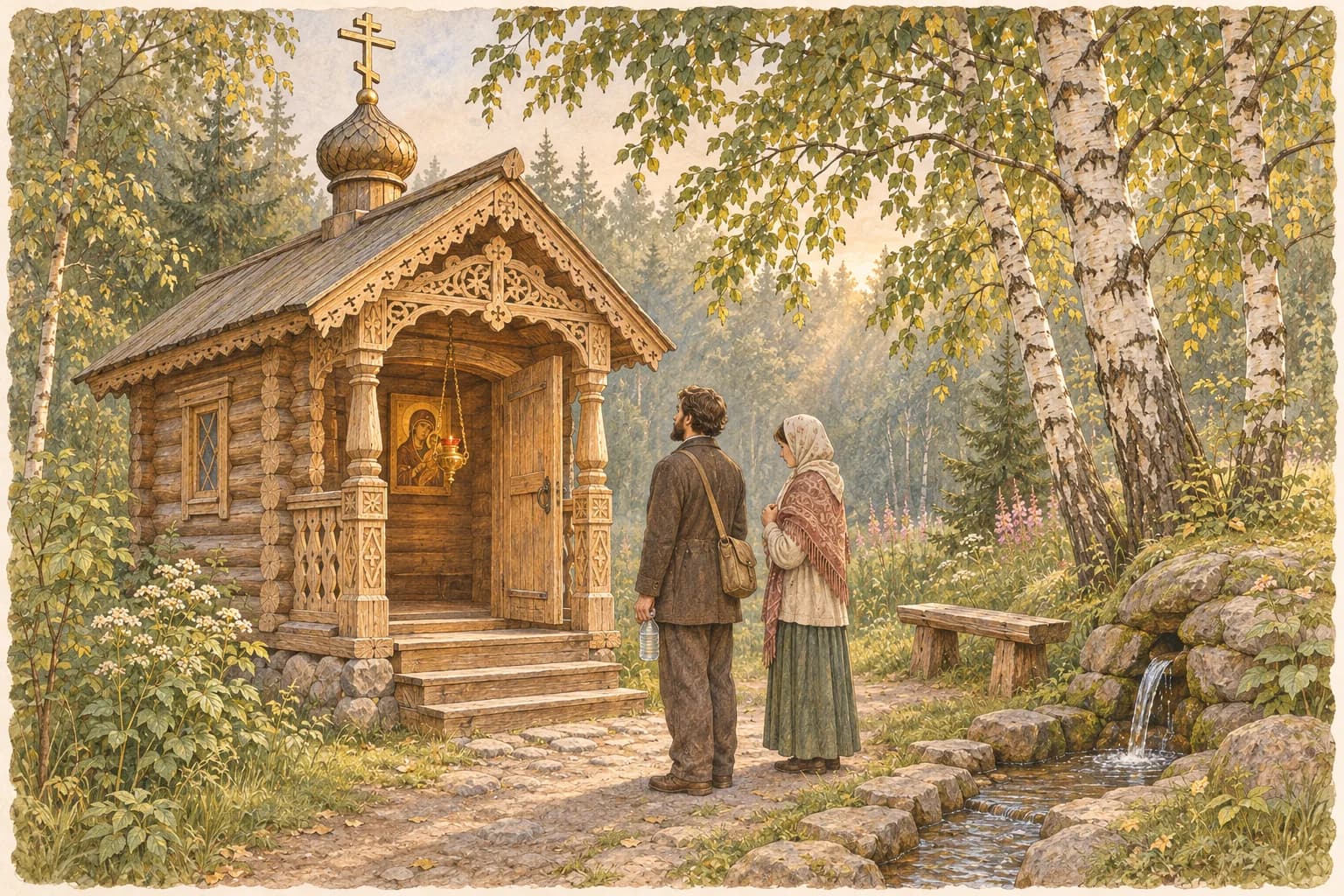
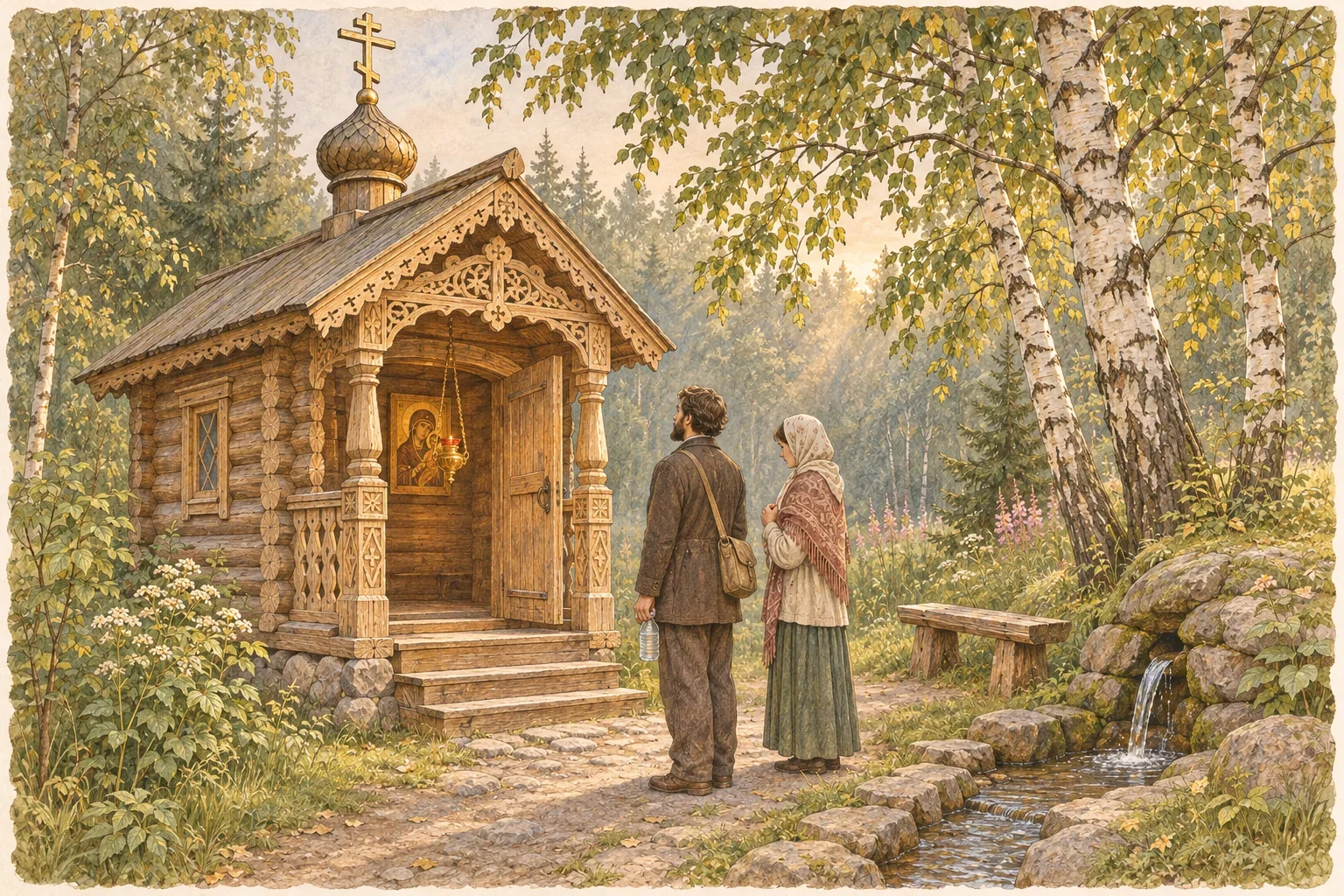
The Russian term chasovnya traditionally means a small place of prayer without a sanctuary arranged for the regular celebration of the Liturgy. The English word chapel has a broader meaning and may also describe a small church with an altar where the Liturgy is celebrated. Prayers and certain services may take place there. A sign alone cannot establish every liturgical arrangement at a particular location.
Chapels can stand beside springs, in cemeteries, at institutions or at places of remembrance. Their purposes vary. Some open only at particular times, so check with the responsible parish or institution before travelling.
Do not promise someone Communion merely because a chapel is nearby. Services and any exceptional arrangements must be checked with the priest. The English word chapel is broader than the traditional Russian term, an important distinction when reading descriptions from other countries.
If you are looking for Sunday Liturgy, find a confirmed schedule. If you want a brief visit for prayer, check access times and visitor arrangements. This connects expectations with the place’s actual life rather than assumptions based on its size.
What distinguishes a Russian chasovnya
The Russian Orthodox chasovnya is intended for prayer but commonly lacks a sanctuary with a holy table for regular celebration of the Liturgy. Its ecclesiastical arrangement and purpose, rather than size, are the main distinctions. A very small church can have a holy table and a full liturgical life, while a prominent building on a square may remain a chasovnya. Size or the presence of a dome cannot reliably establish its status.
In this article, chapel is used to translate the Russian category chasovnya. The English word is broader: it can also mean a worship space with an altar where the Liturgy is celebrated. Consequently, the characteristics of a Russian chasovnya must not be applied to every building called a chapel in English. Check the particular space’s purpose and actual service schedule instead.
Historically, chapels have appeared beside springs, in cemeteries, as memorials, along roads and wherever a place for shared prayer was needed. Their history may connect them with a nearby parish or monastery. To learn why a particular chapel was built, consult local records and reliable information rather than transferring a legend from another similar-looking building.
What services may take place
Prayers, supplicatory services and memorial services may be offered in a chapel according to its purpose and the arrangements authorised by church authority. The Russian name is associated with the prayer hours, but this does not mean every chapel performs an identical service daily. Some have regular schedules, some hold services only on particular days, and some are principally open for individual prayer.
If you wish someone to be commemorated, ask who receives requests and where the service will actually take place. A chapel attached to a parish may have its arrangements handled by that church’s office. A locked door does not necessarily mean there is no church life there: a small building may open according to a timetable, and its caretaker may also work elsewhere.
Can the Liturgy ever be celebrated in a chapel?
An ordinary chapel does not provide for regular celebration of the Liturgy in the same way as a church with a consecrated holy table. The question cannot always be settled by a signboard, however: a historic name may remain after alterations, and exceptional celebrations depend on ecclesiastical permission and the necessary arrangements. It would therefore be wrong to promise that Communion is always available simply because a place is called a chapel.
If your purpose is confession and Communion, find the published timetable and confirm it with the responsible parish. Check the exact location as well as the date: the Liturgy might take place in a nearby church, followed by a supplicatory service at the chapel. Establishing those details beforehand is particularly helpful for older visitors, families with small children and anyone who finds travel difficult.
Prayer at a spring and the use of its water
Some chapels stand beside springs venerated by the local community. Services and church traditions concerning help received by people may be associated with the place. Distinguish devotional veneration, the blessing of water and whether that water is safe to drink. These are different questions: the religious significance of a spring is not itself a water-quality assessment.
Observe instructions about collecting water and access to any bathing area. Immersion is not obligatory for every visitor; age, health, temperature and safety matter. Neither visiting the chapel nor taking a particular quantity of water guarantees healing. A person can pray without bathing and continue necessary treatment without regarding that as deficient faith or disrespect for a holy place.
Preparing for a visit
Check opening hours, the chapel’s affiliation and access to the site. In a small building, consider others by postponing loud conversation, keeping the only passage clear and recognising that a pilgrim group may quickly fill the space. If photography is restricted, follow the notice or ask the responsible person instead of disputing the rules during prayer.
A donation can support maintenance, but it is not a payment for the right to turn to God. Use clear, official ways of helping and do not send money to a stranger solely on the strength of a story told at the entrance. A first visit can have a straightforward purpose: learning the history, praying quietly and, if needed, speaking with a priest at the parish connected with the chapel.
A question for reflection
Have you checked which service actually takes place at the location you have chosen?