
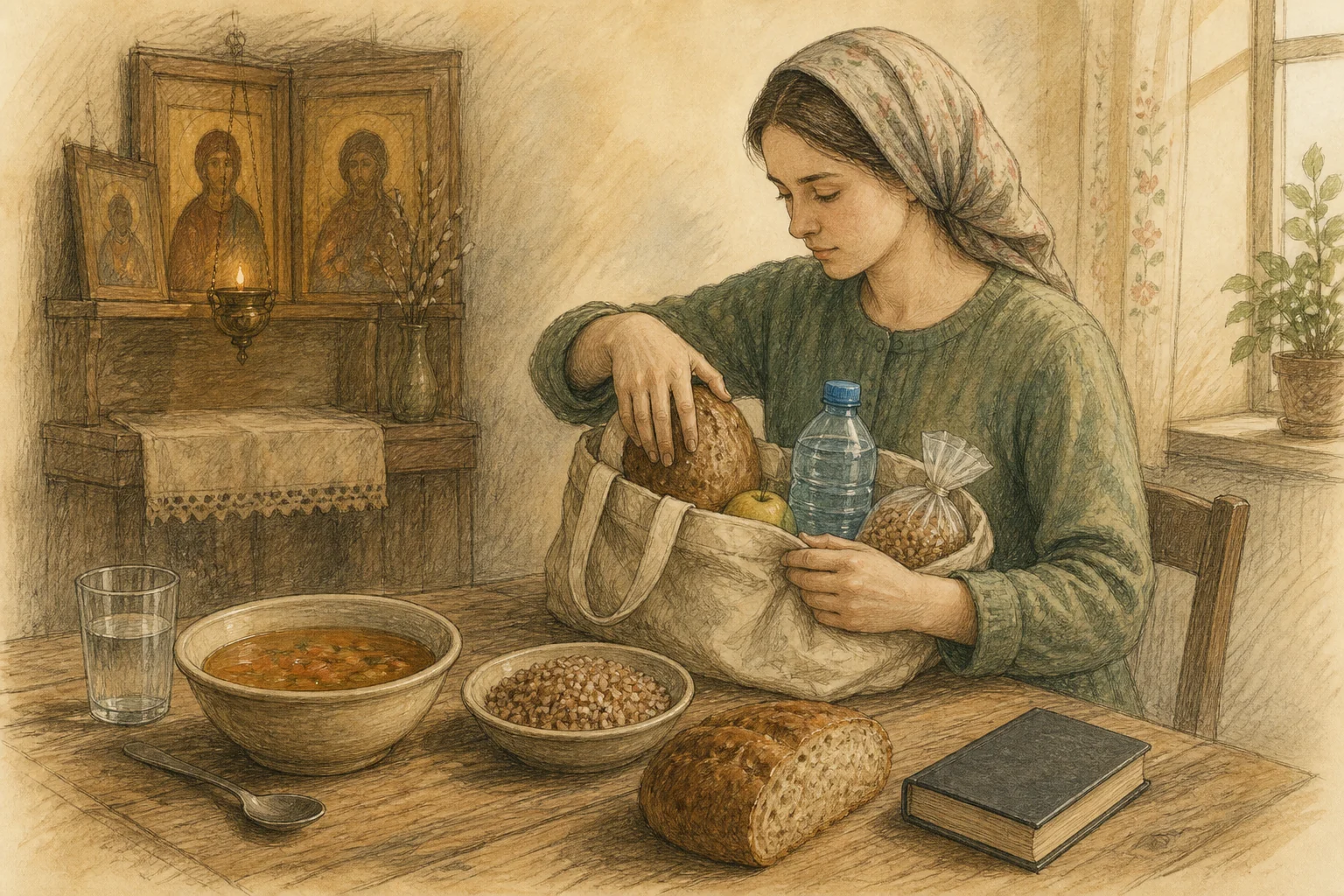
Orthodox fasting is a voluntary period of restraint for repentance, prayer, mercy, and greater freedom from habits that control a person. A change in food is important, but it serves this purpose and cannot replace it. Fasting does not prove one’s value to God, nor does it make a healthy strict faster superior to someone whose illness requires a different diet.
The Church joins bodily effort to attention of the heart: consume less, pray more attentively, seek reconciliation, notice a neighbor in need, and struggle honestly with personal sin. Without these, a fasting menu easily becomes a diet or an occasion for pride.
Why the body participates
A human being does not pray apart from the body. Food, sleep, shopping, entertainment, and repeated habits affect attention and freedom. A simple limitation reminds us that a desire does not have to become an immediate command.
Bodily fasting does not declare food unclean. Meat, dairy products, and a festive meal are gifts of God. At an appointed time, a Christian gives up part of what is lawful in order to learn gratitude and self-command.
Fasting does not purchase God’s love
God does not sell grace for a certain number of meatless days. Salvation is a gift; fasting is a response of faith and a form of training and healing for the will. We cannot present restraint as an invoice and demand success, health, or a fulfilled wish.
If a person breaks a food rule, he or she has not become rejected. Understand the reason calmly, correct the next choice, and do not turn one mistake into a week-long departure from church life.
Fasting seasons in the church year
The four longer seasons are Great Lent, the Apostles’ Fast, the Dormition Fast, and the Nativity Fast. Their length and degree of abstinence differ; the dates of some depend on Pascha.
The usual weekly rhythm also includes Wednesday and Friday, except during fast-free weeks and other calendar exceptions. One-day fasts include the Eve of Theophany, the Beheading of Saint John the Baptist, and the Exaltation of the Cross. Check the Orthodox calendar for the exact day and local observance.
What changes in the diet?
The general direction is abstinence from meat, dairy, and eggs. Rules concerning fish, oil, and wine vary by day and season. The liturgical Typikon also reflects a monastic measure and is not an automatic medical prescription for every layperson.
A beginner benefits more from an agreed and sustainable rule than from two days of maximum severity followed by collapse. Do not compare plates or interrogate a guest about every ingredient.
Simple food instead of culinary competition
Foods permitted during a fast can still become luxurious and excessive. If all available attention goes into elaborate substitutes and expensive desserts, greater freedom has not been gained.
Choose sufficient familiar foods—grains, legumes, vegetables, fruit, bread, and nuts—as health permits. Money or time saved can become practical help for another person.
Prayer is not an accessory to the menu
Add one small, realistic act of prayer: read the usual rule more attentively, attend one additional service, or read several Gospel verses daily. Do not assign yourself hours that cannot be sustained.
If prayer is still unfamiliar, begin with our guide on how to start praying at home. Fasting strengthens a relationship with God, not a competition in the quantity of texts.
Repentance and Confession
A fast helps reveal repeated actions: lying, anger, addiction, indifference, or using another person. Choose one concrete matter and begin repairing it rather than merely producing an inventory of defects.
Confession need not be postponed until the final day before a feast. Consult the service schedule and ask about parish practice early enough to avoid haste.
Mercy is an essential part
Giving up a product means little when a nearby person remains hungry, alone, or without care. Mercy may be financial, practical, and relational: purchase medicine, visit, drive, listen, or give regular support through a trustworthy ministry.
Help should not humiliate its recipient or become a photograph advertising one’s virtue. Ask what is actually needed and respect an answer.
Fasting of speech and digital attention
Slander, mockery, and endless arguments can destroy the fruit of a strict menu. Before sending a message, ask whether it is true, necessary, and expressed without humiliation.
Restrict habitual feeds, short videos, or news to a defined period. Give the recovered minutes to prayer, reading, family, or someone whose message has long remained unanswered.
Entertainment, music, and social occasions
A fast does not require hatred of beauty or permanent gloom. It invites a reduction of whatever scatters attention, inflames passions, or consumes the whole inner life. Canceling a film while scrolling for hours changes nothing.
A peaceful family visit, a walk, or serious art may fit the season. Drunkenness, cruelty, and loss of self-command are not acceptable outside a fast either. Judge the activity by its content and fruit.
Marital intimacy
Spouses may abstain for a time of intensified prayer by mutual agreement. Such a choice must not become unilateral punishment, blackmail, or control of another person’s body.
Private marital circumstances should not be debated publicly. A severe disagreement deserves a discreet personal conversation with a priest and sometimes professional couples support.
Illness, medication, and therapeutic diets
Do not cancel prescribed nutrition, medicine, or procedures because of an internet fasting chart. Diabetes, eating disorders, gastrointestinal disease, cancer treatment, and many other conditions require decisions with a physician.
Tell the priest about the medical limits and find another meaningful measure: simplicity, giving up excess, prayer, mercy, or work on a destructive habit. Emergency care always takes precedence over a menu.
Pregnancy, nursing, and old age
A pregnant or nursing woman needs sufficient nutrition according to medical advice. An older adult must account for weight, medication, protein needs, and the risk of weakness. Dispensation from a food rule is not spiritual laziness.
The bodily measure should support life and prayer rather than produce fainting, severe irritability, or hospitalization.
How children fast
Children should not simply receive an adult rule. Parents, together with a priest and physician where needed, consider age, growth, school, sport, and health. A useful child’s fast may mean fewer sweets and screens, a short prayer, and one concrete act of help.
Do not shame a child with food or force a hungry child to hide. The purpose is freely growing love of God, not anxiety around the plate.
Heavy work and athletic training
Physical labor, shifts, military or emergency service, athletic training, and travel change energy requirements. Nutrition must remain adequate and safe. Food may be simplified without deliberately destroying the ability to work.
A coach does not determine the spiritual rule, while a priest does not replace a physician or qualified nutrition specialist. Their different competence can be combined.
A one-week plan for a beginner
Choose a food measure appropriate to health. Keep a brief morning and evening prayer. Select one service, one digital habit to limit, one work of mercy, and one person with whom reconciliation should begin.
At the end of the week, examine more than ingredients. Has there been less anger, falsehood, and hurry? If the plan was impossible, reduce it honestly rather than abandoning everything.
What to do after a failure
Do not eat every restricted product merely because the day is supposedly ruined. Stop at the next decision and continue. When a medical need or an unknown ingredient caused the change, do not invent moral guilt.
If addiction, binge eating, or an eating disorder becomes visible, greater severity is not treatment. Seek competent professional help.
How a fast ends
Fasting leads to the feast and the Eucharist, not merely to midnight overeating. Participate in worship according to strength, thank God, and reintroduce foods gradually if the body has adapted to another diet.
Keep at least one acquired practice: regular prayer, support for a particular person, or a continuing limit on digital noise. Then the feast does not erase the path that led to it.
Frequent mistakes
Common dangers are pride in severity, judgment of another person’s dispensation, expensive fasting gastronomy, refusal of medicine, anger toward family, and expectation of an automatic miracle. The remedies are counsel, proportion, quiet mercy, and attention to one’s own heart.
Do not publish a detailed account of your effort in search of praise. At the same time, never hide a medical danger from a physician or pastor.
Common questions
Must a beginner immediately follow the strictest rule?
The goal is a sustainable church rhythm. Begin with a real measure and seek guidance, especially during illness or a first attempt.
Is accidentally eating an ingredient a sin?
An accident is not conscious contempt. Do not panic. Continue the fast and learn attention without compulsive checking.
May I visit friends?
Yes. Inform the host without making demands, choose what is available, and do not turn the table into a theological dispute.
May I exercise?
Yes, when nutrition and workload remain safe. Seek expert advice during illness, weakness, or intensive training.
Should I ask a blessing for fasting?
The common church rhythm is known, but a personal measure should be discussed during illness, pregnancy, heavy labor, an eating disorder, or a first serious attempt.
The essential point
The purpose of fasting is a change of mind and heart with God’s help. Food disciplines the body; prayer returns attention to God; repentance corrects the path; mercy opens a person to the neighbor.
Official Orthodox teaching repeatedly warns that changing food without prayer and love is not yet a true fast. If you need an individual measure, use the parish contact page while also following competent medical advice.