
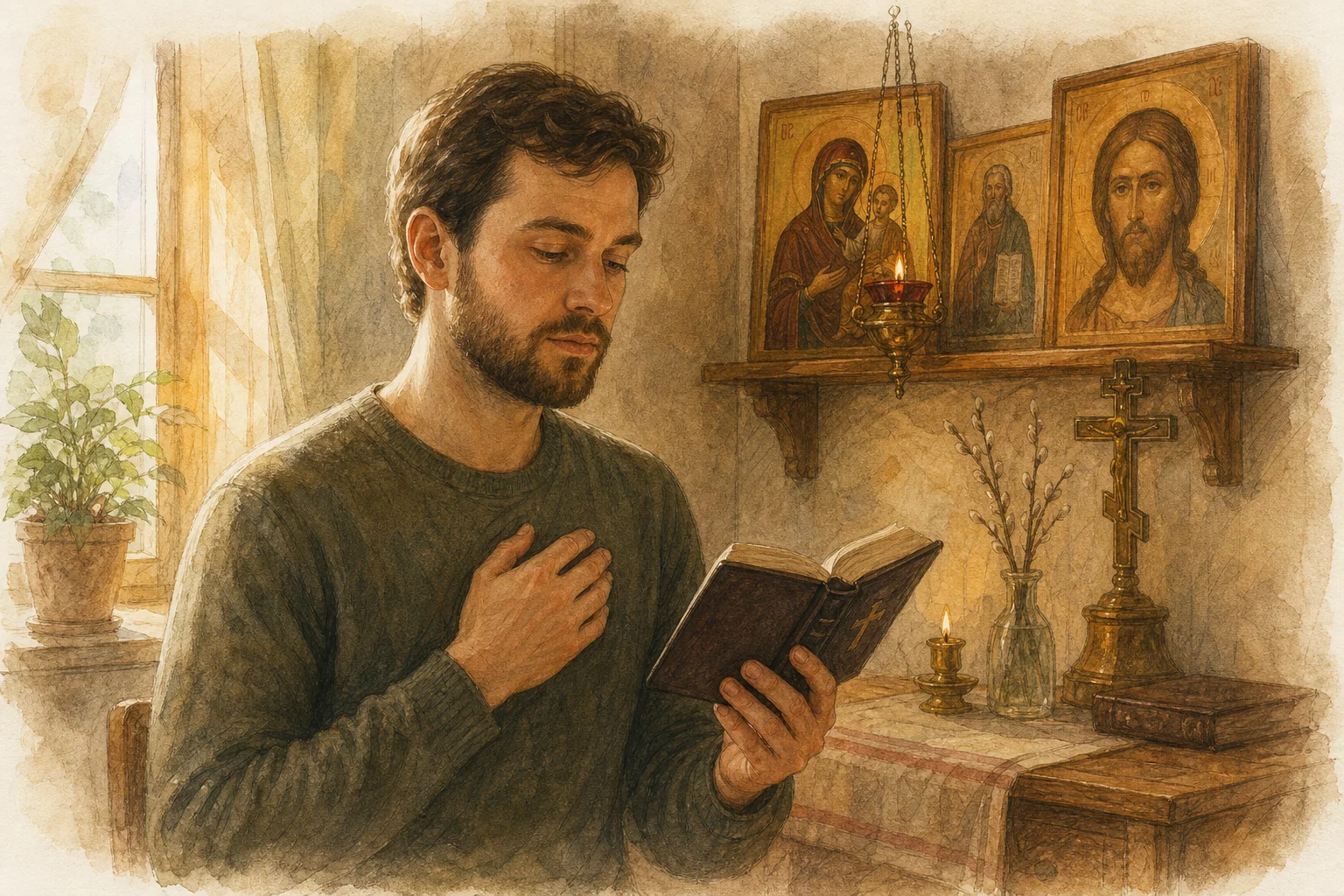
To begin praying at home, choose a short and stable time—perhaps five to ten minutes in the morning and evening. Stand or sit before an icon if you have one, silence notifications, read several familiar prayers and a short Gospel passage, then speak honestly to God about your life. A small rule kept daily is better than a rare hour-long burst.
Home prayer does not require becoming a “proper” person first. It is the honest beginning of relationship with God: thanksgiving, petition, repentance, silence, and willingness to let life change.
Why pray if God already knows?
Prayer does not give God information He lacks. It opens us to encounter, allows truth to be named, and entrusts it to the One who knows us more deeply than we know ourselves. Someone we love may already understand our pain, yet conversation remains part of relationship.
In prayer we do not only ask circumstances to change. We learn gratitude, notice another person, admit wrong, and ask what can be done rightly today.
Choose a real time, not an ideal one
Do not wait for an hour of perfect silence, a special feeling, or a new prayer book. Find a small period you can actually preserve. For one person it is the first minutes after waking; for another, after children have gone to sleep.
Connect prayer with a stable action such as washing, drinking water, or closing a work computer. Do not turn the connection into superstition: missing the usual minute does not ruin the day.
How should a prayer place be arranged?
A clean and quiet corner with an icon of Christ and, if desired, the Mother of God and saints is enough. A vigil lamp or candle may support attention, but an open flame must never be left unattended.
There is no need to buy many icons or objects at once. A prayer corner is not an exhibition or magical protection for an apartment. It reminds us of God’s presence and helps attention gather.
If no separate place is possible, pray wherever several quiet minutes can be kept. God hears a person on a journey, in a hospital, and in a crowded room.
How can morning prayer begin?
After waking, leave the phone aside briefly. Make the sign of the cross, give thanks for a new day, and ask for help to live without falsehood or cruelty. Choose the normal short opening and one or two morning prayers from a reliable prayer book.
Add several Gospel verses or the day’s reading if that does not overload the rule. End with one concrete intention: call someone lonely, ask forgiveness, or do today’s work honestly.
How should I pray in the evening?
Before sleep, remember the day without humiliating yourself. What calls for thanks? Where did you hurt someone? What remains unresolved? Bring it to God and ask for strength to take the next step.
When exhausted, do not force a long text without attention. Read the Lord’s Prayer, several psalm verses, name those you love, and finish in peace. Return to the normal rule the next day.
A prayer book or personal words?
The Church’s prayers teach us not to close around one desire. They include praise, gratitude, repentance, and prayer for others. Personal words allow today’s particular pain to be named. The forms do not compete.
A helpful order is to begin with an established prayer, remain silent briefly, speak personally, and conclude with thanksgiving. See May I pray in my own words? for more detail.
How large should a prayer rule be?
A beginner need not automatically take the full morning and evening offices together with several canons and an akathist. A large rule may feed pride or quickly produce burnout.
Begin small and observe attention after two or three weeks. Ask a priest about a long-term rule, preparation for Communion, or a special promise. The guide A prayer rule for beginners develops this further.
What should I do about distractions?
Thoughts about work, shopping, and conversations will appear. Do not treat every distraction as defeat. Notice it, refuse the inner argument, and return to the words.
A slower pace, quiet reading aloud, a shorter text, and a phone in another room help. If one task intrudes repeatedly, write it on paper and promise to return after prayer.
What if prayer produces no feeling?
Warmth and comfort may come, but they are not a quality score. Prayer can feel dry because of exhaustion, grief, or an ordinary period of spiritual labor.
Do not manufacture experience or repeat a text until the desired emotion appears. Remain honest, shorten the rule, and read the Gospel. Persistent low mood, insomnia, and loss of strength call for medical help as well as pastoral support.
Prayer for people we love
Name people and ask for peace, health, and salvation without dictating a script to God. Prayer for reconciliation belongs with a willingness to speak and forgive; prayer for the sick belongs with practical care and treatment.
Do not use prayer to control a partner, force someone to return, or punish an enemy. Ask first for truth, mercy, and wisdom to act without evil.
What if I miss a day?
Do not double the rule as punishment or wait until Monday. Return at the next possible moment. Repentance is a turning toward God, not accounting for missed pages.
If omissions are constant, reduce the length, change the time, and examine the reason. The rule may be unrealistic, or life may currently require a different rhythm.
Home prayer and the parish
Prayer at home does not replace the Divine Liturgy, the Mysteries, and a community. In church we hear Scripture with the Church, learn to pray beyond ourselves, and participate in the Eucharist.
Parish worship also does not eliminate personal prayer. Sunday continues on Monday when someone gives thanks, remembers a neighbor, and attempts to live by what was heard.
Frequently asked questions
How many minutes should I pray?
Begin with five to ten minutes morning and evening. Attention and stability matter more than a number; refine the length gradually.
May I pray sitting or lying down?
A healthy person normally prays standing, while illness, weakness, and caring for a child permit sitting or praying in bed.
Is a candle necessary?
No. It can help attention but is not a condition for God to hear prayer.
What should I read first?
The Lord’s Prayer, a short morning or evening prayer, several psalm verses, and a brief Gospel passage are enough to begin.
May I read from a phone?
Yes when no book is available, but disable notifications and reduce distraction. A printed text often supports stable prayer better.
How home prayer relates to parish life
Prayer at home does not replace worship or participation in the sacraments. It prepares the heart to come to church with attention gathered through the week. The words of the Liturgy gradually become familiar, petitions become more deliberate, and thanksgiving continues after the service.
You may also follow the Church calendar, remember the living and the departed by name, and check the service schedule in advance. Keep this simple: a prayer rule is a meeting with God, not a scorecard of completed religious duties.
What should I ask the parish?
If you do not know which prayer book to choose or how a rule should fit work, illness, and preparation for Communion, use the contacts. Find the next service in the schedule.
The first step need not be large. Today choose several minutes, thank God, read the Church’s words, and speak honestly. Return quietly tomorrow.