
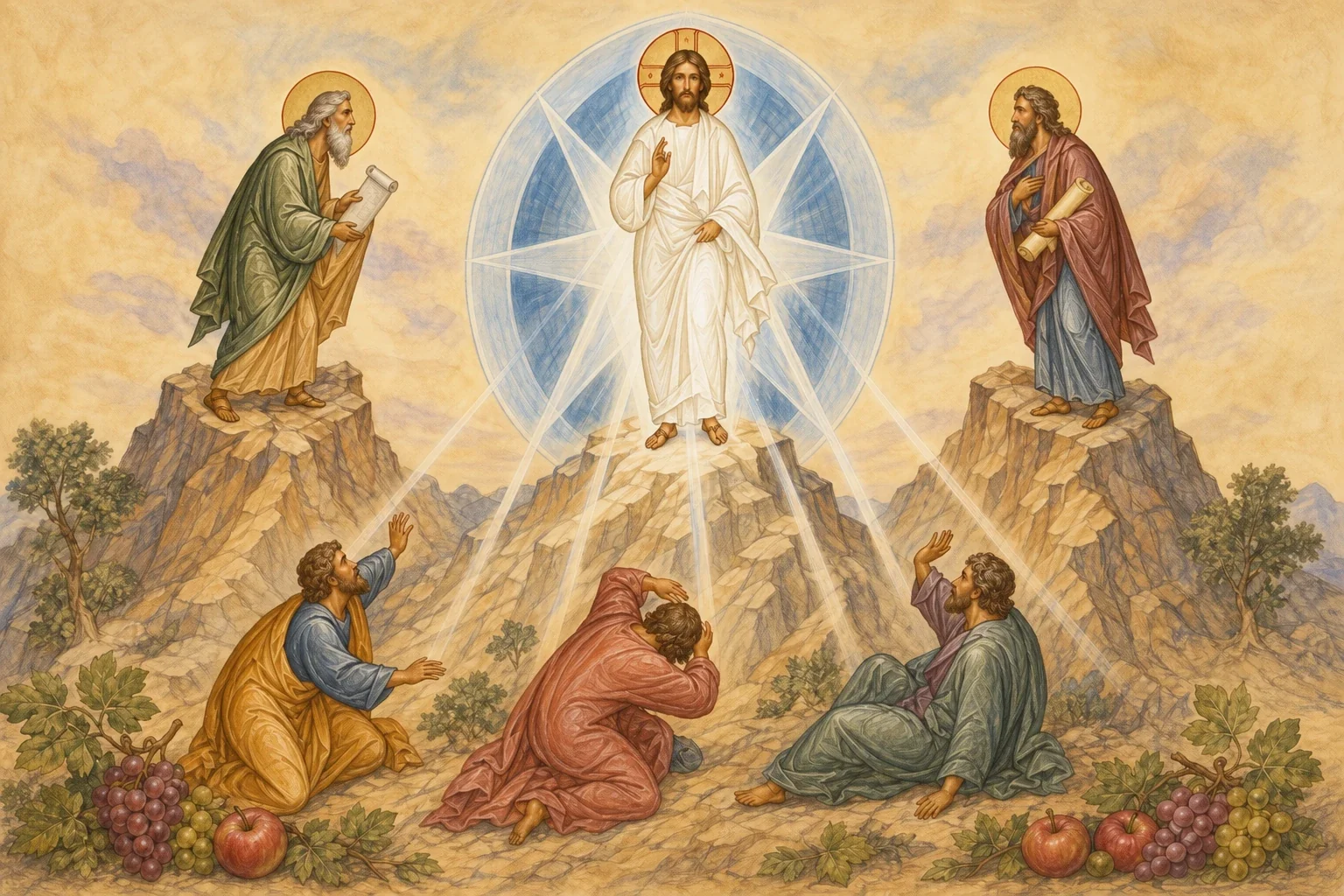
The Transfiguration of the Lord is the Great Feast celebrated on August 19 in the Russian Orthodox calendar, remembering how Jesus Christ revealed His divine glory to three disciples on a mountain. His face shone, His garments became white, Moses and Elijah appeared, and the Father’s voice came from the cloud.
Christ did not turn into another being or receive glory for the first time. The disciples were allowed to perceive what always belongs to Him: Jesus is truly God and truly human, and the way to glory passes through the voluntary Cross.
Where the Gospels tell the event
Matthew, Mark, and Luke describe the Transfiguration. Shortly beforehand Peter confesses Jesus as the Christ, and the Lord begins to speak clearly about His coming Passion and Resurrection.
The feast therefore cannot be separated from the Cross. Light strengthens the apostles before what will appear to be defeat.
Who went up the mountain?
Peter, James, and John accompany Christ. The same disciples will later remain near Him in Gethsemane, witnessing both glory and human sorrow.
The choice of three does not mean that the others are loved less. Witnesses receive responsibility to preserve and proclaim what they saw after the Resurrection.
Which mountain was it?
The evangelists do not name the mountain. Church Tradition associates the event with Tabor, which is why Christians speak of Taboric light and icons show separate rocky peaks.
Historical geography is interesting but not the center of faith. The primary question is who revealed glory and why the vision was given.
What does “transfigured” mean?
The word describes a change in the visible form before the disciples. Christ’s divine nature neither appeared nor disappeared; their perception was opened to glory ordinarily concealed by His humble human appearance.
The feast does not treat the body as a shell to discard. Christ’s human face and garments themselves become radiant.
What is Taboric light?
Orthodox theology speaks of uncreated light, a real manifestation of divine glory rather than ordinary sunlight or a psychological fantasy. God remains incomprehensible in His essence while truly communicating grace to humanity.
Do not attempt to induce such an experience through breath techniques, staring at a candle, or sleep deprivation. Spiritual life is tested by humility and love, not visual effects.
Why Moses and Elijah appear
Moses represents the Law and Elijah the Prophets. Together they witness that the Old Testament is fulfilled in Christ and that He does not destroy God’s purpose.
They also represent different states of human history: Moses died, while Elijah was taken alive. Christ is Lord of the living and the dead.
What did they discuss?
Luke says they spoke about the “exodus” Christ would accomplish in Jerusalem. The word joins the Cross to the Old Testament liberation from slavery.
Glory does not distract from suffering. It reveals that the Passion is not an accidental catastrophe but a freely accepted saving way.
Why Peter proposes three tents
Peter wants to preserve the revealed joy and offers three shelters. The Gospel honestly notes that he did not fully know what he was saying.
It is natural to retain a luminous moment, but the disciples must descend to people and complete the path. Faith cannot live only on a summit of intense experience.
The cloud and the Father’s voice
The luminous cloud recalls divine presence in Israel’s history. The voice names Jesus the beloved Son and commands the disciples to listen to Him.
Attention moves from Peter’s plan to obedience to Christ. The principal answer to the feast is not seeking another vision but hearing the Gospel.
Why the disciples fall
In the icon Peter, James, and John appear in strong movement: one covers his face, another falls, and another turns. Their response expresses human limitation before divine glory.
It is not a punishment. Christ touches the disciples and tells them not to fear.
Reading the feast’s icon
Christ stands at the center of a mandorla and rays proceed from Him. Moses and Elijah stand at either side while the three apostles occupy separate slopes below.
The geometry establishes order: the source of light is Christ, not the sun. The disciples’ movement contrasts with His calm stability.
When it is celebrated
The Russian Orthodox Church keeps August 6 in the Julian calendar, corresponding to August 19 in the civil calendar. The date is fixed.
The feast occurs during the Dormition Fast. Fish is permitted according to the usual rule, while personal practice accounts for health.
How the services unfold
A vigil is celebrated on the eve and the festal Divine Liturgy in the morning. The Gospel, troparion, and canon repeatedly join light to the coming Cross.
Grapes and other fruit are normally blessed after Liturgy. Confirm the time in the parish schedule.
Why grapes are blessed
In lands of ancient Christian culture, grapes ripened at this season and were important for Eucharistic wine. First fruits were brought in thanksgiving and the harvest was shared.
Blessing does not add magical chemistry. It teaches people to recognize a gift, thank the Creator, and refuse to possess the harvest only for themselves.
The Russian name “Apple Savior”
In northern lands apples and other available fruit replaced grapes, and the day acquired a popular name. The custom is beautiful when the apple does not become the main character instead of Christ.
The word Savior refers to the Lord, not a seasonal market. The Gospel and Liturgy remain the center.
May apples be eaten before August 19?
No universal church prohibition binds every layperson, region, and circumstance. Waiting for the first-fruit blessing is a voluntary tradition and historically concerned harvest growers especially.
Do not shame a child, pregnant woman, ill person, or resident of another climate. Gratitude matters more than superstitious fear of a date.
What to bring for blessing
Bring a small amount of clean fruit in a convenient bag or basket. Keep passages clear and do not bring spoiled food, alcohol, or unrelated objects.
Set part aside for someone who cannot attend. Blessing naturally continues through sharing.
Holy Communion
The festal Liturgy leads to the Eucharist. Prepare through prayer, the Eucharistic fast, repentance, and the parish order for Confession.
Permission for fish concerns the festal meal and does not cancel abstinence immediately before the Chalice. Our guide to fasting before Communion explains the distinction.
What human transfiguration means
Christian transformation is neither a cosmetic version of the self nor a cult of success. Grace heals will, mind, relationship, and body so that a person becomes able to love.
Change appears concretely: ending a lie, asking forgiveness, working faithfully, and caring for the weak. Intense feeling without fruit quickly disappears.
Transfiguration during a difficult season
The disciples receive light before the Cross, not instead of the Cross. The feast therefore speaks to someone unable to remove illness, bereavement, or external hardship immediately.
Faith does not require calling pain good. It reveals Christ nearby and allows Him to transform how the trial is lived.
Explaining the feast to a child
Say that the disciples saw the light of glory that always belongs to Jesus and heard the command to listen to Him. Find the rays, prophets, and apostles in the icon.
Bring a few pieces of fruit, give thanks, and share them. Do not frighten the child with an apple prohibition.
Common questions
Are the Transfiguration and “Apple Savior” the same day?
The popular name belongs to the date, but the Church celebrates Christ’s Transfiguration rather than an apple harvest.
Why did Christ forbid immediate reporting?
The disciples could understand the vision only after the Cross and Resurrection, without reducing glory to political triumph.
Is fish permitted?
Yes according to the usual rule of the feast during the Dormition Fast. Account for personal health.
Must fruit be blessed?
No. It is a thanksgiving custom, not a condition of participation.
What should be done with blessed fruit?
Eat it without waste and share it. Do not preserve it until it spoils out of fear.
The essential point
The Transfiguration reveals divine glory in Jesus Christ and strengthens the disciples before the Cross. Light does not remove suffering but reveals its Paschal meaning.
Listen to the Son, participate in the Liturgy, give thanks for the harvest, and seek real change in life. The feast will then become more than a summer custom.