
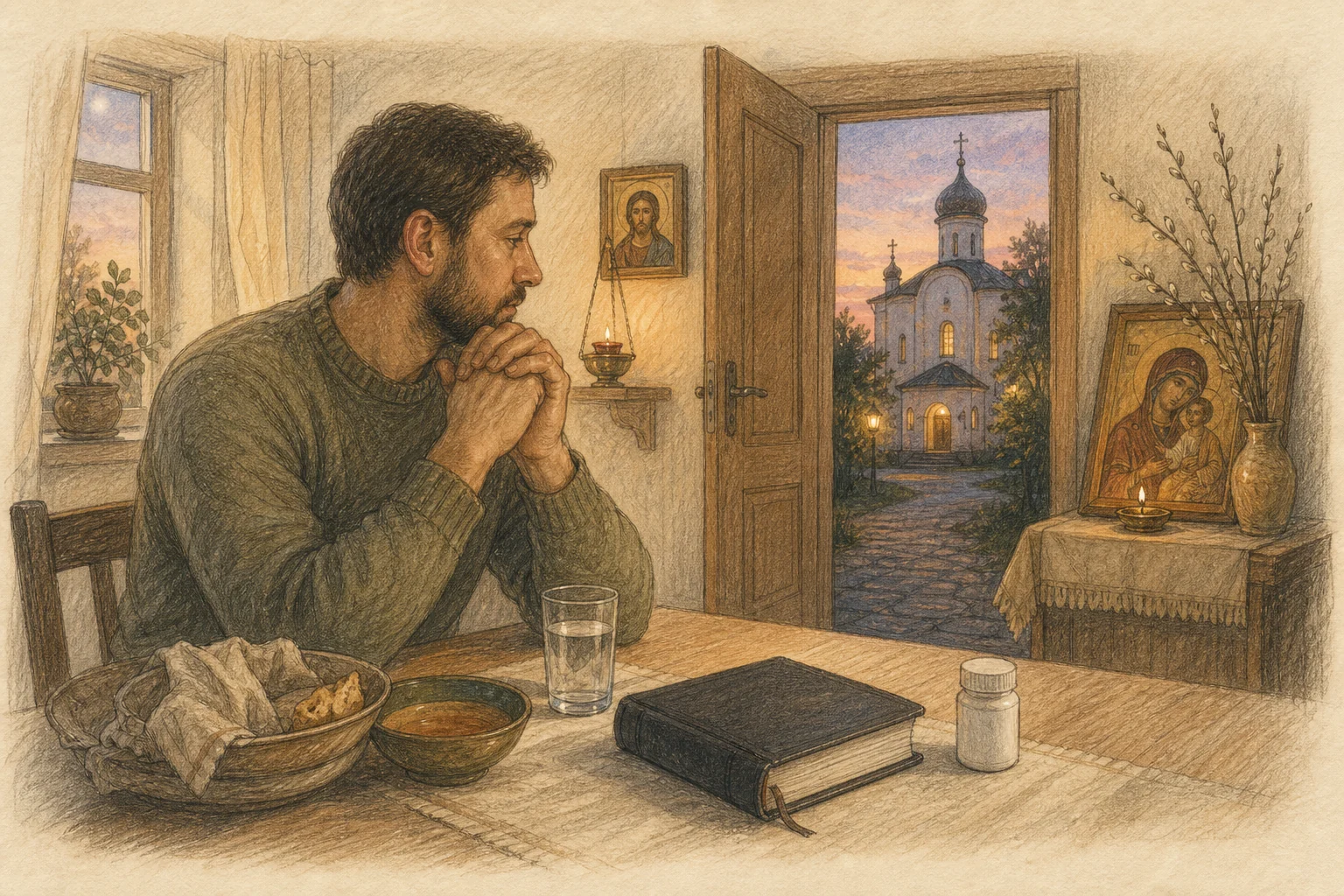
The usual preparation for a morning Divine Liturgy includes a Eucharistic fast from midnight: a person does not eat or drink before receiving the Holy Gifts. This is not a mechanical examination, however, and it is never a reason to stop necessary medicine or endanger a child, a pregnant woman, an older person, or someone who is ill. The spiritual measure is agreed with a priest; medical decisions remain with the treating clinician.
Fasting before Communion is larger than the question of breakfast. It helps a Christian become attentive, seek reconciliation, pray, and approach the Chalice with faith and repentance. Anyone receiving for the first time or returning after a long absence should speak with the parish priest in advance.
What is the Eucharistic fast?
The Eucharistic fast is abstinence from food and drink immediately before Holy Communion. For a morning Liturgy, the common practice in the Russian Orthodox Church uses midnight as the clear boundary. After an evening meal, the communicant does not have breakfast or morning coffee but comes to church fasting.
The purpose is to set the encounter with Christ apart from the ordinary course of the day. Hunger does not earn Communion, and the rule does not prove that a person is flawless.
How is it different from a longer church fast?
Great Lent and other fasting seasons regulate the kinds of food eaten over a period of days or weeks. The Eucharistic fast concerns the final hours before receiving and normally means no food or drink. The practices are related, but they are not identical.
It is therefore unsafe to assume that every person must add three days of a particular diet before every Sunday. Preparation accounts for regular participation in church life, health, and the pastoral order of the parish.
Why does the fast begin at midnight?
Midnight creates a simple boundary for a morning service: the new day begins in expectation of the Liturgy. It prevents anxious calculations based on the time of a last snack.
When the Liturgy is celebrated at night or later in the day, a literal “from midnight” rule may not fit. Ask the priest beforehand how long to abstain. Do not construct a rule from an anonymous comment or another parish’s exceptional practice.
The evening before Communion
Eat a moderate supper at a reasonable hour rather than holding a feast “in advance.” Avoid intoxication, overeating, and entertainment that leaves no possibility of quiet prayer or waking for worship.
Confirm the service time, prepare suitable clothing, write any commemoration names, and organize what children will need. Ask forgiveness where you have caused harm, and do not continue a hostile argument online deep into the night.
Prayerful preparation
A communicant normally keeps evening and morning prayers and reads the prayers appointed in his or her tradition before Holy Communion. The amount should not become a race through unfamiliar words without attention.
If you are beginning, exhausted after work, or unable to understand the liturgical language, do not silently abandon everything or stay away from the Chalice out of shame. Ask the priest how to establish an honest and sustainable rule.
Confession and Communion are distinct mysteries
Confession is the Mystery of repentance; Communion is participation in the Eucharist. Parish practice may differ. Someone who receives rarely will normally confess before returning, while a regular communicant discusses the frequency of Confession with a spiritual father.
Do not derive a universal schedule from someone else’s circumstances. When the absence has been long, a serious sin is burdening the conscience, or a difficult question needs time, arrange Confession before the final minutes of the Liturgy.
Are several meat-free days always required?
A Christian who already follows the church calendar and receives regularly is not automatically assigned extra food restrictions before every Sunday. A newcomer or someone returning after years away may be given a particular rule by the priest.
Preparation concerns the whole life: reconciliation, turning from deliberate evil, prayer, and participation in worship. A reasonable measure received with humility is more fruitful than self-appointed exhaustion.
May I drink water, coffee, or tea in the morning?
The ordinary Eucharistic fast includes beverages, so coffee, tea, juice, and water without a health need wait until after Communion. Gum, candy, and smoking also contradict the bodily attentiveness of the fast.
Illness, dehydration risk, or necessary medicine changes the practical situation. Responsible care for life replaces online severity. Discuss a known need in advance and do not conceal it out of fear of being judged.
Do not stop prescribed medicine
A medicine prescribed for the morning must not be stopped, delayed, or rescheduled without medical advice. If a tablet requires water or food, follow the prescription and tell the priest.
Holy Communion does not require self-harm. Changing insulin, anticonvulsants, heart medicines, hormones, or any treatment that depends on precise timing can be especially dangerous.
Diabetes, digestive disease, and other limitations
Long abstinence may be unsafe with diabetes, an ulcer, recovery from surgery, and many other conditions. First establish a safe plan with the clinician; then ask the priest to shape the church practice within those boundaries.
Give concrete information: when the Liturgy begins, when food or medicine is normally taken, and what happens if it is delayed. Our guide to fasting during illness, pregnancy, and treatment addresses this in greater detail.
Pregnancy and breastfeeding
A pregnant or breastfeeding woman should not prove faith by dehydration, weakness, or risk to the child. If water, a small meal, or medicine is necessary, health comes first.
A calm arrangement with the parish priest is far better than arriving at church unable to stand, pray, care for the baby, or travel home safely.
Preparing children
Infants receive Communion without an adult Eucharistic fast. As a child grows, abstinence is introduced gradually according to age, health, waking time, and the length of the service.
Do not leave a young child hungry until noon merely to imitate an adult rule. Ask the priest for an age-appropriate measure and bring food that can be offered immediately after the Chalice.
Older people, night shifts, and demanding work
An older person may need water and morning medicine; a night worker may need food to work safely; a driver must remain fit to operate a vehicle. Such circumstances are not a shameful spiritual failure.
Describe the routine honestly and ask for a real rule. Sometimes another Liturgy is the best choice; sometimes the person takes what is necessary and receives with the priest’s blessing.
May I brush my teeth?
Yes. Keep ordinary hygiene while trying not to swallow water or toothpaste. The Eucharistic fast does not require anyone to arrive unwashed or to fear every accidental drop.
If a small amount of water is swallowed inadvertently, do not panic. Mention it briefly if the conscience is troubled and follow the priest’s direction.
What if I accidentally ate or drank?
Do not hide what happened, and do not declare on your own that everything is ruined. Approach the priest before Communion and explain briefly what happened, when, and why.
He may bless you to receive or suggest another day. In either case, the Liturgy has not become pointless. Remain in prayer and do not turn a mistake into despair.
Reconciliation matters more than visible strictness
A person cannot prepare well while deliberately holding hatred and simultaneously taking pride in not swallowing water. Make the possible step toward peace: admit your fault, stop the insult, and postpone the argument.
Not every conflict can be repaired immediately, especially when a relationship is unsafe. Reconciliation never requires returning to abuse. It begins with refusing revenge and speaking honestly with a priest or another trustworthy helper.
First Communion or a return after a long absence
Do not begin by guessing every rule. Contact the parish through the contact page, describe the situation, and ask when to come for a conversation and Confession.
Check the service schedule, arrive before the Chalice is brought out, and remain for the whole Liturgy. Preparation becomes intelligible when it belongs to the life of a community rather than a collection of contradictory online checklists.
A concise preparation plan
Several days beforehand, learn the parish order and arrange Confession if needed. On the previous evening, eat moderately, finish urgent tasks, seek peace as far as possible, and read the prayer rule you can keep attentively.
In the morning, do not eat or drink except for a genuine health need, arrive early, and participate in the Liturgy. After receiving, remain for the thanksgiving prayers and read our guide to the hours after Holy Communion.
Common questions
How many hours must I fast before Communion?
For a morning Liturgy, the usual boundary is midnight. For a night or evening service, and in cases of illness, ask the priest in advance.
May I take morning medicine?
Take necessary medicine as prescribed. If it needs water or food, do not cancel it yourself; tell the priest about the medical requirement.
Must everyone fast for three additional days?
No universal three-day addition applies to every communicant. A personal rule depends on church life, health, and pastoral guidance.
May I receive if I did not confess that morning?
The order depends on the person and parish practice. Regular communicants agree on a rhythm of Confession with their priest; a long absence normally requires a conversation and Confession.
What should I bring for a child?
Bring water and suitable food for after Communion, comfortable clothing, and anything required for health. Establish the child’s fasting measure beforehand.
The essential point
Fasting before Holy Communion is an attentive expectation of meeting Christ. The ordinary measure for a morning Liturgy begins at midnight, but it belongs within prayer, repentance, reconciliation, and pastoral guidance.
Do not turn the rule into superstitious fear, and do not sacrifice treatment for external rigor. Describe limitations honestly, prepare faithfully within your strength, and approach the Chalice with trust in God.