
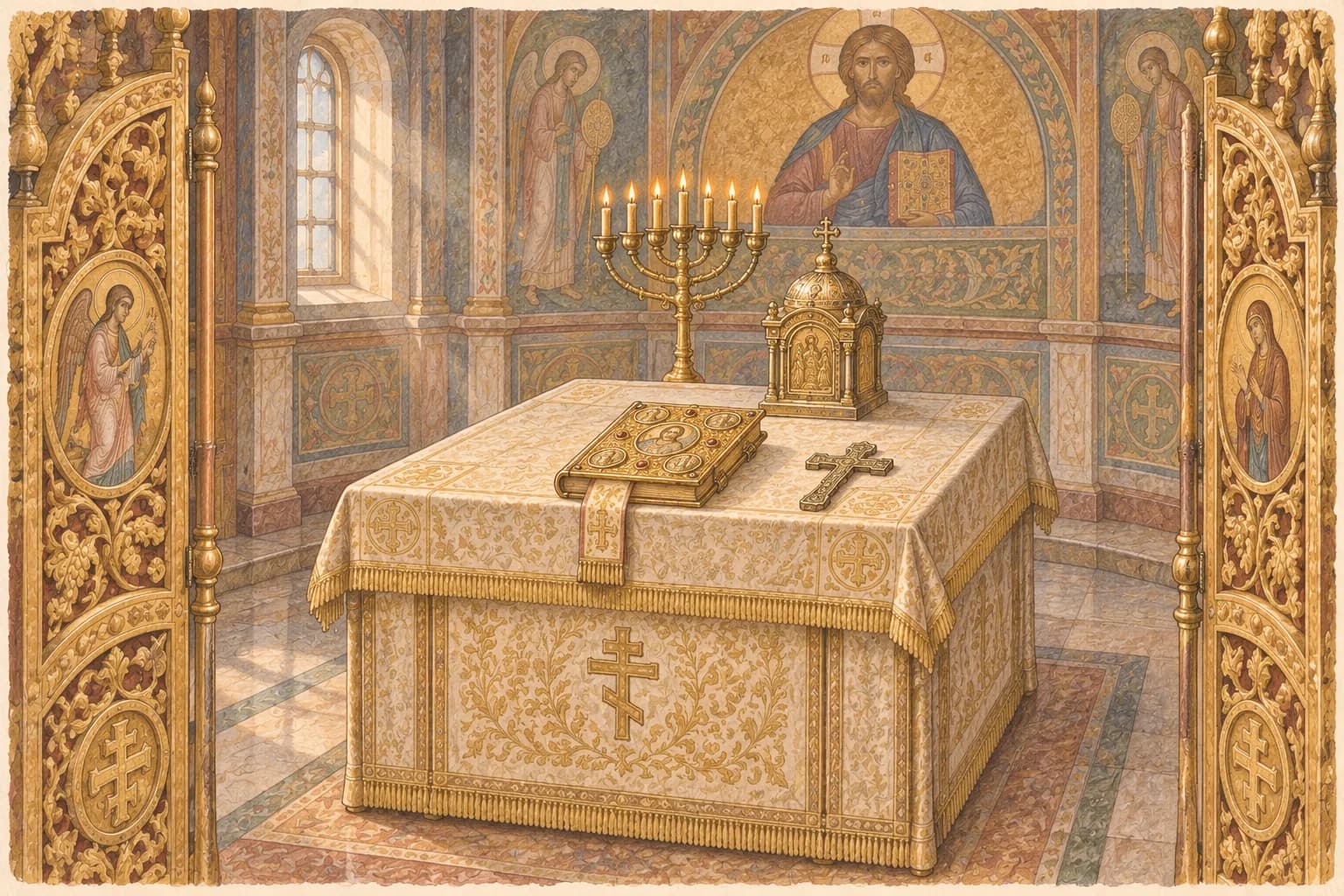
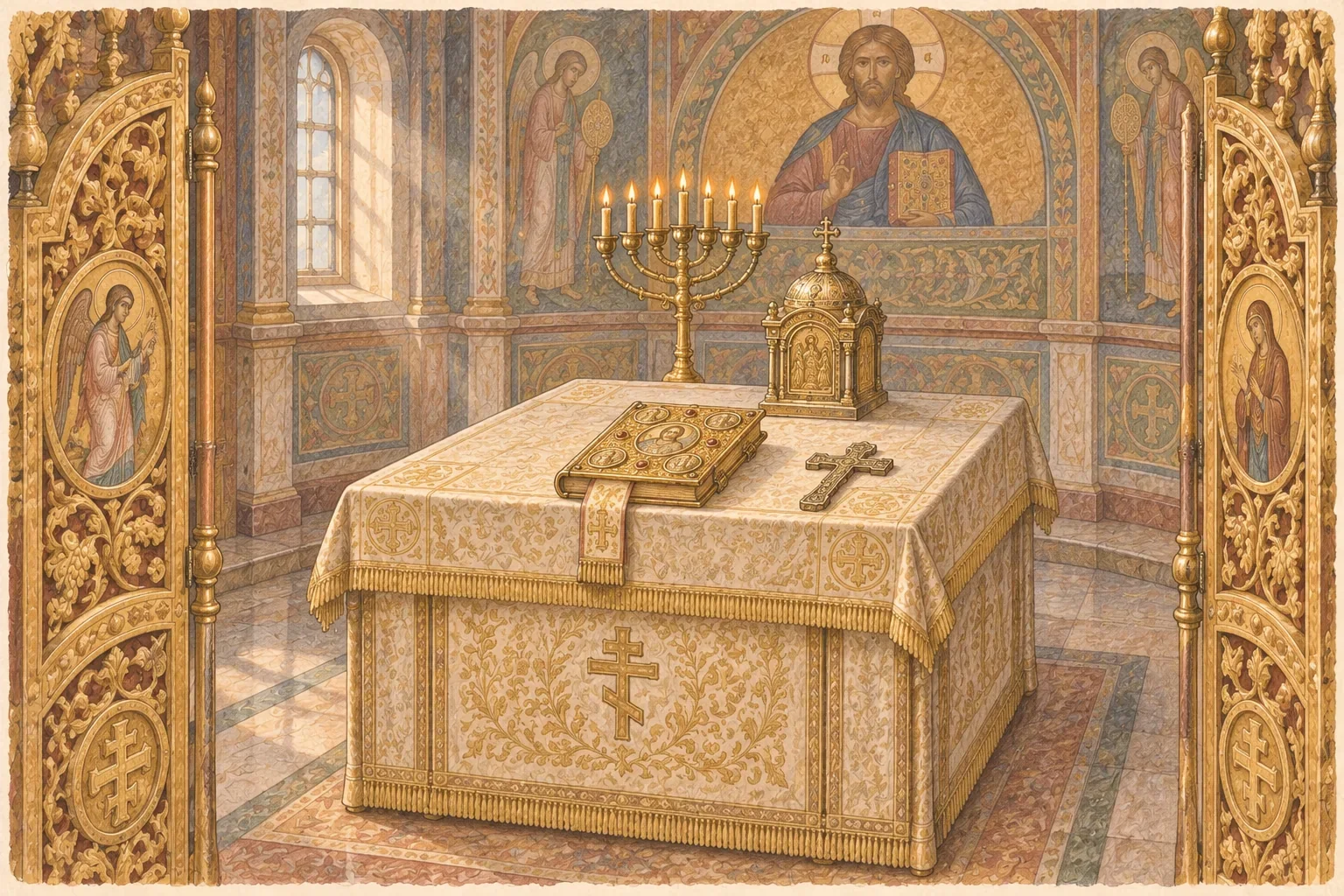
The Holy Table is the sacred table in an Orthodox sanctuary on which the Eucharist is celebrated. Here the term does not mean a throne or ordinary furniture. Its purpose belongs to the Church’s central act of worship, and its use follows ecclesiastical order.
Liturgical objects, including the Gospel book and a cross, are placed on the Holy Table. Their arrangement is explained in teaching about the Liturgy. Joining in prayer does not require every worshipper to inspect each object at close range.
The Holy Table differs from the table of preparation and from a lectern holding a book or icon. Calling each a table or stand does not make them interchangeable. Visitors should not enter the sanctuary and touch the Holy Table as though inspecting a museum exhibit.
If a child asks what lies beyond the icon screen, begin with the sanctuary and the Eucharist. Arrange a guided visit for a fuller explanation. Learning about the building works best with permission and without disrupting worship.
The central table of the sanctuary and the Eucharist
In an Orthodox church, the holy table is the principal sacred table in the sanctuary, where the Eucharist is celebrated. The Russian word prestol here names a liturgical object rather than an ordinary seat. Someone familiar with its secular meaning of throne should therefore note the context: the subject is the holy table, not the bishop’s chair.
A Gospel book and cross are normally placed on the holy table. The Gospel book is used for liturgical readings and carried out solemnly at appointed moments; the cross expresses the saving Crucifixion of Christ and is used in the corresponding sacred rites. These are not decorative objects chosen merely to furnish a surface.
The antimension is directly connected with the Eucharist: a consecrated cloth bearing an image of Christ’s burial and the bishop’s signature. It is used in celebrating the Liturgy and expresses the serving priest’s relationship with his bishop. Distinguish the antimension from the table’s outer coverings: it is not an ordinary tablecloth or an interchangeable piece of fabric.
The tabernacle holds the reserved Holy Gifts, used particularly for giving Communion to the sick outside the communal Liturgy. Its artistic form may vary, but its purpose is defined by what it contains. Understanding these objects helps explain why the holy table is not a place for personal belongings and why handling it follows an established ecclesiastical order.
Holy table, sanctuary and iconostasis are different
In Russian church usage, altar commonly means the sacred space beyond the iconostasis. The holy table stands within that space. The iconostasis is the screen bearing icons and containing the sanctuary doors. Entering the sanctuary and approaching the holy table are therefore not identical expressions: one concerns the space and the other a particular sacred object inside it.
Translation can increase confusion. English altar may refer to the table itself, whereas the Russian term often denotes the whole sanctuary. In bilingual descriptions, holy table for prestol and sanctuary for the enclosed area make the distinction clearer. This prevents readers from thinking that the languages are describing entirely different aspects of worship.
Why visitors do not approach the holy table on their own
The sanctuary is not an ordinary passageway or an unrestricted part of a sightseeing route. Access is connected with liturgical service and established ecclesiastical order. Even someone who assists at church should not assume that permission to enter includes permission to touch everything inside. The responsible minister explains the particular tasks and boundaries.
This does not mean the prayer of those standing outside the sanctuary matters less. The Liturgy is the shared work of the Church, with people occupying different places according to their ministry. A parishioner does not need to approach every sacred object to participate fully in prayer. If you want to understand the sanctuary better, ask for an explanation or use the church’s educational materials without disrupting a service.
Why a holy table has a dedication
A church or side chapel may be dedicated to an event in sacred history, to the Lord, to the Mother of God or to a saint. This gives rise to references to a holy table’s dedication and the patronal feast. A large church can contain several chapels with separate dedications, so its calendar may include more than one patronal celebration. That does not automatically mean each chapel is an independent parish.
The dedication helps explain service announcements and local history. A church may be known by its principal dedication while a particular service takes place in a side chapel. Consult the church’s own description to understand its arrangement. A photograph of the exterior cannot reliably establish the number of holy tables or reconstruct the history of their consecration and later changes.
What to notice when learning about the Liturgy
A beginner can connect visible movements of the clergy with the broad course of the service: preparation, readings, the Eucharistic prayer and Communion. Not everything happening in the sanctuary is visible from the nave, and not every movement requires a separate symbolic interpretation. Some actions have straightforward practical explanations, while their theological context is expressed in the prayers.
A good guide distinguishes established practice, historical explanation and spiritual interpretation. It does not promise that the location of objects alone will explain every moment. When teaching a child, begin with the simple point that the Eucharist is celebrated on the holy table, which is why it receives particular reverence. Further details can be added gradually alongside experience of attending the service.
Consecration and ordinary cleaning are different
The holy table belongs to the church’s consecration and its established rite. Parishioners cannot simply manufacture a table, put it in place and begin using it liturgically as though it were ordinary furniture. Preparing a new place of worship falls within ecclesiastical order and the bishop’s responsibility. The distinction also matters when helping with cleaning: an assignment to wash the floor or wipe windows does not authorise independently cleaning the holy table or moving sacred objects. Establish the task’s actual scope first, so voluntary help supports the sanctuary’s purpose.
A question for reflection
Can you describe the Holy Table’s purpose separately from its decoration?