
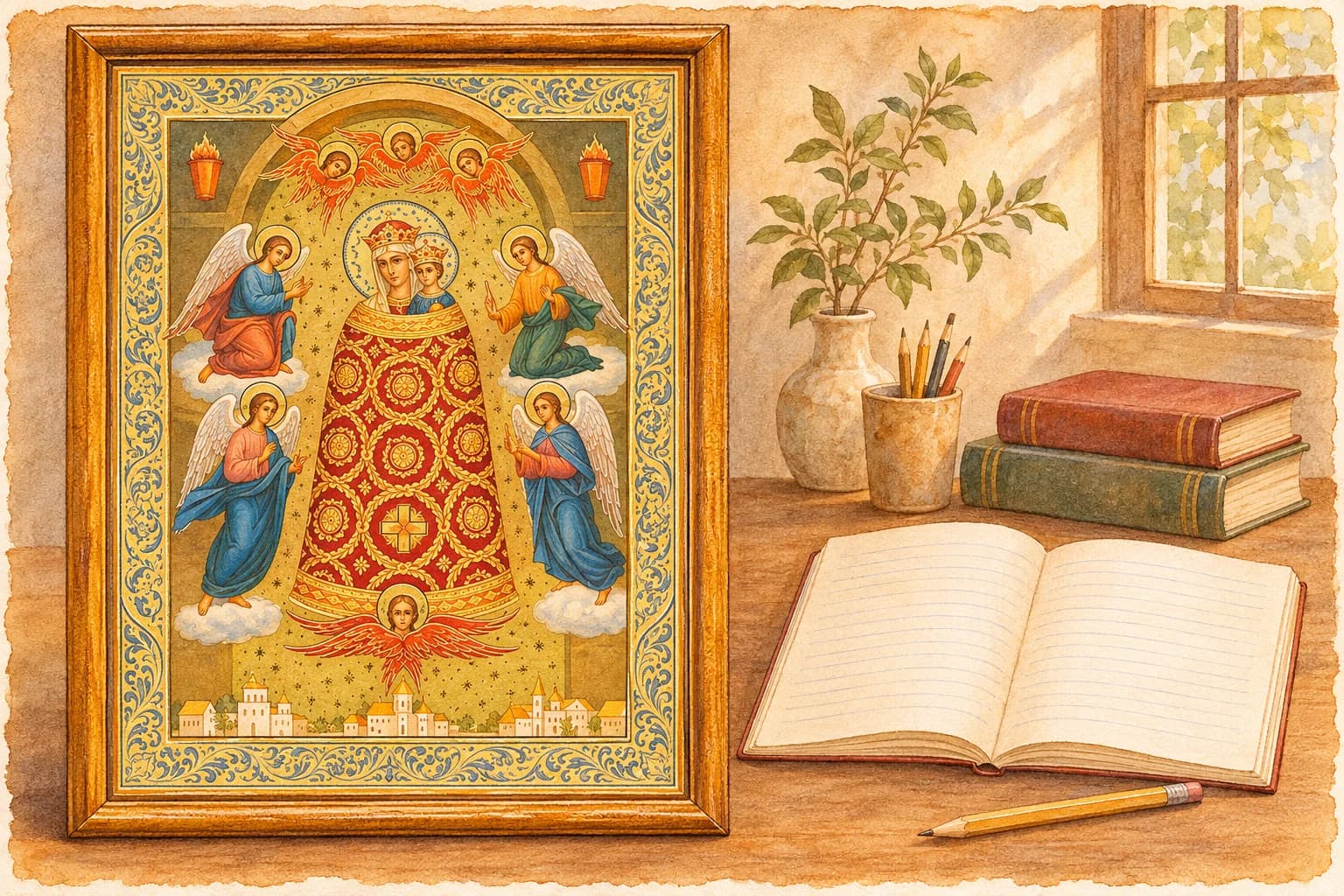
Before the icon known as the Giver of Understanding, people pray for help with learning and discernment. Its title does not promise instant ability or passing an examination without preparation. Prayer may ask for patience, attention and strength for honest work.
The image has a distinctive composition featuring the Mother of God and Child. Use a church description of its type rather than invent meanings for every decorative detail. The history of veneration does not replace understanding what prayer is.
Memory and learning difficulties do not prove a child’s spiritual inadequacy. Persistent difficulties need educational and sometimes medical assessment. Such help should not be opposed to prayer, and a problem should not be hidden for fear of judgement.
Combine prayer with preparation: divide the task, plan rest and ask for clarification. If giving the icon to a student, do not attach a guarantee of success to the gift. Offer real support instead.
Recognising the Giver of Understanding
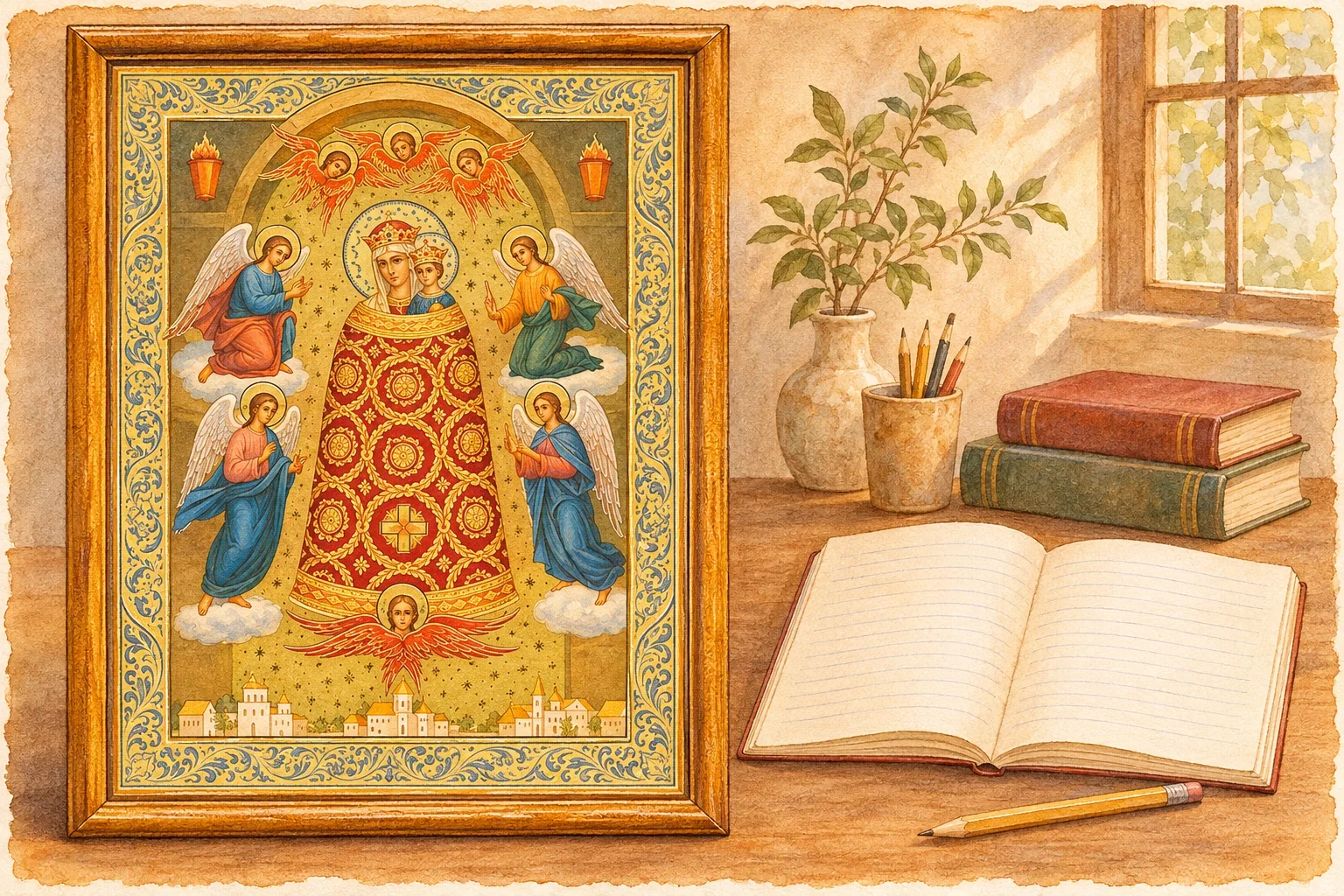
In a common form of this icon, the Mother of God and Child appear together within an ornate shared garment, accompanied by angels with lights and an architectural setting. The unusual outline often prompts questions from someone seeing the image for the first time. It does not depict a classroom or identify a patron restricted to one academic subject. The image directs attention to the Mother of God’s intercession and to Christ, in whom Christian hope rests.
Individual copies differ in their details. Inscriptions, additional figures and decoration should be considered with reference to a description of the particular work. There is no need to assign a secret meaning to every line or treat a later decorative feature as obligatory for the entire type. Begin with the complete title, then establish where the particular copy was made and is kept. This separates the history of an individual object from the wider tradition of its veneration.
The composition’s history and the tradition about the icon
The linked historical account connects this composition with the image of the Mother of God at Loreto in Italy. The unusual shared garment of Mother and Child helps explain that artistic relationship. Research into the form’s origins and the prayerful veneration of the image address different questions. An adopted artistic motif does not by itself explain the icon’s subsequent life within Russian church tradition.
A separate traditional account concerns a man who prayed for the restoration of his understanding and was instructed to paint the image. This should be presented as a religious tradition, not a medically documented case or a promise that every person praying will experience the same recovery. Distinguish the history of the iconographic form, the history of a particular copy and the devotional narrative explaining its title.
What to pray for before an examination
Prayer about studying can be specific: understanding a difficult topic, staying calm while answering, overcoming avoidance or honestly acknowledging a gap in knowledge. It does not require promising God a special payment for the desired mark. Gratitude is appropriate even when a result is modest but the student has worked conscientiously. A Christian approach to education includes truthfulness: asking for success sits uneasily with planning to deceive an examiner.
Begin practical preparation by listing the topics and the time actually available. Separate material you understand from material that needs explanation. After a brief prayer, choose one manageable task instead of trying to repair an entire school year at once. If anxiety prevents reading or sleeping, discuss it with a trusted adult or a qualified professional. The icon recalls turning towards God; it does not replace a workable routine, sleep or help from a teacher.
Supporting a child who finds learning difficult
Parents need to identify the actual difficulty. A child may understand a subject but read instructions slowly, know an answer but fear speaking in class, or work hard yet struggle under an excessive workload. The same low mark can conceal very different causes, so support must differ too. Begin with a calm conversation and examples of specific tasks. Describing the problem as inadequate faith does not explain difficulties with reading, attention or memory.
Ask the teacher what already works and what adjustments could help: shorter tasks, clearer sequences or an additional explanation. Persistent difficulties may warrant specialist educational assessment. Parents’ prayer can be expressed through patience with the child’s pace of learning. A gift of an icon should communicate support: the child is loved for more than high marks, and human dignity does not depend on a position in a classroom ranking.
Understanding beyond school
The icon’s title does not restrict prayer to school examinations. Adults also need understanding when learning a profession, reading Scripture, considering a family disagreement or making a responsible decision. Understanding includes distinguishing facts from impressions, listening to objections and admitting an error. Praying for it entails willingness to learn, rather than merely seeking confirmation of a position already chosen.
A practical expression may be as simple as checking the source of a message, asking a clarifying question or consulting someone with relevant expertise. Prayer before an icon is not a method for obtaining a guaranteed choice between two possible futures. It accompanies judgement and effort while preserving freedom and responsibility. If the image is given to an older person experiencing memory loss, care must also include practical assistance and medical support. Retaining memory is not a test of how strong that person’s faith is.
A question for reflection
Which specific learning difficulty needs support now?