
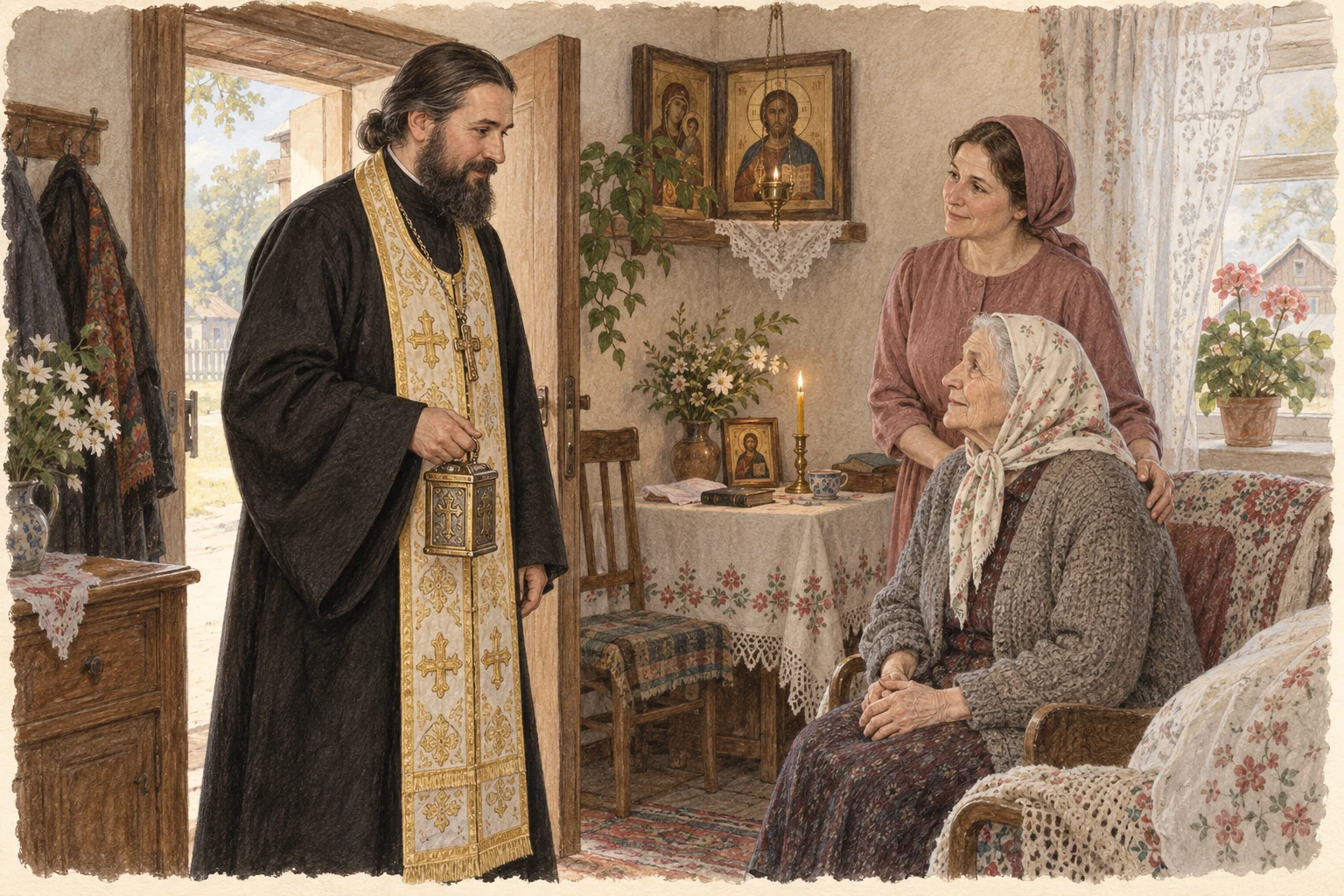
An Orthodox Christian unable to attend church because of illness or serious frailty can contact a parish to ask about receiving Communion at home. There is no need to postpone the conversation until the last hours of life. Begin with a telephone call, explain the circumstances, and ask how a priest's visit can be arranged.
Ask the person first
When the person can express a preference, discuss inviting a priest with them. Ask plainly whether they would like a conversation and Communion. Do not arrange a surprise visit to force agreement. Relatives may mean well, but a sacrament must not become an instrument of family pressure.
If the person cannot respond or their ability to communicate has changed, tell the priest, including anything known about their earlier wishes. Do not decide for yourself which sacramental actions are possible. Explain, where appropriate, that a priest's visit does not mean abandoning treatment or predicting an imminent death.
Information for the initial call
Give the person's name, address, a contact person's telephone number, and the reason they cannot attend church. Explain what is known about their Baptism and church life. Say immediately if the situation is urgent. Confirm the floor, lift access, entry code, and how the priest will get into the home. Small practical errors can delay an agreed visit.
Mention known infection-control requirements, communication difficulties, or swallowing problems. You do not need to send a complete medical history to a parish group chat. Share the information necessary to plan the visit and agree on how to report a change in the person's condition.
Preparation alongside medical care
Do not automatically apply ordinary fasting expectations to someone seriously ill. The Church's document on Eucharistic participation provides exceptions to the Eucharistic fast for serious conditions requiring food or medication and for the dying. Discuss the person's preparation with the priest and explain the prescribed treatment schedule.
Do not independently stop medication or necessary food for the visit. Medical decisions belong with the treating professionals. Ask what prayers are manageable, how confession will be arranged, and whether a relative can help with reading. Difficulty standing or reading for long periods should not prevent the initial conversation.
Preparing the room
Clear a small, stable table and a convenient route to the person, and turn off the television. Ask the priest what else is needed rather than purchasing a special kit. Do not move medical equipment or reposition the person against care instructions merely to make the occasion look more formal.
Allow privacy for confession as far as circumstances permit. A relative can help arrange the space and then step away. Do not record the visit without the participants' consent. Afterwards, ask whether the person needs rest and make a separate arrangement with the parish about future contact.
When medical help cannot wait
In an immediate threat to life, call emergency medical services: 112 in Russia or the local emergency number elsewhere. A request for a priest can be made at the same time, but waiting for him must not delay medical assistance. For someone in hospital, coordinate access with staff.
A broadcast service may support prayer, but it does not provide Communion remotely. Do not try to recreate the sacrament using ordinary bread and wine. The practical next step is direct contact with the parish and careful attention to this particular person, their wishes, and their condition.
When Speech Is Difficult but the Person Wants to Participate
Ask which way of communicating is most comfortable: short questions, slower speech, writing, or help with a hearing device. Tell the priest before arrival. Difficulty speaking should not automatically be taken as lack of understanding or willingness. A relative can explain the person's usual way of responding without substituting their own decision for it. Discuss opportunities for personal communication and the companion's role with respect for the person concerned.
If circumstances change, do not conceal this to preserve the appointment. Call to explain that the person is exhausted, has moved to another ward, or cannot currently hold a conversation. Where swallowing is difficult, do not experiment independently with ways of administering Communion. Give the priest the relevant information and discuss safe care with healthcare professionals. Preparation must reflect the actual circumstances, not a photograph of how a similar visit looked in someone else's home.
What One Designated Relative Can Arrange
Choose one person to agree the time and inform others. They can prepare directions, meet the priest at the entrance, and establish who will help provide quiet. This does not give them authority to direct the patient's conversation with the priest. If relatives have different expectations, discuss them beforehand rather than arguing at the bedside. Move household tasks, telephone calls, and conversations about future plans to another room for a while, as far as possible.
Afterwards, do not question the person about their confession or require a description of special feelings. Ask about ordinary needs and whether they would like further contact with the parish. Do not assess spiritual results by an immediate change in physical wellbeing. If regular contact is needed, discuss what visits are possible without promising a timetable on the priest's behalf. Care continues after he leaves through quiet attention, respect for your loved one's wishes, and the ordinary responsibilities of looking after them. The visit is part of that care, not a substitute for everything that follows.
Sources
- On the Participation of the Faithful in the Eucharist, 2015 (Russian)
- OCA: Communion and those unable to gather at church
- Russian Emergencies Ministry: calling emergency medical assistance (Russian)