
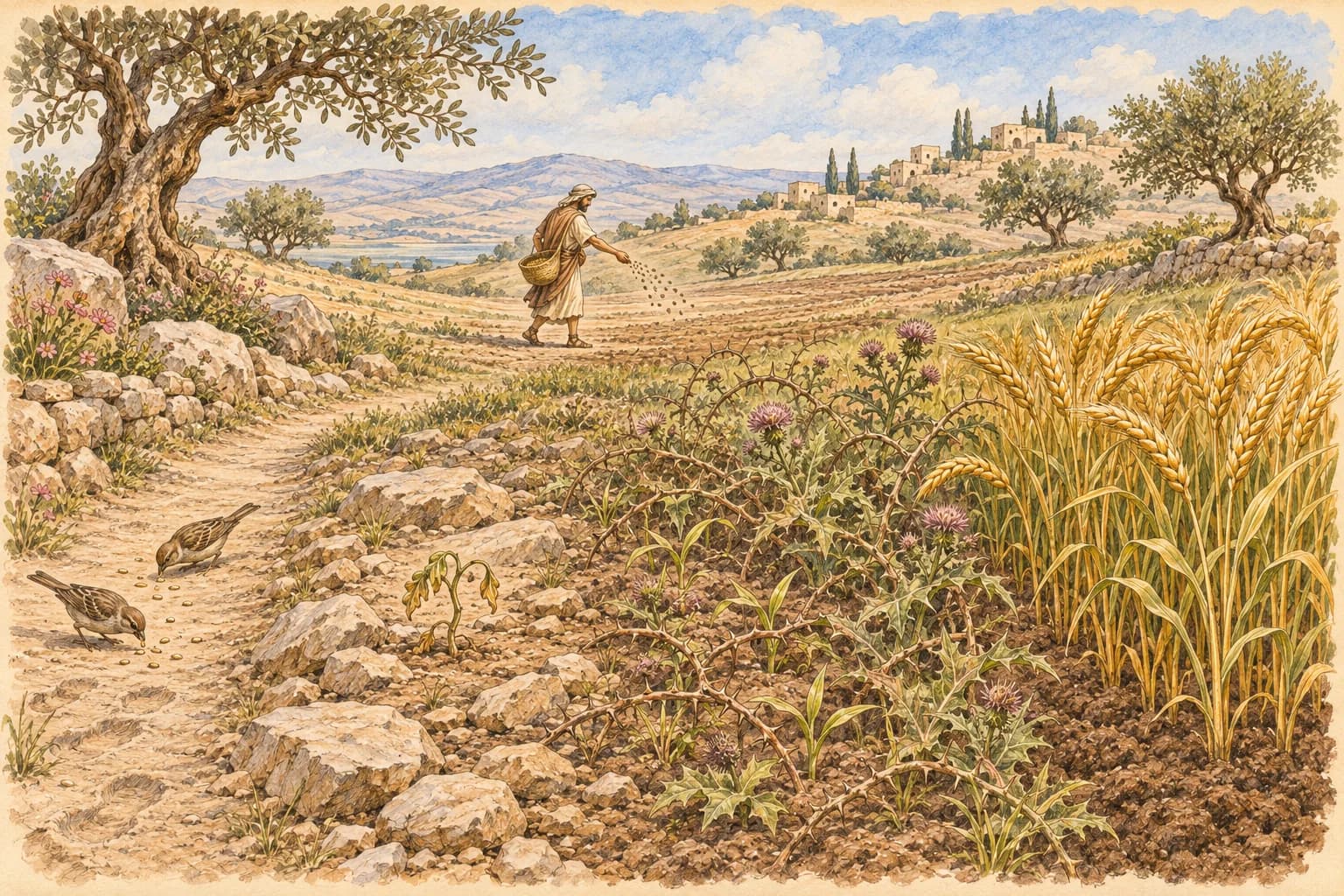
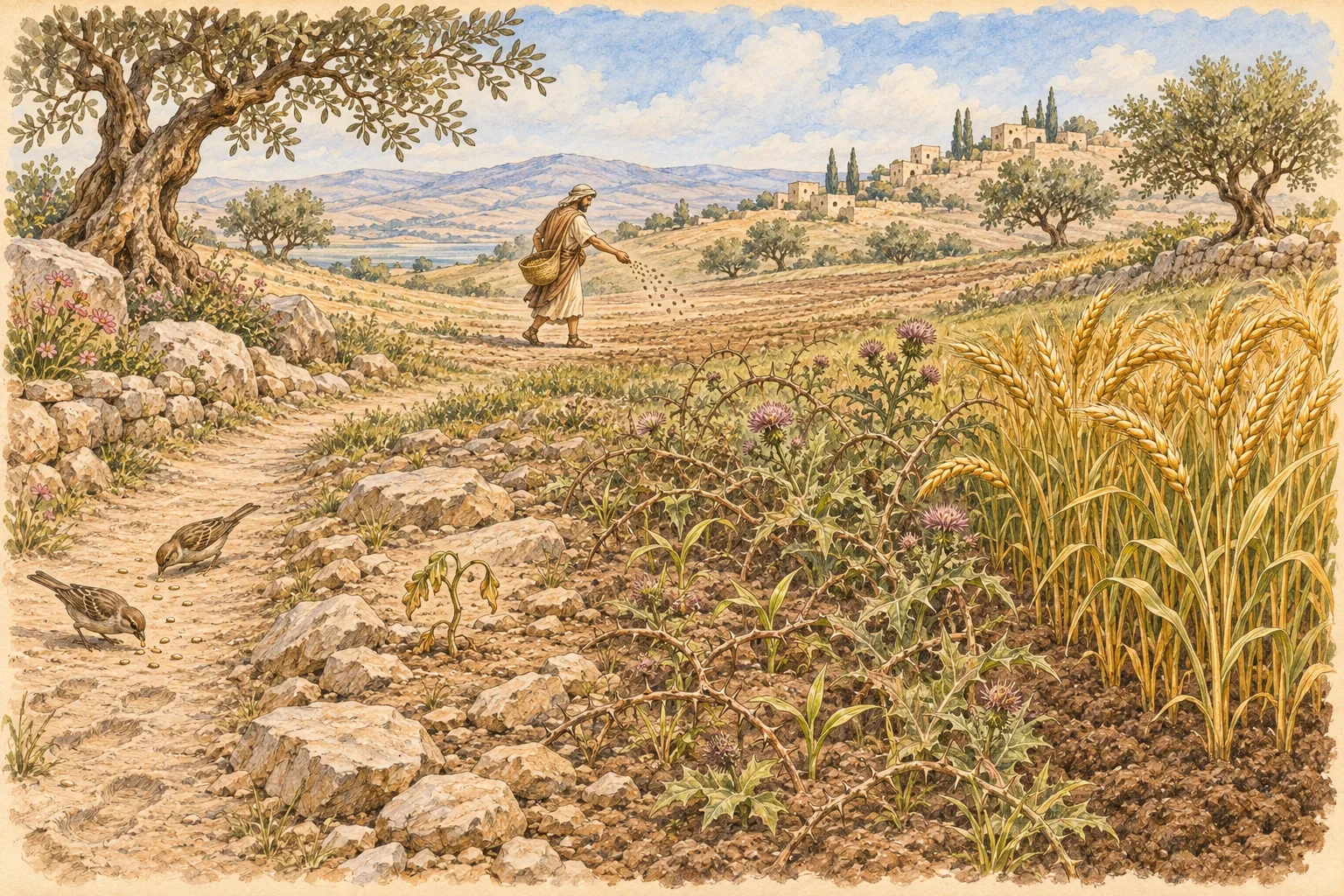
In the Sower, different soils show ways of receiving the word. Christ explains obstacles including shallow reception, trouble, anxieties and the lure of wealth. The point is not to classify everyone permanently into spiritual categories.
The seed is the same, but its conditions differ. Rapid growth does not guarantee lasting fruit, and an unimpressive beginning does not establish someone’s future. Read both the story and the explanation that follows.
Calling someone bad soil is no reason to deny them respect. The parable first examines our own listening. It also provides no mathematical measure of spiritual success based on visible results.
Identify one obstacle you recognise: haste, constant distraction or fear of difficulty. Consider a small change of habit. Setting aside attentive time for Scripture is more useful than merely promising to read more chapters.
Why the same sown message bears different fruit
In Mark four, the sower scatters seed that falls beside the path, on rocky ground, among thorns and on good soil. The story begins with an ordinary agricultural activity, but Christ then explains its relationship to hearing the word. The central question is therefore not how the farming technique compares with modern methods, but what happens to what people hear within their lives.
The seed is not described as having a different quality in each location. What differs is its reception and subsequent growth. This prevents the convenient conclusion that every failure must result from an insufficiently persuasive sermon. At the same time, the parable does not authorise listeners to assess other people’s souls arrogantly. Its first challenge concerns our own hearing: what remains of the Gospel word after the initial impression, when ordinary tasks and difficulties return?
The path and rocks: hearing is not yet taking root
Beside the path, the seed remains exposed and quickly disappears. In the explanation, this concerns a word that does not remain with its hearer. Even someone who has attended church for years may recognise the experience: the reading was spoken, but scarcely attended to. Notice this without theatrical self-accusation and try a simple response: return to the passage, clarify an unfamiliar word and briefly state what you understood.
On rocky ground, growth comes quickly but lacks sufficient root. A joyful beginning does not endure a trial. The parable does not condemn joy; it shows that emotional enthusiasm alone is insufficient. Someone may eagerly adopt a new practice and then abandon everything at the first difficulty. Taking root involves steadiness, a sustainable routine, church participation and willingness to ask when something is unclear. The speed of initial change does not measure the depth of faith.
Thorns: how concerns can choke a good beginning
Among thorns, the plant does not vanish immediately. It grows but becomes crowded out by what grows beside it. The Gospel explanation names cares, the deception of wealth and other desires. The distinction is subtle: the problem may not be open rejection of faith, but the fact that it is continually denied room. Religious vocabulary and familiar labels remain, while decisions are governed by other ambitions.
The parable does not demand abandoning care for children, work or sick relatives. Responsibility for others can itself express faith. The question is what that concern becomes: conscientious service or an endless anxious attempt to control everything, displacing trust, prayer and mercy. Consider not only spending but attention: what occupies thought, which desires feel beyond examination and for what reason an obvious good action is repeatedly postponed.
Good soil and patience with growth
Good soil receives the word and bears fruit. The differing yields should not become a league table of personal spiritual success. Fruit cannot be measured solely by visible activity or eloquence about faith. A changed attitude towards another person, refusing a habitual lie, readiness for reconciliation and patient work may be less impressive but important expressions of receiving the word.
The different soils should not be treated as four permanently fixed human castes. The parable calls people to hear, and that call itself invites attention and response. Choose one Gospel passage and observe its effect over a week: what became clearer, what resistance appeared and what practical step was possible. There is no need to issue a final verdict on yourself every day. The farming image recalls time: growth needs care and patience, though patience is not the same as doing nothing.
Should the different Gospel accounts be compared?
The Sower also appears in Matthew and Luke. Comparison can reveal nuances in the explanation, but a beginner should first read one complete account together with its interpretation. Immediately assembling isolated lines from all three can obscure each evangelist’s sequence of thought.
After the first reading, write down questions about your own hearing rather than assigning other people to categories. Then compare the obstacles and signs of fruit emphasised in another account. This develops attention to the text. It is more useful than treating the parable as a final classification of which acquaintance belongs to which soil and why that person supposedly cannot change.
A question for reflection
What prevents a word you have heard from becoming a lasting action in your life?