
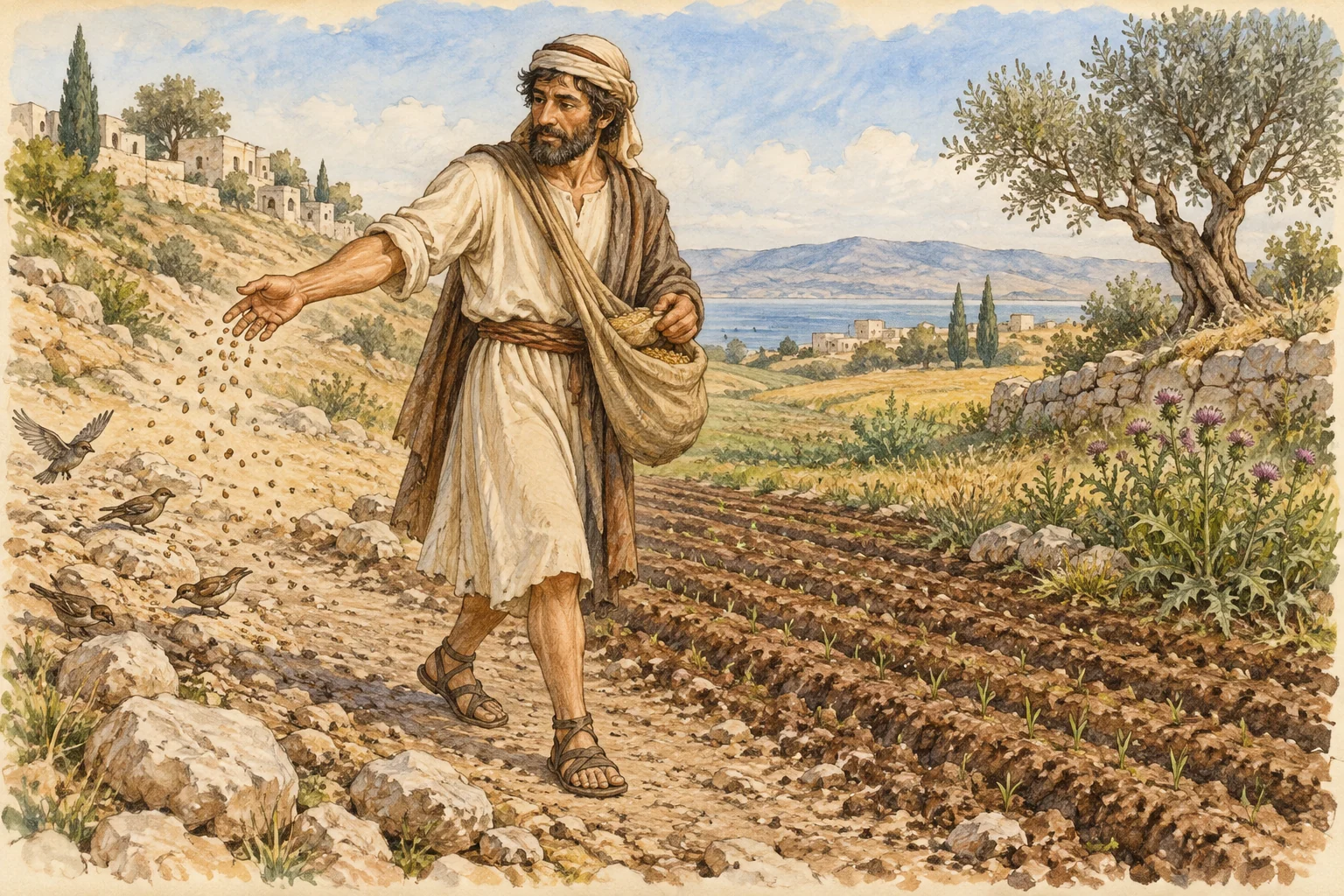
A parable of Christ uses a familiar scene to confront listeners with a question about God and their response to him. A field, road, family home, or banquet is recognizable. Yet the conclusion often unsettles expectations: an outsider shows mercy, while someone certain of being right fails to recognize a brother.
Read the Question Before the Story
Before explaining details, read the preceding verses. Who is speaking with Jesus? What is being asked? Who finds his words difficult? A parable is spoken within a particular encounter, not as an answer to every possible question. Read the ending too: a final exchange may change your understanding of the whole story.
Not every modern moral anecdote is a parable of Jesus. If a story arrives as a social-media image, look for its chapter and verse reference. A story may be helpful without having been told by Christ. Label a retelling as a retelling rather than substituting it for the Gospel text.
The Sower: Listening Instead of Labelling
In Matthew 13:1–23, Christ himself explains the story of the seed. The different soils show what happens to the word that is heard: it may not be received, may be abandoned when difficulty comes, or may be choked by cares. It is more useful to examine our attention than to classify acquaintances as different kinds of bad soil.
Ask what currently crowds out what you have heard. The response need not be a dramatic new promise. It might be one change, such as no longer postponing reconciliation or making time to read attentively. Fruit implies growth over time, not only a powerful reaction to a sermon.
The Samaritan: Becoming a Neighbour
In Luke 10:25–37, the question about one's neighbour is answered through assistance to an injured person. The Samaritan does more than feel sympathy: he stops, attends to the victim, and provides for continuing care. Christ moves the discussion from defining a circle of “my people” to acting mercifully.
This is not an instruction to enter every dangerous situation alone. Today, assistance may involve calling emergency services, finding a safe way to support someone, and involving people with relevant expertise. The point is not to abandon prudence but to refuse a convenient excuse for passing by another person's need.
Two Sons and an Unfinished Conversation
In Luke 15:11–32, read beyond the younger son's return to the father's conversation with the elder son. One returns from far away; the other is physically at home but cannot share the joy over his brother. The father's mercy reaches toward both. The ending asks listeners whether they will enter that joy.
Do not turn every object in a parable into a symbol invented on the spot. Begin with the text and its main movement, then consult the Church's interpretations, distinguishing them from personal associations. Fruitful reading is not the decoding of a secret message. It leads toward a more truthful understanding of God, our neighbour, and the next action we take.
When discussing a parable as a family, ask what surprised each person rather than testing for the correct answer. Return to the text and separate what it says from what you imagined. A narrative may describe an action without revealing every motive. Being able to say “the passage does not tell us that” encourages attentive reading and resists hasty judgement.
What connects the stories of the lost?
Luke 15 begins with objections to Jesus receiving sinners. The stories of a lost sheep, a lost coin and the two sons follow. Reading only about the younger son can obscure the question of joy: are the listeners willing to share in rejoicing over another person's return? The surrounding passage helps explain why the conversation with the elder son matters. It is not an unnecessary addition after the story has already reached a happy ending.
Notice the recurring movement from loss to recovery without treating every image as identical. A coin does not make decisions, whereas a person responds to love. Similarities reveal a shared theme but do not authorize transferring every detail from one story to another. Nor does each household object need an independent doctrinal meaning. Sometimes an object simply makes the situation recognizable. Begin with what the narrative actually emphasizes before consulting a fuller interpretation.
Application is not accusation
After reading about the sons, it is tempting to decide which relative is the real prodigal. Assigning roles to other people usually closes conversation. Instead, name a difficulty of your own: do I resent someone being given another chance, can I acknowledge my own departure, or can I rejoice without comparing achievements? These questions do not pretend to reveal a relative's hidden thoughts and do not turn the Gospel into a means of controlling them.
A modern example helps only when clearly identified as an example. A story about a colleague receiving help after a mistake may illuminate resistance to mercy, but it does not become another episode of the Gospel. In a family discussion, do not demand an immediate admission in front of everyone. Someone may need time to think privately. A small, freely chosen action, such as refraining from a cutting reminder of another person's past, is a better conclusion than obtaining the expected answer through humiliation. The passage can remain open for further reading rather than becoming a test everyone must pass.