
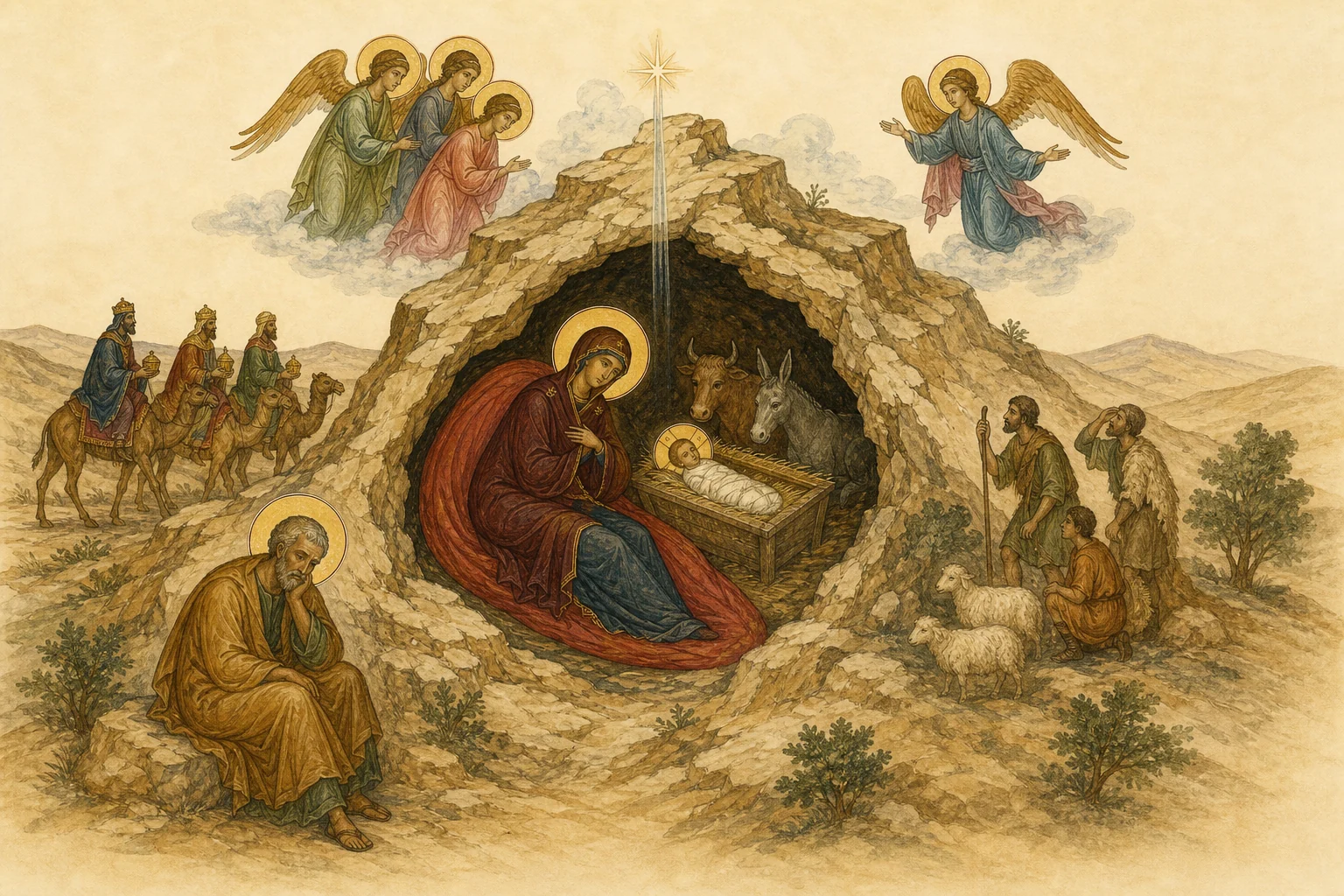
The Nativity of Christ is the feast of the Incarnation: Jesus Christ is born of the Virgin Mary and enters human life not as an outside observer but as a true human being. God accepts the vulnerability of infancy, the poverty of Bethlehem, and the fullness of our nature without sin.
Orthodox Christians do not celebrate the Nativity as a winter fairy tale or a family ritual for good fortune. The manger, shepherds, Magi, and star speak of the Savior who comes to everyone—the near and the distant, the poor and the learned, the confident and the searching.
The central meaning of the Nativity
Christian faith proclaims more than the birth of a great teacher. The eternal Son of God becomes human without ceasing to be God. This is called the Incarnation.
God does not save the world by issuing an order from a distance. He enters history, receives a human body, grows, works, suffers, and passes through death. Neither the weakness of an infant nor human pain remains foreign to Him.
Where the Gospels tell the story
Matthew speaks about Joseph, the star, the Magi, the flight into Egypt, and Herod’s violence. Luke narrates the census, the manger, the angelic message to shepherds, and their visit to the Child.
The accounts complement one another without supplying the precise minute of every episode. The Nativity icon gathers the events theologically rather than depicting one photographic second.
Why Christ is born in Bethlehem
Mary and Joseph travel to David’s city in connection with a census. The birth in Bethlehem joins Jesus to the messianic promise and the royal house of David.
His kingdom appears unlike Herod’s power. The Child lies not in a palace but in a manger; God acts through humility rather than coercion.
The cave, manger, and swaddling clothes
In the Orthodox icon, the Child is placed inside a dark cave. His bands and the shape of the manger recall burial cloths and a tomb, so the path toward the Cross and Resurrection is already visible.
The darkness represents a world in need of light. Christ does not wait for ideal conditions but enters human poverty and disorder.
The Mother of God and her free response
Mary is not a passive instrument. Her answer at the Annunciation is free and full of trust. At the Nativity the Church calls her Theotokos, Mother of God, because Jesus born from her is truly God and truly human.
Veneration does not place Mary in God’s place. Orthodox Christians give thanks for her faithfulness and ask the prayers of the Lord’s Mother.
The righteous Joseph
Joseph the Betrothed protects Mary and the Child, receives a difficult calling, and acts after angelic warnings. The icon often shows him seated apart in thought, acknowledging the reality of doubt and temptation.
His quiet service teaches that faith is not always the absence of questions; it can be faithfulness within incomplete understanding.
Why the shepherds arrive first
The shepherds receive the angelic message at night and go to the manger. Unnoticed workers become the first witnesses because God’s gift is not allocated by social position.
Their haste is not religious panic. They hear good news, examine it, worship, and return to ordinary life glorifying God.
Who were the Magi?
The Magi were wise men from the East who saw a star and set out to find the newborn King. The Gospel does not state their number or say that they arrived at the manger at the same moment as the shepherds.
The traditional number three comes from the three gifts: gold, frankincense, and myrrh. Their journey reveals that Christ comes to nations beyond Israel.
What the Bethlehem star means
The star leads the Magi to Christ and serves as a sign, not an invitation to construct a horoscope. The Gospel directs attention from the heavenly phenomenon to the Person of the Child.
A Christian need not identify an astronomical mechanism in order to receive the text. Astrology and fortune-telling contradict trust in God and human freedom.
Herod and the children of Bethlehem
The Nativity narrative contains darkness as well as light. Herod sees the Child as a threat, attempts to kill Him, and forces the family to flee to Egypt. The Church remembers the children killed in Bethlehem.
The feast does not close Christian eyes to war, refugees, or violence against children. God enters precisely such a world and calls His people to protect the vulnerable.
Why January 7 is used in Russia
The Russian Orthodox Church celebrates December 25 according to the Julian calendar, which corresponds to January 7 in the civil Gregorian calendar during the twentieth and twenty-first centuries. Some Orthodox Churches use another calendar arrangement and celebrate on civil December 25.
These are not two different births and not two faiths. The calendar system changes; the event celebrated is one.
The Nativity Fast and the Eve
The forty-day Nativity Fast prepares through prayer, abstinence, and mercy. Its final day is the Eve of the Nativity; the Slavic name is connected with a traditional grain dish.
Waiting for the first star can recall Bethlehem, but it is not a universal fasting requirement for children, the ill, and every layperson. Follow the church calendar and a personal rule rather than competing in hunger.
How the Nativity services are arranged
The liturgical order combines special Hours, Vespers, Liturgy, Great Compline, Matins, and the festal Liturgy; the distribution changes according to the weekday and local schedule. A parish commonly serves a vigil in the evening and Liturgy at night or in the morning.
Confirm the exact time. The word “vigil” does not mean that every parish service lasts through the entire night.
Holy Communion at the Nativity
The festal Liturgy naturally leads toward the Eucharist, but preparation includes more than completing a food fast. Prayer, repentance, reconciliation, and the parish order of Confession all matter.
If you have not received for a long time, contact the parish before the final day. A significant spiritual question deserves more than the crowded minutes before the Chalice.
The tree, gifts, and family meal
A decorated tree, presents, and festal food may express beauty, generosity, and family joy. They become a problem when purchasing and exhaustion replace the feast.
Set a limit on spending, choose gifts that truly support a person, and preserve time for worship and rest. The Magi’s gifts inspire giving rather than competition over price.
Carols and visiting neighbors
Nativity hymns and carols can carry the Gospel message from home to home. Respect personal boundaries, children’s safety, and the rules of the household.
Do not mix caroling with divination or mandatory payment. A good song, a visit to someone lonely, and help for a family express the feast more clearly.
Explaining the Nativity to a child
Begin simply: God became human and came to us as a Child. Look at an Orthodox icon, read Luke’s account of the shepherds, and explain why the family had no comfortable place.
Do not use Herod or divine punishment to frighten a child into obedience. Let the child choose a gift for someone in need and discover that Christian joy can be shared.
When the feast is lonely or painful
Images of perfect family happiness can wound someone who is bereaved, divorced, far from home, or ill. There is no duty to perform cheerfulness. Attend a shorter service, call a trusted person, or ask the parish for support.
Bethlehem was neither comfortable nor cloudless. Christ comes into a single room, a hospital, a night shift, and a home still learning to live after loss.
Work, travel, and an impossible night service
A clinician, driver, emergency worker, or parent of an infant may miss the night Liturgy. Necessary service to people does not make the Nativity lost.
Find a morning service, read the Gospel at home, pray before work, and do not endanger safety through sleep deprivation. The liturgical feast is wider than one midnight hour.
Nativity superstitions
The Church does not teach fortune-telling during the festive days, interpreting the identity of a first visitor, counting twelve dishes as a required rite, or demanding a sign about the future. Such actions replace trust in God with an attempt to control uncertainty.
Do not declare sewing, cleaning, or necessary work sinful. Reducing haste for prayer is good; fearing a household action as a magical violation is not.
A practical preparation plan
One week before, check the schedule, arrange Confession, complete major shopping, and choose an act of help. On the Eve, keep the fast according to strength, read the opening chapters of Matthew and Luke, and prepare for worship.
After the Liturgy, break the fast moderately, attend to loved ones, and remember someone alone. Continue festal joy during the appointed fast-free days rather than returning immediately to ordinary distraction.
Common questions
Why do Russian Orthodox Christians celebrate on January 7?
It is December 25 in the Julian calendar used by the Russian Orthodox Church. The difference concerns calendars, not a different event.
Must everyone eat nothing until the first star?
No universal requirement binds every layperson. The Eve is a fast day, but health, age, and the received church rule determine the measure.
May I receive if I did not keep the whole fast?
Do not decide automatically. Explain the circumstances to a priest, prepare according to ability, and follow his direction.
Are twelve dishes required?
No. That is a regional household custom, not a condition established by the Church.
May I greet Christians who celebrate on December 25?
Yes. Offer a respectful greeting without changing the calendar practice of your own parish.
The essential point
The Nativity announces that God has drawn near and entered the most vulnerable human life. Bethlehem’s poverty reveals the power of humble love.
Meet the feast through the Liturgy when possible, prayer, reconciliation, and mercy. The star, gifts, and meal will then point toward Christ instead of concealing Him.