
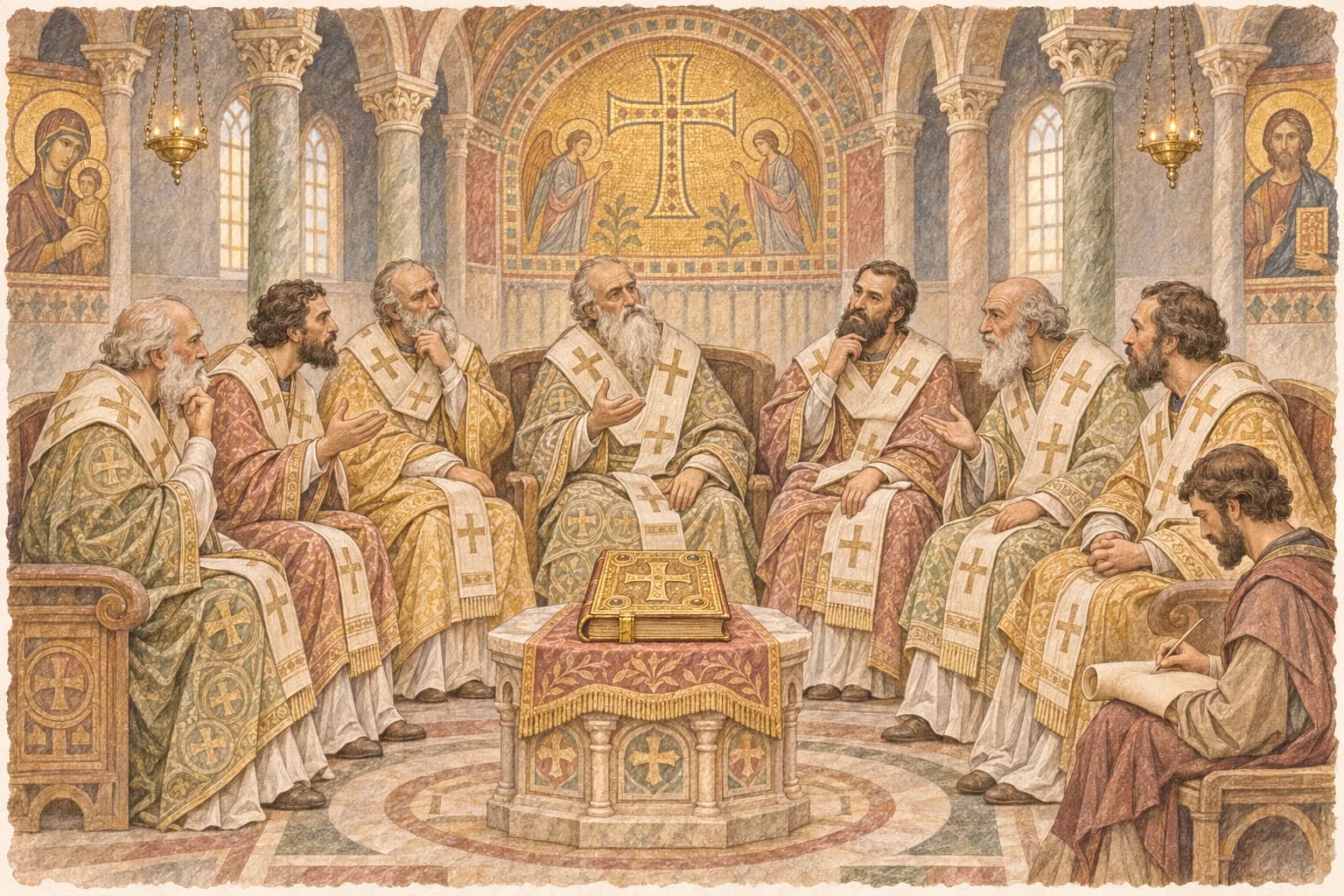
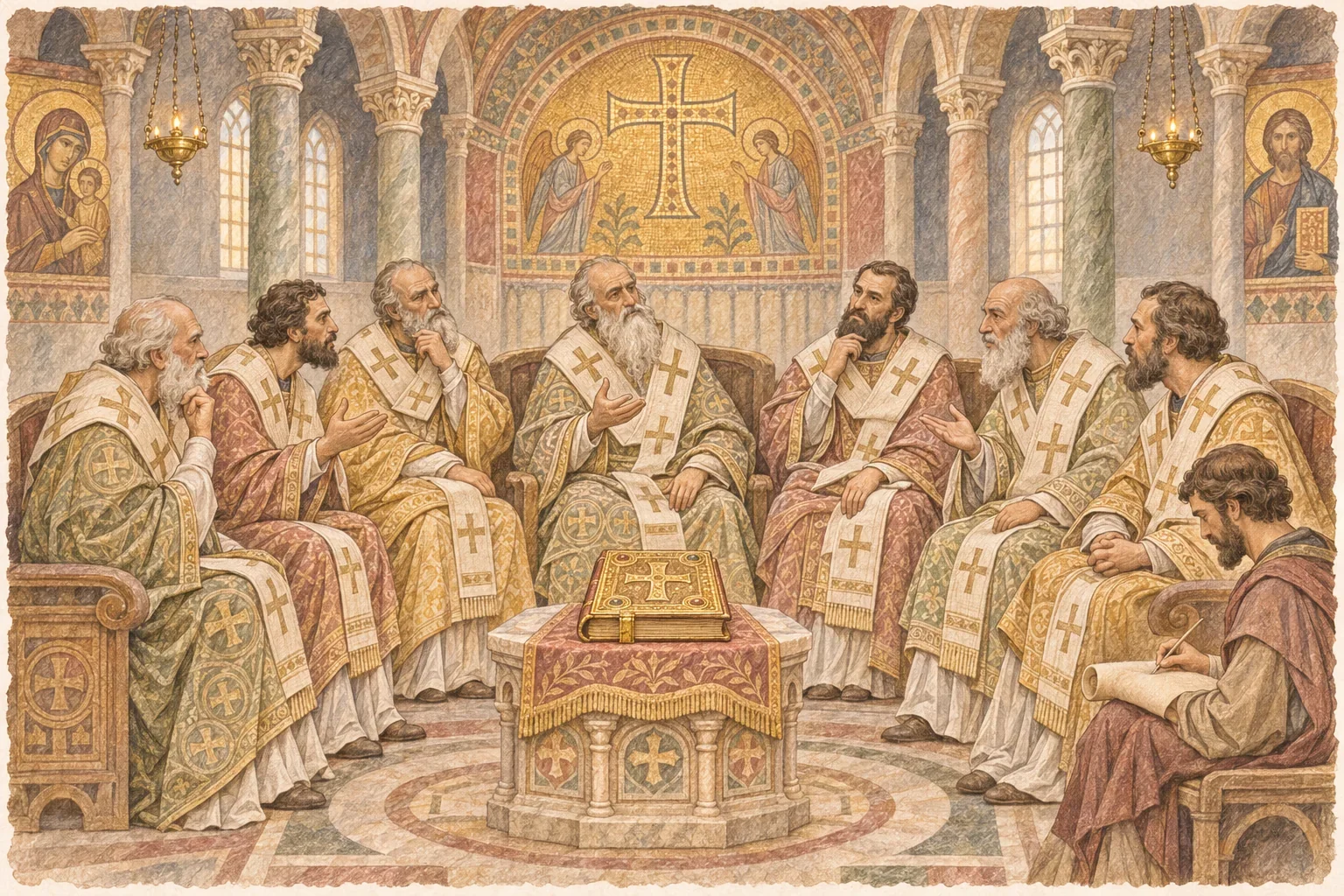
Standard Orthodox teaching enumerates seven Ecumenical Councils. Held between the fourth and eighth centuries, they addressed central doctrinal and ecclesiastical questions. The number seven does not mean the Church stopped meeting in councils afterwards.
The first two councils are especially associated with confession of the Trinity and the Creed; subsequent councils addressed Christological questions, and the seventh the veneration of icons. These are introductory landmarks, not substitutes for studying each council’s decisions and historical setting.
An Ecumenical Council should not be imagined as a vote that invented faith for the first time. The Church articulated and defended received apostolic witness. Nor does every large gathering of bishops automatically possess the same status.
Start with a short sequence of names, centuries and principal questions. Check a church textbook rather than an image with unsourced dates. Then choose one council and examine the substance of the faith it defended.
The first two councils and confession of the Trinity
The First Ecumenical Council met at Nicaea in 325. Central issues included teaching about the Son of God and opposition to Arianism. Confessing the Son as of one essence with the Father excluded the idea that he was a created being, however exalted above the rest of creation. The council also addressed matters of church order, so reducing all its work to a single brief formula would be incomplete.
The Second Ecumenical Council met at Constantinople in 381. It is associated with affirming Orthodox confession of the Trinity, including teaching concerning the Holy Spirit. The Nicene-Constantinopolitan Creed recalls these two conciliar stages in the Church’s usage. Beginners should first understand the confession’s meaning and then explore the detailed history of texts and participants.
The third and fourth: who is Jesus Christ?
The Third Ecumenical Council met at Ephesus in 431. In the controversy associated with Nestorius, the unity of Christ’s person was central. Calling the Virgin Mary Theotokos concerns the identity of the one born from her according to his humanity: not a separate human alongside the Son of God, but the incarnate Son himself. It does not mean that divinity began to exist through a human mother.
The Fourth Council met at Chalcedon in 451 and confessed the same Christ in two natures, divine and human. The definition preserves the fullness of both natures and unity of person. It opposes both confusion that destroys genuine humanity and division into two independent subjects. Studying the meaning is more helpful than mechanically memorising labels for controversies.
The fifth and sixth: further Christological clarification
The Fifth Ecumenical Council met at Constantinople in 553. Its decisions belong to Christological debates and the interpretation of earlier definitions. Proper study requires historical context, including the controversy over the so-called Three Chapters. A short council list cannot replace examining which writings and interpretations were discussed and why the issue mattered for ecclesial unity.
The Sixth Council met at Constantinople in 680–681. It confessed two natural wills and two natural operations in Christ, corresponding to his two natures. This is not a doctrine of two personalities struggling against one another. It affirms that the assumption of human nature is real and includes a human will: Christ’s humanity is not reduced to a passive shell for divinity.
The seventh council and the veneration of icons
The Seventh Ecumenical Council met at Nicaea in 787 and defended the veneration of icons during the iconoclastic controversy. It distinguishes veneration of an image from the worship belonging to God alone. Honour offered to the image relates to its prototype; the panel and paint are not declared an independent deity. This distinction is essential to understanding Orthodox practice concerning icons.
The decision does not authorise every religious fantasy in visual form. The image’s content, relation to church faith and proper understanding of veneration still matter. Nor did every historical conflict disappear immediately on the day of the council. A conciliar definition and the subsequent history of its reception are related but distinct subjects of study.
Why conciliar life continued after the seven councils
Enumerating seven Ecumenical Councils does not mean that the Church stopped gathering and making decisions after the eighth century. Local and other councils have their own places in church history. Yet a large attendance or an impressive title does not automatically add a meeting to the commonly received list. Its content and ecclesial reception matter, not simply the event’s size.
For an introduction, write a sequence: Nicaea 325, Constantinople 381, Ephesus 431, Chalcedon 451, Constantinople 553 and 680–681, and Nicaea 787. Add each council’s principal question beside it. Then choose one subject and read a sourced educational explanation. This makes it easier to see beyond the dates to the living question of what the Church confesses and which distortion it rejects.
A question for reflection
Which particular council’s central question would you like to understand?