
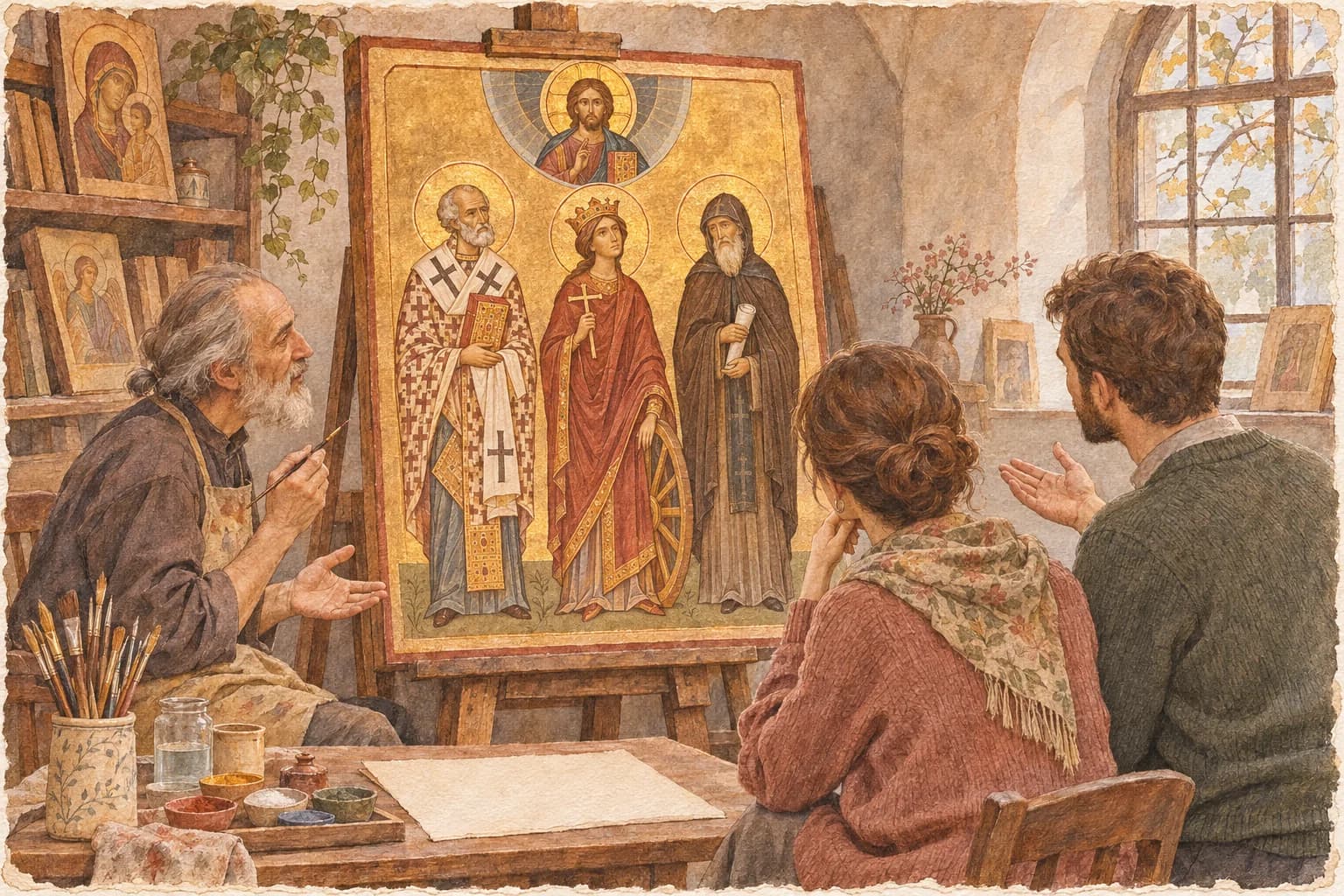
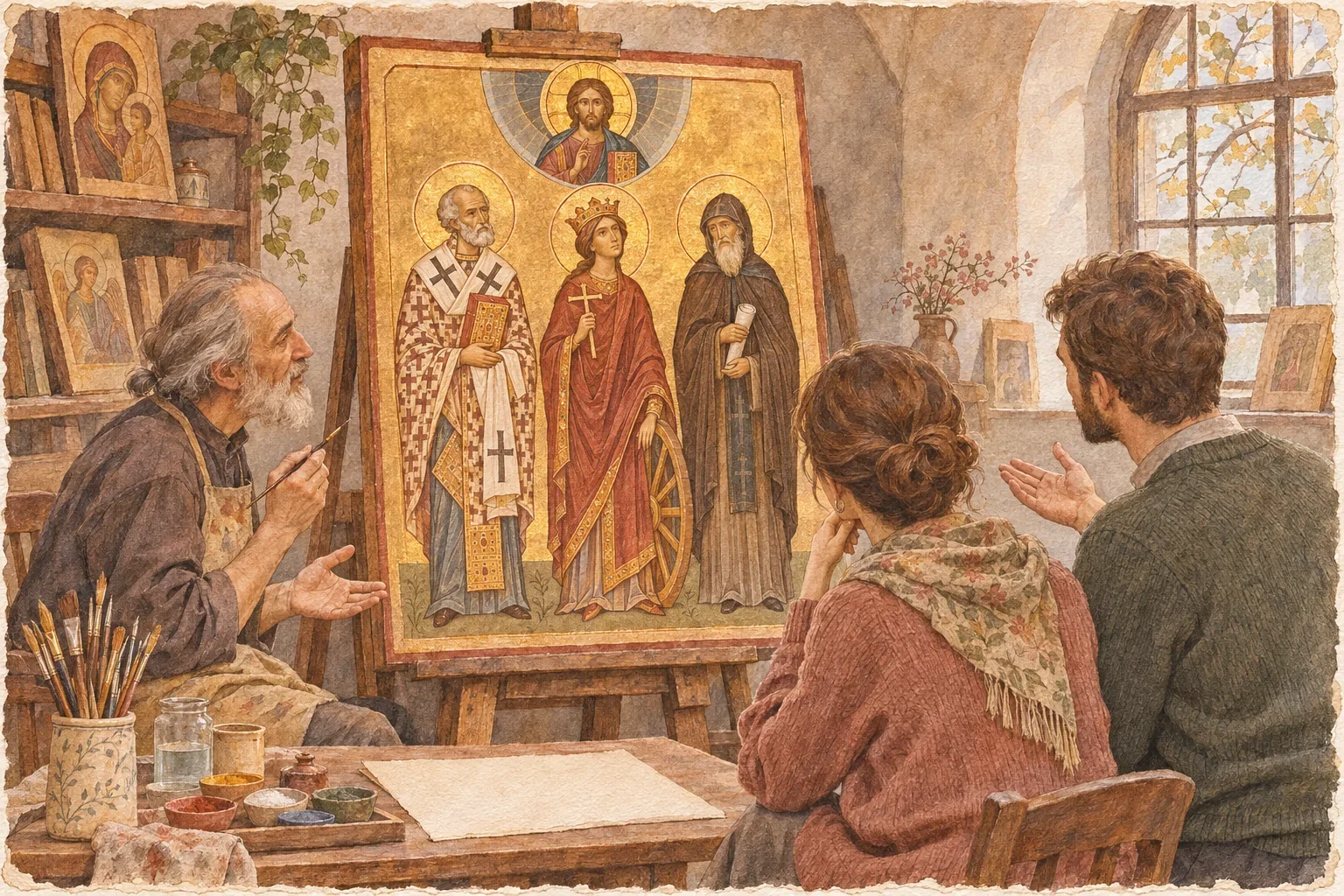
A family icon commonly depicts the patron saints of family members. There is no single obligatory composition for every family. Establish the particular saints from baptismal names before commissioning it, rather than selecting arbitrary namesakes.
Give the iconographer the saints’ full designations and discuss the composition. Modern nicknames do not always identify a patron. If information is missing, ask the parish before expecting an artist to guess.
A family icon is not a certificate of a flawless marriage or a guarantee against conflict. An expensive image does not replace respect and care. Divorce or bereavement does not make the icon spoiled simply because the family’s circumstances changed.
Discuss size, placement, budget and timing carefully. Consult the family when giving a gift if faith or names are uncertain. The image belongs to prayer and remembrance, not an obligation to display it to visitors.
Identifying the family’s patron saints
The first step is to gather baptismal names and information about the saints after whom family members were named. A personal name alone may be insufficient: the calendar contains several saints named Alexander, Anna or Mary. If a baptismal certificate or a record of the name day survives, start there. Do not select a saint simply because that image appeared first in a search or seemed more attractive than another.
When information is missing, there is no need to invent a precise history. Discuss the question with a priest and clarify the family member’s patron calmly. Meanwhile, postpone the commission or choose an ordinary icon of Christ or the Mother of God for the home. A specially commissioned family icon is not a prerequisite for prayer; its absence does not make family church life incomplete. Particular care is needed when a surprise gift is being planned and the giver does not know the exact names.
What to discuss with the iconographer
Give the artist the saints’ full designations: not merely Nicholas, for example, but Nicholas, Archbishop of Myra in Lycia, if he is the intended patron. Agree on the number of figures, the panel’s dimensions and its intended location. Too many figures on a small panel can leave faces and inscriptions difficult to distinguish. A preliminary design helps the family assess the composition and correct an identification before the painting is complete.
Discuss materials, technique, cost, timing and care requirements. Practical clarity is appropriate when commissioning a sacred object and protects both parties. Artistic preferences should not turn the icon into an arbitrary family collage, however. An iconographer works within the Church’s tradition of depicting saints. Requests for ordinary family portraits or invented symbols require considered discussion rather than automatic inclusion.
When the family’s circumstances change
A birth, remarriage, bereavement or divorce may change a household, but the saints already depicted do not thereby cease to belong to the Church. An icon should not be destroyed or hastily repainted merely because family circumstances have changed. Remembrance of patron saints can continue even when relationships between people are difficult. Decide respectfully who will keep a shared sacred object, without using it as a means of pressure.
If the family wishes to add a saint, consult the iconographer first: not every completed composition can be altered without damage. A separate small icon may be the more appropriate choice. When inheriting an icon, record whom it depicts, who commissioned it and which family events are associated with it. Such notes preserve memory for children while distinguishing known facts from relatives’ later assumptions.
Making the icon part of prayer at home
Place the icon where people can pause before it and where it is protected from damp, heat and accidental damage. There is no requirement for an elaborate interior or an expensive lamp. Children can begin with names: identify their saint, tell one understandable episode from that saint’s life and explain why Christians ask saints to pray with them. A patron is not the child’s duplicate, whose every external circumstance must be copied.
Shared prayer is more likely to grow through a modest, steady practice than through compulsory lengthy readings that become a source of arguments. Choose a brief time when the household can actually gather, taking participants’ ages into account. If someone does not share the faith, displaying the family icon should not become a condition of being welcomed at home. Its meaning emerges through turning to God, remembering the saints and caring for one another; the cost of the artwork cannot create that life by itself.
Is a family icon the same as a wedding icon?
Not necessarily. A wedding pair commonly means icons of Christ and the Mother of God associated with the couple’s blessing and crowning. A family icon depicting patron saints has a different compositional purpose. Both may belong in the same home without competing with each other. Before buying a gift, clarify which image the family means: everyday terminology can be imprecise.
If funds are limited, there is no obligation to commission an elaborate composition to satisfy someone else’s idea of a proper household. The image should be understandable to those praying before it. Learning about the family’s saints and caring for icons already owned are more useful than a hurried, expensive purchase.
A question for reflection
Are all the proposed saints actually the family members’ patrons?