
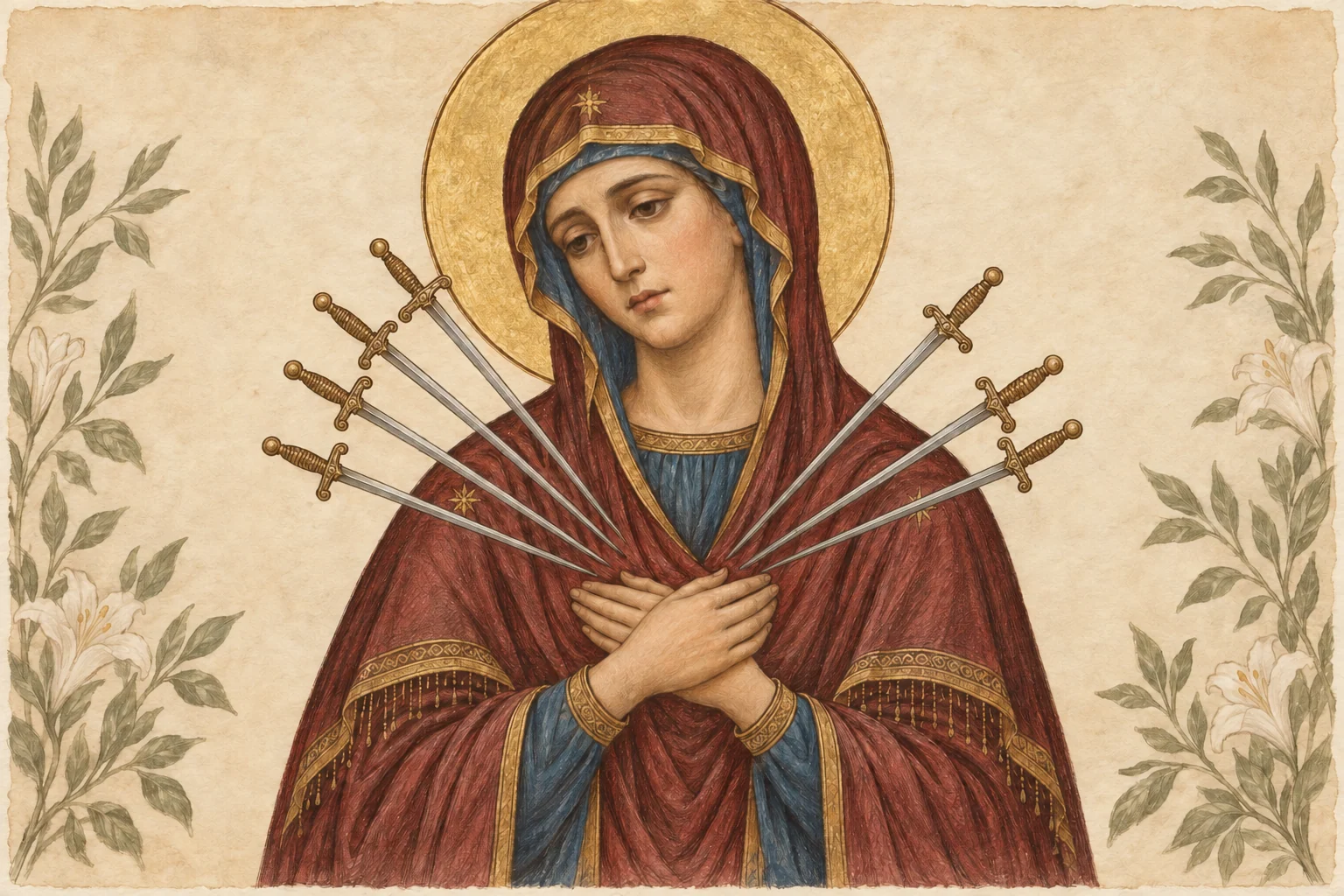
The Seven Arrows icon depicts Mary without the Child, with swords or arrows directed towards her heart. It expresses suffering and compassion rather than a plan for an invisible security system. Its meaning becomes clearer through Simeon's prophecy in the second chapter of Luke, not through instructions about finding the correct wall in a house.
Simeon's Prophecy
At the presentation of Jesus in the Temple, Simeon tells Mary of the opposition her Son will encounter and of a sword passing through her soul (Luke 2:34–35). This is not a prediction of a literal injury inflicted by seven objects. The icon makes visible the depth of maternal sorrow associated with Christ's suffering.
In this reading, seven conveys the fullness of grief, not seven unavoidable attacks, illnesses, or enemies. There is no need to extract a personal prediction from the composition. Encountering the icon during a difficult day does not constitute a sign that disaster must be approaching one's family.
Related but Distinct Images
The Seven Arrows composition normally groups the weapons as three and four. In Softener of Evil Hearts, also called Simeon's Prophecy, the traditional arrangement is three on either side and one below. Their meaning is closely related, and their names are often confused in everyday usage. Precise identification should consider both the inscription and the actual arrangement.
This does not mean that one icon deals with domestic arguments and the other with external enemies. Sacred images do not have separate administrative responsibilities. If a prayer book uses one title and a household icon another, calmly clarify the composition rather than fearing that prayer has been sent to the wrong address.
Tradition and Its Limits
Church tradition associates the Seven Arrows image with the Vologda region and the discovery of a panel previously unrecognised as an icon. Its principal Russian observance is civil August 26, corresponding to Julian August 13. The discovery narrative must be distinguished from the independently documented history of a particular modern copy.
A seller's guarantee of protection from envy is not Church teaching. Provenance, the quality of the image, and a suitable size can be assessed; guaranteed power over other people's thoughts cannot be purchased. Nor can the behaviour of a candle reliably disclose which person supposedly wishes a family harm.
Reconciliation Without Coercion
Prayer before the image may ask for the softening of one's own heart, an end to hostility, and help with a peaceful conversation. A practical continuation might be pausing before a harsh reply, refusing to repeat a humiliating story, or listening carefully. This does not mean that every conflict is your fault or that one participant can carry all the responsibility for repairing it.
Where violence is involved, reconciliation must not be interpreted as an obligation to return to danger. Protecting oneself and children, seeking help, and maintaining reasonable boundaries are compatible with prayer. Place the icon somewhere clean and convenient for worship, without calculating a protective radius. The important question is not how its arrows align with a doorway, but how a person learns to hold truthfulness, compassion, and responsibility together.
Avoid telling a relative that an icon is being installed to make them stop being angry. That turns it into a reproach. Offer shared prayer, then separately discuss the specific behaviour causing harm and requiring change.
Why the Arrows Are Not Aimed at an Enemy
The weapons point towards the Mother of God; they are not shown as instruments for attacking other people. That observation already distinguishes an image of compassion from the idea of an icon sending harm back to a particular neighbour or relative. If attention fixes on counting arrows while forgetting who is depicted, prayer can become a search for someone to blame and punish.
The relationship between Seven Arrows and Softener of Evil Hearts also has a liturgical expression. The OCA description notes that they share a troparion and kontakion. Distinguishing the arrangement of the weapons helps identify images accurately, but does not require opposing their meaning in prayer. Understanding the plea to overcome hardness of heart matters more than anxiously selecting a supposedly exclusive effective version.
Naming Hurt Without Labelling the Person
In an ordinary family disagreement, name a particular action rather than passing a final judgement on someone's character. Explain, for example, that interruptions prevent you from finishing a thought, and ask for a few minutes to answer. That differs from declaring that the other person has an evil heart and needs the icon to correct it. A religious title should not become a way to win an argument while denying someone the opportunity to explain.
Where conversation is safe, agree to pause when tension rises and decide when to return to the subject. Where threats or violence are present, this conversational measure cannot substitute for protection and appropriate assistance. Softening your own heart does not mean refusing to recognise harm. Prayer before the image can join a wish not to take revenge with a determination to stop dangerous conduct. These responsibilities are compatible; reconciliation must not be purchased at the expense of the injured person's safety.