
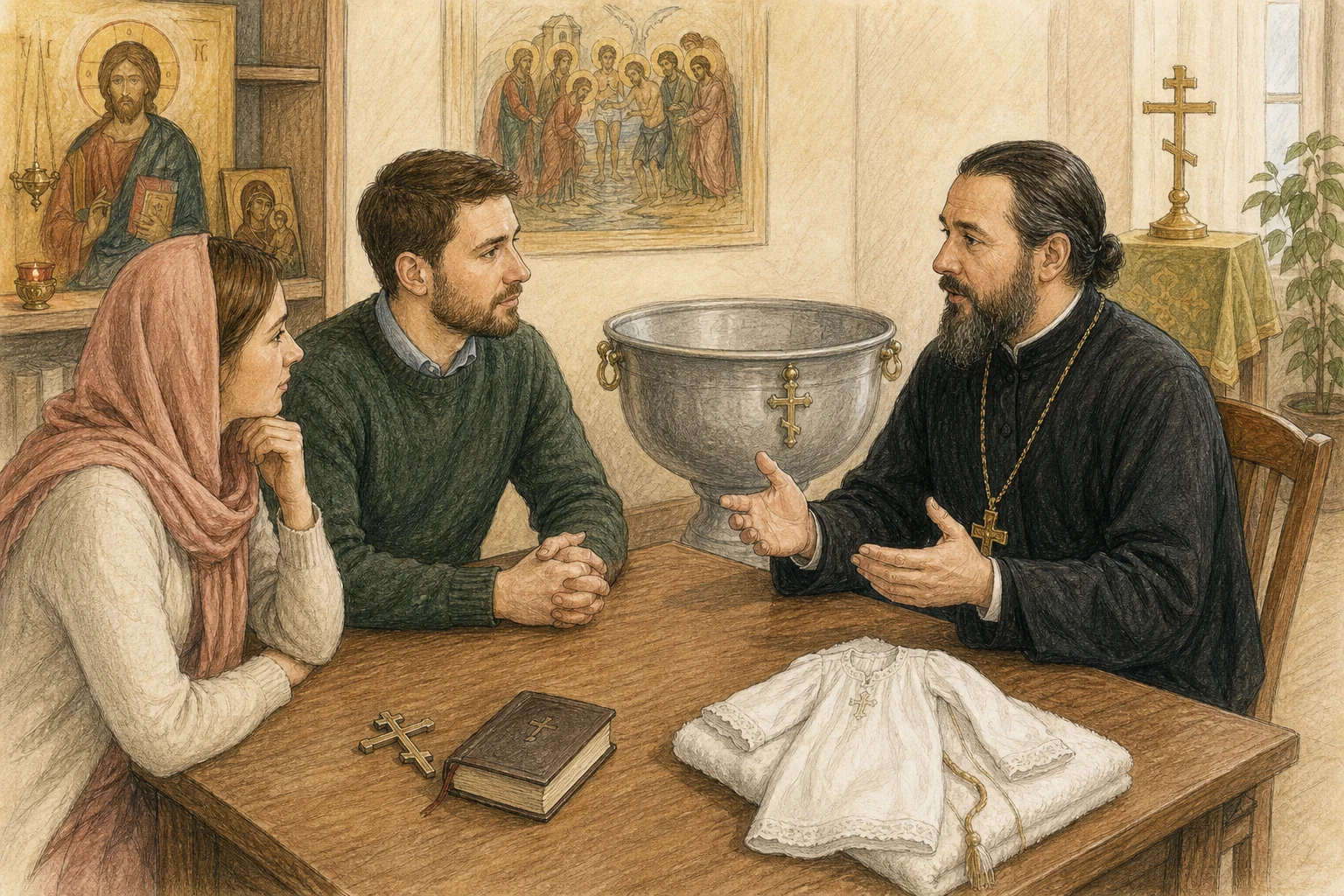
A godparent should be an Orthodox Christian who understands the Creed, attends the required preparation, and is ready to help a child live in the Church for years. The central role is not buying a cross or organizing a celebration but praying, setting an example, and helping with Communion, confession, and questions of faith.
Ordinarily a boy needs a male sponsor and a girl a female sponsor; a second godparent is a widespread custom. Exact requirements must always be confirmed with the parish before people are invited.
What a sponsor is
The Church word “sponsor” or “godparent” is connected with receiving the newly baptized from the font and confessing the faith on behalf of an infant. The sponsor becomes a spiritual relative and witness to the promise of Christian formation.
This is not an honorary role for one day. It implies prayer, relationship, and responsibility continuing after the photographs and family meal.
Who may become a godparent?
A baptized Orthodox Christian able to confess the faith consciously and participate in Church life is suitable. The person should understand the promise and be able to support the child through regular communication and prayer.
The parish assesses age and practical maturity. A nominally chosen teenager or adult who explicitly rejects the faith and agrees only to please relatives cannot fulfill the ministry.
Who may not serve?
A child’s biological father and mother do not become that child’s sponsors. A person of another religion or an unbaptized person cannot confess Orthodox faith on behalf of the Church. A married couple is ordinarily not chosen together as the two sponsors of one child because of the spiritual relationship created.
Other canonical or pastoral restrictions may apply. Do not finalize the names from an article alone. Tell the priest about proposed sponsors in advance, especially when family relationships are complicated.
Is one enough, or are two required?
Orthodox tradition regards one sponsor of the corresponding sex as sufficient: a man for a boy and a woman for a girl. Two godparents, one man and one woman, have become a common family practice and may share the work.
Number is less important than faithfulness. One believing and responsible sponsor is better than two accidental people who disappear after the celebration. Confirm any parish administrative requirement.
Why friendship and wealth are not the criteria
A close family friend does not automatically become a spiritual mentor. Ask not “what gift can this person afford?” but whether he or she prays, worships, can face difficult questions, and will remain connected when circumstances change.
A candidate’s honest refusal deserves respect. “I am not ready” is better than a promise made from social pressure.
What should a godparent know about the faith?
A sponsor should understand the basics: who Jesus Christ is, the Holy Trinity, Baptism, Chrismation, the Church, confession, and Communion. The Creed must not be read as an unknown password.
Our detailed guide explains the Creed in simple language. Questions should be brought to the catechetical meeting.
Why catechetical preparation is needed
A conversation helps parents and sponsors understand the sacrament, its actions, and the responsibility that follows. It is neither a bureaucratic barrier nor an examination designed to reject people; it prevents blind promises.
The parish explains the number and format of meetings and any documents. If a sponsor lives elsewhere, ask whether preparation may be completed in that person’s local Orthodox parish with confirmation.
What the sponsor does during Baptism
The sponsor participates in the renunciation of evil and union with Christ, recites the Creed, holds the child when directed by the priest, and receives the child after the font. The sponsor then assists during Chrismation and the procession around the font.
Do not grab the child or direct the service independently. Listen to the priest; roles are assigned according to the child’s sex, the space, and safety.
What should be learned beforehand?
Understand and, if possible, memorize the Creed, the Lord’s Prayer, and basic brief prayers. If nervous, keep a printed text nearby. Attentive reading is better than a confident rush through words that have no meaning for the speaker.
Ask which language will be used and who will recite the text. Practice aloud so that unfamiliar liturgical forms do not become a surprise at the font.
Spiritual preparation
A parish may recommend confession, Communion, fasting, and prayer. The measure should account for health, pregnancy, work, and actual Church experience; candidates should not impose extreme rules on one another.
It is important to seek reconciliation, reject a merely formal role, and tell the priest honestly about doubts. The sacrament does not demand the performance of perfection, but it does call for a truthful intention.
What to bring
The list often includes a baptismal cross, shirt or garment, large towel, cloth, and a change of clothes. For an infant, bring diapers, normal feeding supplies, and warm clothing appropriate to the season.
The family decides who purchases each item; this is not a theological obligation assigned to the sponsor. Confirm the cross size, safe cord or chain, and parish requirements.
Clothing and practical readiness
Choose modest, comfortable clothing and footwear suitable for standing and holding a child safely. A woman can ask about the parish custom regarding a head covering; a man removes his hat in church.
Avoid long accessories that could fall into the font and strong perfume near an infant. Arrive early and silence the phone.
A sponsor who lives in another city
Distance does not by itself remove responsibility when a person keeps contact, prays, and visits when possible. The sponsor ordinarily participates in the sacrament in person. Merely writing down the name of an absent person does not automatically create sponsorship.
Discuss the situation before setting a date. Do not promise that a priest will necessarily approve a sponsor “by proxy.”
What to do after Baptism
Learn when the child should first receive Communion and help the parents come. Remember the baptismal day and name day, and give not only objects but time, shared prayer, and an age-appropriate book.
Our article on the first steps after a child’s Baptism provides a practical plan. Put actual meetings into a calendar rather than relying on vague intention.
If the parents rarely attend church
Do not make every visit an accusation or take over the parents’ place. Offer specific help: attend a short service together, explain preparation for Communion, or care for younger children while the family participates.
At the same time, do not pretend that the promise means nothing. Preserve prayer and relationship calmly, and discuss serious conflict with a priest.
Can a godparent be replaced?
Sponsorship in a completed Baptism is not reassigned like a document entry. If a godparent disappears, dies, or abandons the faith, another reliable Christian may become an important mentor, but that person does not retroactively participate in the past sacrament.
Do not leave a child without support because of the formal absence. Parents, parish members, and other believers can help the child grow.
Privacy, photographs, and family boundaries
Ask the parents before posting any images of the child or naming the sacrament publicly. A godparent’s spiritual role does not grant unlimited access to the child’s private life or authority over parenting decisions.
Respect parental safety rules and resolve disagreements without using the baptismal promise as leverage. Spiritual kinship should deepen trust, not control.
Frequently asked questions
May a husband and wife sponsor the same child?
Ordinarily they are not chosen together because of the spiritual kinship created between sponsors. Existing marriage and particular relationships must be discussed with the priest beforehand.
May a pregnant woman become a godmother?
Pregnancy itself does not make her incapable. Health, ability to hold the child, and parish requirements should be considered.
May someone sponsor several children?
Yes, when the person can actually pray, communicate, and accept responsibility for each rather than accumulating honorary roles.
Must a godparent pay for the Baptism?
No. Family financial arrangements do not define spiritual ministry. Questions about a parish donation should be addressed without treating the sacrament as a sale.
What if the sponsor does not know the Creed?
Attend preparation, study the text, and learn to recite it with understanding. If the person does not share the faith, another candidate should be chosen.
A short checklist
Confirm the candidate with the parish; attend catechesis; understand the Creed; clarify confession and Communion; prepare clothing and supplies; arrive early; and make a real plan for prayer and contact afterward.
Preparation can begin through the parish contact page and schedule. A good godparent is not perfect, but believes, learns, and remains present.