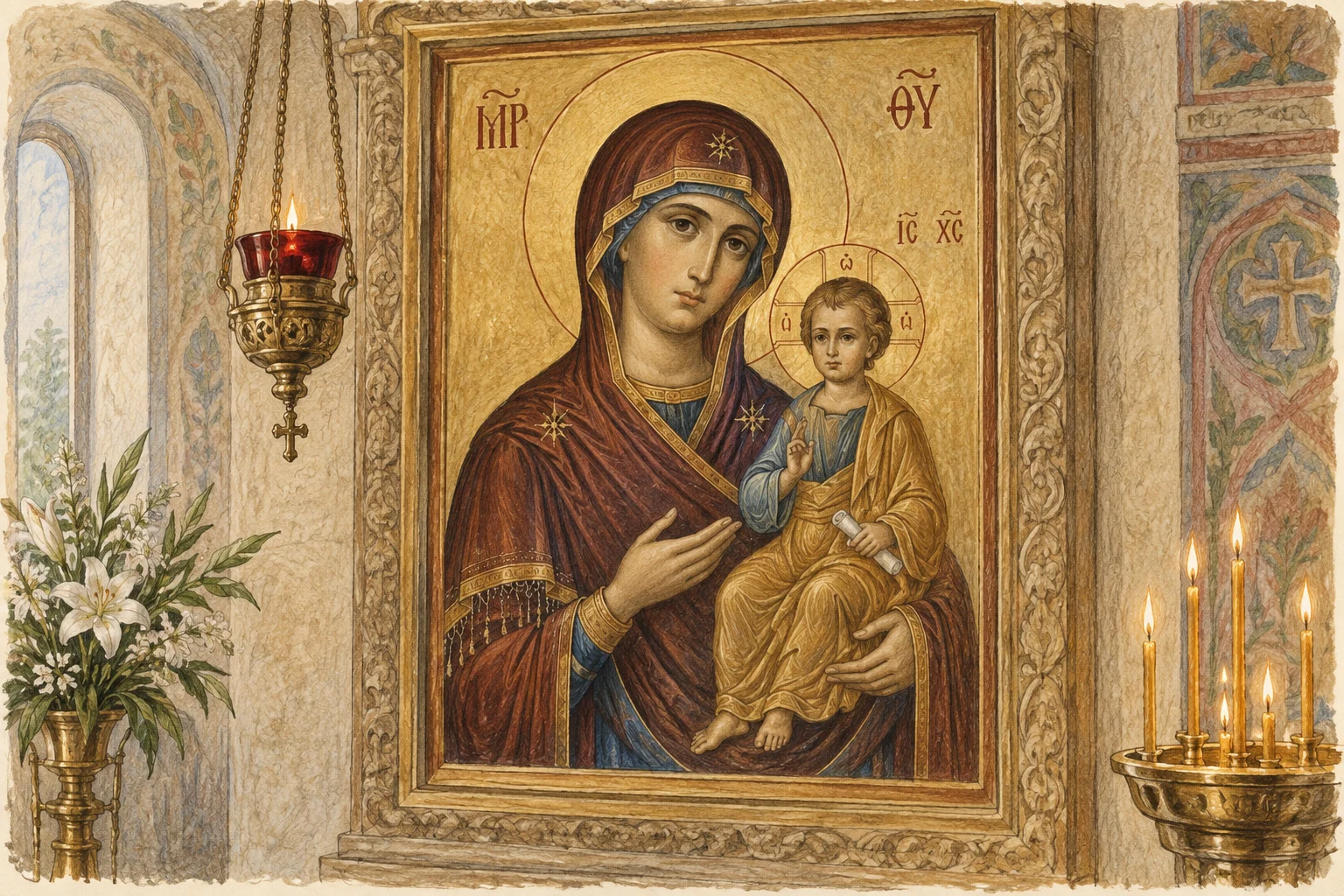
Hodegetria is commonly translated as Guide or She Who Shows the Way. In the Smolensk icon this does not promise faultless navigation or special control over transport. The Mother of God points towards Christ: the way presented by the image concerns him first of all. This is the best starting point for both historical interest and personal prayer.
Reading the Gesture
Mary supports the Child with one arm and directs attention towards him with her other hand. Christ blesses; his presence is not absorbed into a maternal embrace. The restrained composition faces the worshipper and challenges the wish to seek consolation apart from the Gospel. The Mother presents her Son rather than replacing him.
This helps distinguish Hodegetria from Tenderness compositions, where the meeting of the faces carries particular visual weight. It does not divide Mary into a stern version and a kind version. The same person is depicted. Different iconographic arrangements communicate different aspects of a single ecclesial faith.
The Smolensk Name
The Church's narrative connects the image with Byzantium, a princely family, and Smolensk. The tradition of its presentation to Princess Anna belongs to the eleventh century; its later association with Smolensk supplied its familiar name. Russian Julian-calendar churches celebrate the main commemoration on civil August 10, or Julian July 28. Not every detail of the early tradition is independently documented.
Distinguish the ancient object, later copies, and the iconographic type itself. “Smolensk” written on a family icon does not prove that its panel ever stood in that city. It may identify the model followed by the painter. Dating and provenance require evidence about that particular object rather than reliance on a familiar name.
Asking for Guidance
Prayer before a journey, a significant decision, a course of study, or an attempt at reconciliation is entirely appropriate. Asking for guidance does not remove the need to check a route, prepare documents, or take responsibility for a decision. An icon in a car grants no special right of way and cannot make dangerous driving safe.
When a choice is difficult, separate prayer from a demand for a sign. Ask for discernment, discuss the actual circumstances with a competent person, and make a considered decision. Do not declare every coincidence a revelation. The angle of an icon, a reflection in its glass, or the position of a candle is not a reliable answer to questions about work, marriage, or health.
Introducing the Icon to a Child
Invite a child first to find the Child Jesus and then to follow the direction of Mary's hand. “She is showing us Christ” explains the composition more faithfully than a list of supposed protective properties. A short Gospel account of someone's encounter with the Saviour can then open a conversation about listening to him.
The same sequence helps an adult: look, understand the name, pray, and consider the next responsible action. The feast does not require a journey to a distant shrine. Taking part in one's own parish and helping a neighbour can give prayer a concrete continuation. Ordinary life should not be treated as spiritually empty compared with pilgrimage. The way towards Christ begins before a ticket is bought, and continues when the traveller returns home.
For a family discussion, ask what helps someone choose an honest path today. The answer need not be grand: checking a doubtful message before forwarding it, or refusing to exploit another person's confusion, makes guidance concrete.
How a Journey Becomes a Local Memory
In the Church's account of the Smolensk image, its presentation to Princess Anna and Vladimir Monomachos's later transfer to Smolensk are separate stages. That sequence explains why the tradition's Byzantine setting is compatible with a Russian geographical name. An image can acquire its familiar name through the community that receives it, rather than on the day it is painted.
This gives a useful reading distinction: brought to a city does not mean painted there. A photograph labelled with a church's name may similarly identify a place of veneration without establishing origin. In a family history, separate what is known about relatives passing on a particular icon from the general history of the Smolensk Hodegetria. The stories may share a title and composition without sharing the same wooden panel.
Seeking Direction Without Surrendering Responsibility
The name Guide is particularly meaningful when a difficult decision lies ahead. Distinguish asking for help from wanting to escape responsibility. In considering a job, for example, write down its duties, conditions, implications for the household, and questions still unanswered. Prayer does not oblige you to treat the first offer as the only predetermined choice, nor does it prohibit further investigation.
If advice conflicts with what you want, consider the reasons offered rather than immediately looking for a confirming sign before the icon. At the same time, even well-intentioned advice does not replace your consent. Mary pointing towards Christ invites attention to the direction of a life, not a complete map of every practical decision. Sometimes the next honest action is refusing deception, asking a clarifying question, or admitting that a decision is not yet ready. This is more modest than a promise of infallible guidance, but more useful in the circumstances people actually face.