
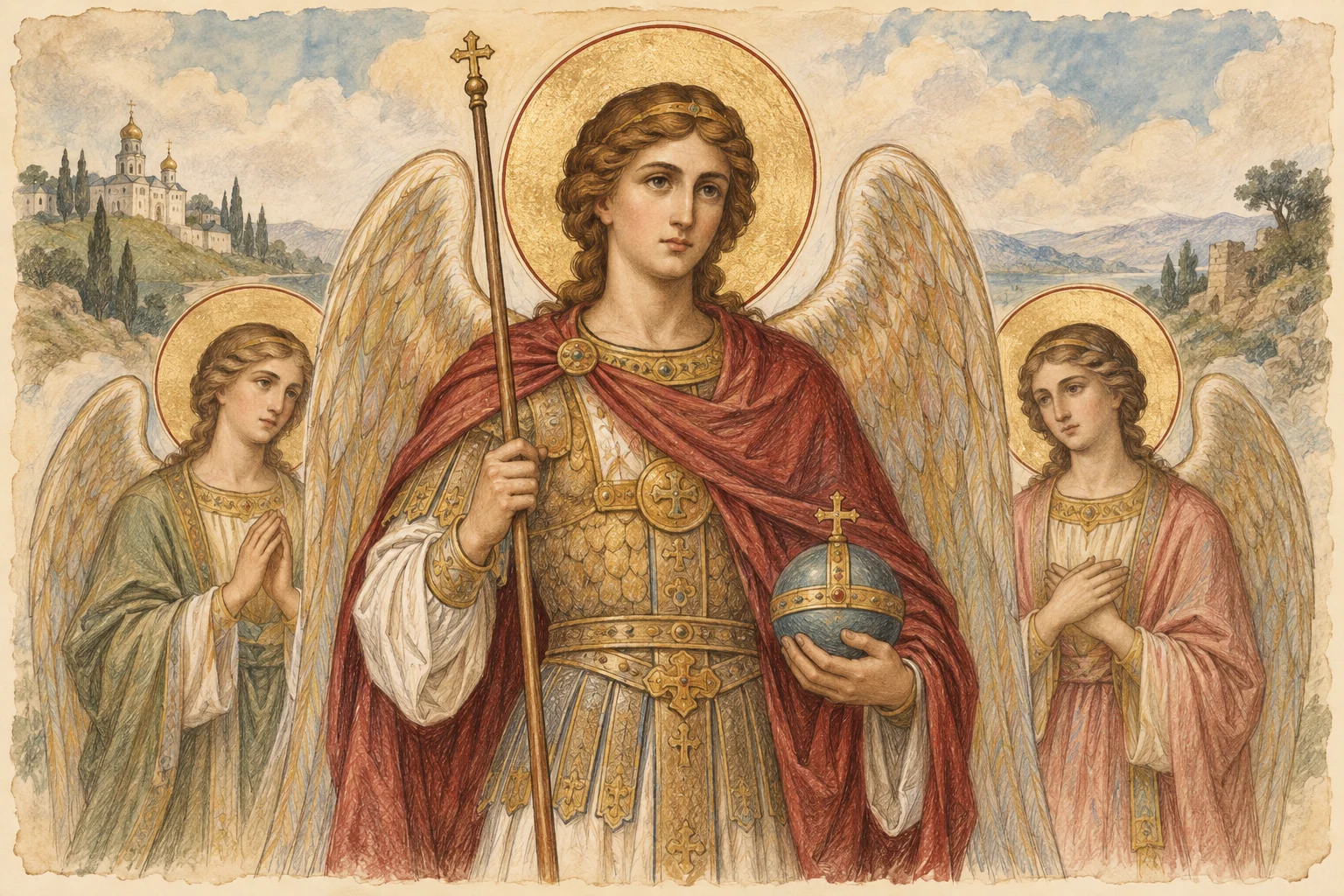
The Synaxis of Archangel Michael and the other Bodiless Powers is celebrated in the Russian Orthodox Church on 21 November in the civil calendar, corresponding to 8 November in the Julian calendar. The feast honours all the holy angels, not Michael alone.
What does Synaxis mean?
Synaxis means a gathering or common celebration. It does not mean a cathedral building. “Bodiless” means angels do not possess human bodies. Wings in an icon belong to the language of imagery, not an anatomical description.
Michael as commander
Archistrategos means chief commander. Michael’s biblical role concerns service to God and resistance to evil. He is not an independent source of power operating apart from the Lord.
Michael appears in Daniel, Jude and Revelation. These passages must be read with attention to their literary setting. Prophetic and apocalyptic images are not practical instructions for manipulating hidden forces.
The angelic ranks
Church tradition speaks of nine ranks: Seraphim, Cherubim, Thrones, Dominions, Powers, Authorities, Principalities, Archangels and Angels. English translations of some rank names vary. Their purpose is to speak about heavenly service, not to supply a catalogue of spirits available for human use.
The feast and a personal patron
The common feast of the heavenly powers includes gratitude for angelic help. It does not replace the commemoration of the saint whose name a person bears. A name day relates to that patron saint. If you are uncertain about your baptismal patron, ask rather than identifying one solely through a date calculation.
Prayer, not esotericism
Use the Church’s prayers to ask for help in a good life and protection from evil. Zodiac signs, calculations of a “personal archangel”, secret names and paid rituals are not required. Christian prayer does not bring heavenly beings under human control.
Keeping the day
Check the parish schedule and attend worship when possible. At home, read an appropriate biblical passage and pray. A useful practical question is whether talk about evil has become an excuse for our own hostility or refusal to help.
Resistance to evil in daily life begins with rejecting dishonesty, cruelty and revenge, not with cultivating suspicion of neighbours. A person troubled by frightening experiences should not receive only an explanation about hidden powers; support from trusted people, a priest and an appropriate professional may be needed.
Veneration Does Not Mean Deification
The Church's account of the feast distinguishes honouring angels from imagining that they created the world or govern it in God's place. This distinction matters more than curiosity about a detailed map of heaven. An angel is not a separate god assigned to a particular set of problems. Michael does not replace Christ when a situation feels especially frightening.
Prayer for help should therefore not become a search for a stronger heavenly patron who can bypass everyone else. A person asks for assistance rather than hiring an agent. Advertising that promises a particular result after buying an archangel amulet offers an entirely different approach to spiritual life. An angel's name on an object does not turn a commercial promise into the Church's teaching.
Pictures and Lists of Names
An icon supports veneration; its visual details are not a means of discovering the physical organisation of an invisible world. Adults and children alike can learn to distinguish an icon, artistic fantasy, and an advertising image. If uncertain, consult a church description and read the inscriptions. Not every winged character in a book or game represents what the Church teaches about angels.
Be particularly cautious about charts that assign an angel to a minute of birth, a candle colour, or a lucky number. Familiar names do not make the surrounding system reliable. No secret name has to be discovered before prayer can be heard. Nor should an error in a calculation make you fear you have lost protection: dependence on such calculations is not what this feast concerns. A confusing chart can simply be set aside rather than completed out of anxiety.
Speaking With Children About Unseen Help
Begin with a straightforward distinction: we do not see everything that exists, but that does not make every invented story true. Use a church text to discuss the feast instead of composing a detailed daily routine for a guardian angel. If a question exceeds your understanding, say that you need to find out. An adult's honesty is more useful than a confident invention a child will remember as Christian teaching.
Do not use angelic help to frighten children with abandonment for disobedience. Nor should children be told they can disregard safety because they will certainly be prevented from coming to harm. Adult care, attention on the road, and asking for help remain necessary. Hope does not release parents from supervision or make a frightened child responsible for their own fear. The discussion should leave room for questions, not create a new set of invisible dangers to worry about.
Making Decisions Without Searching for Signs
Before a major decision, people may wish for an unmistakable signal: a repeated number, a chance remark, or an unusual coincidence. Coincidence alone does not establish that an archangel commands you to move home, lend money, or end a relationship. Distinguish known circumstances, personal wishes, and what remains uncertain. Consult people who understand the issue, and do not impose a personal decision on others in the name of heavenly powers.
A practical response to the feast can be more modest: take greater care with the truth, refuse cruelty, and avoid spreading frightening rumours. This does not reduce the angelic world to human ethics. It asks how veneration affects our conduct. It should help us live before God rather than encourage us to suspect a hidden threat in every person and event. When a conversation about angels leaves a family increasingly fearful, it is worth pausing and checking the claims instead of adding more alarming explanations.