
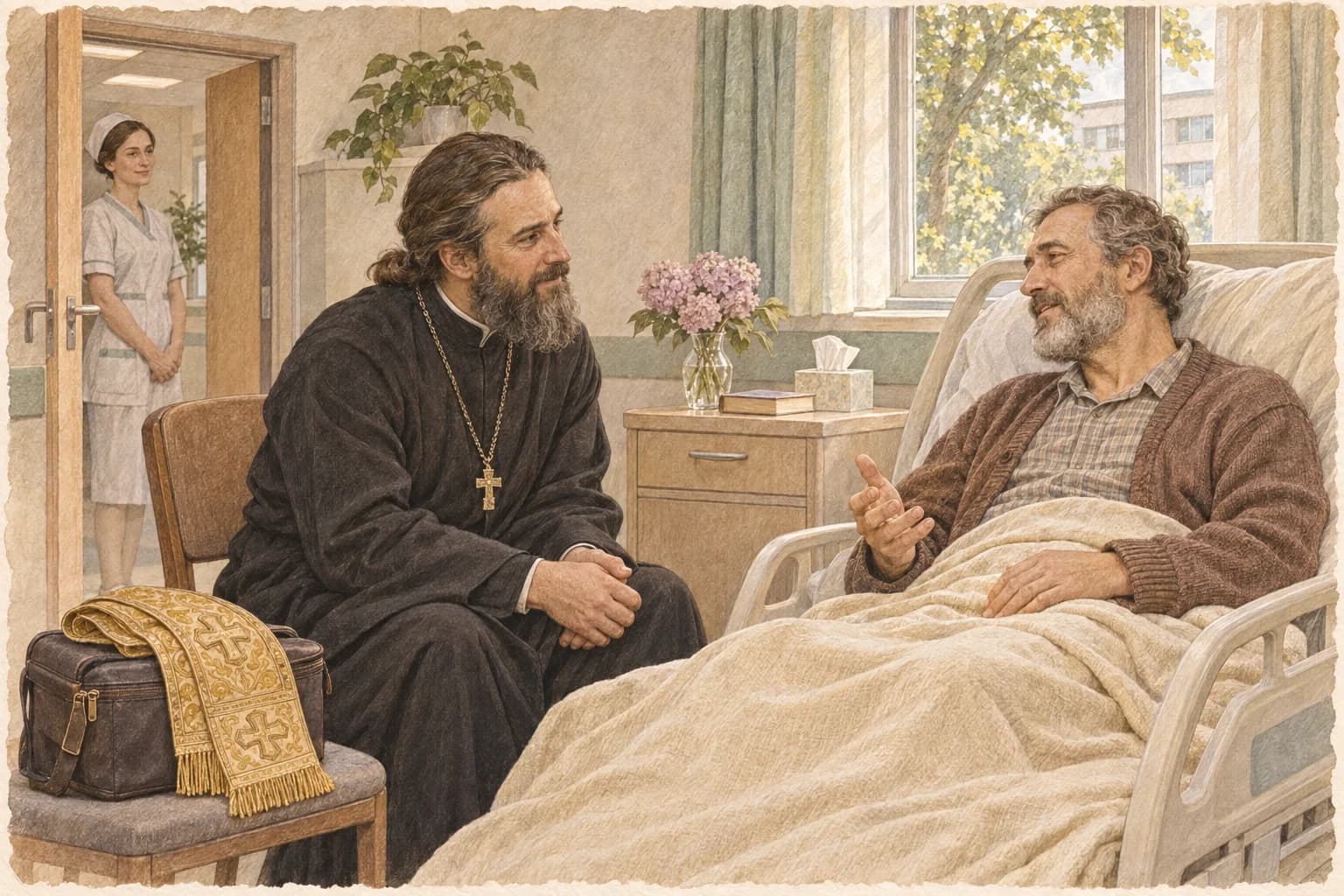
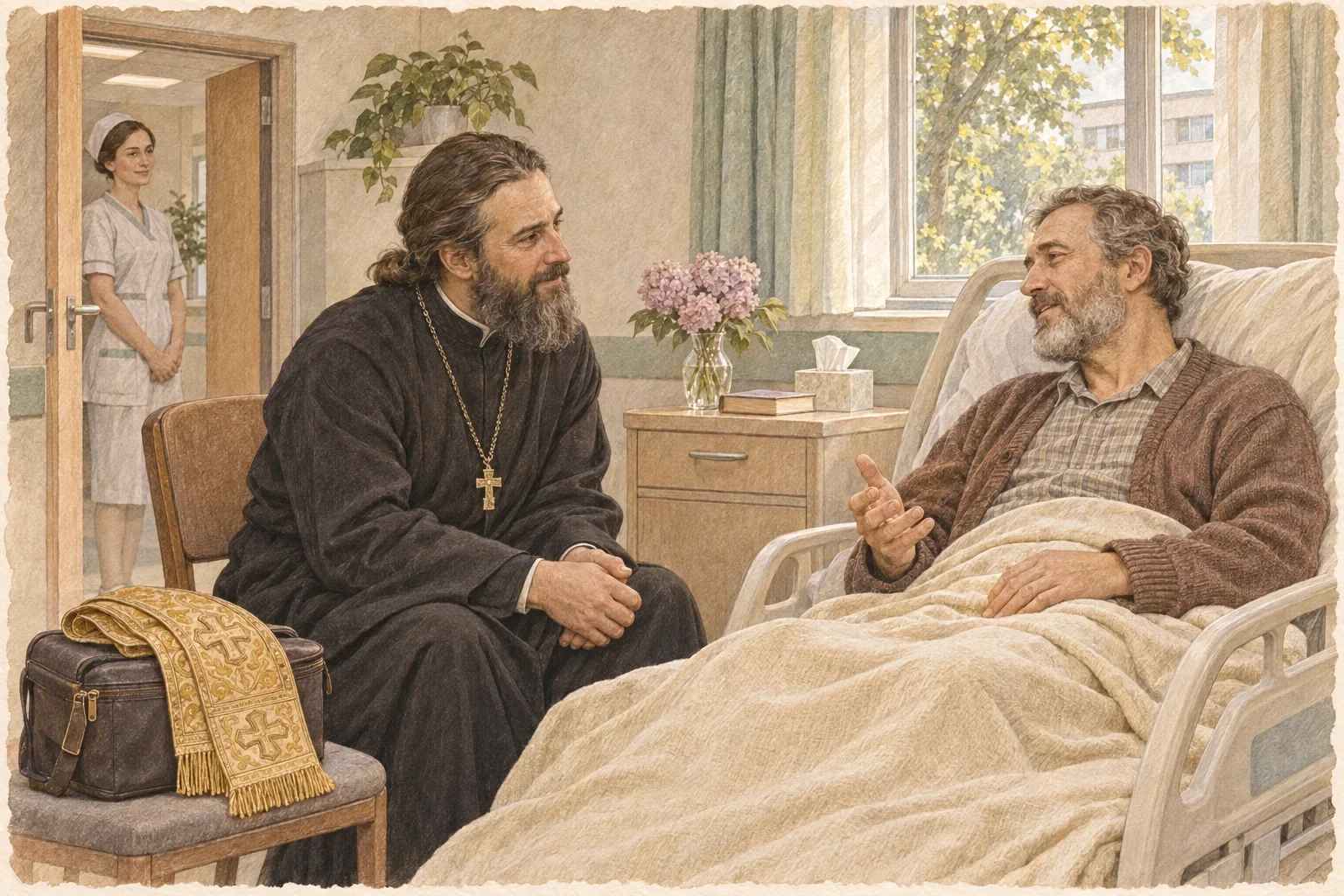
Holy Unction can be celebrated in hospital when a priest’s visit and bedside arrangements can be agreed. Start with the hospital chapel, chaplain or a nearby parish. Explain that the person is an inpatient and check access requirements with hospital staff.
If the patient can express their wishes, ask whether they want to meet a priest. Explain calmly that Unction does not mean someone is being regarded as dying. Questions about consciousness and participation should be discussed with the priest rather than settled by general online advice.
The visit must not obstruct urgent medical care. Restrictions in intensive care, isolation units or during procedures require coordination with staff. Neither relatives’ wishes nor the religious importance of a visit authorises disregarding hospital arrangements.
Have the hospital name, ward, coordination contact and a brief indication of urgency ready. Share personal information only with those arranging the visit. Do not post the diagnosis and room number publicly; the priest can clarify supplies and the possibility of other sacraments.
Beginning the arrangements
The most direct route is often the hospital chapel or the staff member responsible for contact with religious organisations. If no contact is known, ask staff how priests’ visits are arranged in that hospital, then contact a nearby parish if necessary. State the purpose clearly: the patient is requesting Unction, confession, Communion or simply a conversation. These requests may accompany one another, but they are not the same action.
An initial call usually needs the hospital, ward, access arrangements and urgency. If the condition is changing rapidly, explain that plainly without attempting to make a medical prognosis. The priest needs to know that this is not simply a convenient appointment several weeks away. Equally, relatives cannot promise his immediate arrival on his behalf: travel, existing duties and admission procedures must be coordinated. One family contact helps avoid contradictory messages from several people.
The patient’s wishes and a calm explanation
Some patients fear the suggestion of Unction because they associate it exclusively with imminent death. Explain that the Church prays for healing and strengthening, and that inviting a priest does not itself communicate a medical prognosis. Do not use threats of death to secure agreement. When the patient can express a clear preference, that preference must be heard even when anxious relatives want everything arranged their own way.
If the person is unconscious, markedly confused or unable to speak, give the priest accurate information about the condition and any known religious wishes. Do not replace that conversation with a confident rule found online. Whether and how a particular sacrament can be celebrated requires pastoral consideration. At the same time, the absence of ordinary verbal response does not authorise relatives to make judgements about the person’s inner life or declare them deprived of God’s care.
What to agree with the ward
Visiting arrangements may depend on treatment procedures, infection restrictions, other patients and the ward’s facilities. Establish who authorises access, what requirements apply to visitors and when the visit will least interrupt treatment. If admission is restricted, use the official coordination process rather than seeking a way past staff. The religious importance of the request does not make hygiene arrangements unnecessary.
In a shared room, consider other patients’ peace and privacy. Do not automatically invite a large accompanying group or discuss personal information loudly. Candles and other items acceptable in a church may be prohibited in a medical setting; clarify this beforehand. The priest can arrange what is needed for worship within the available conditions. Relatives do not need to transform the ward into a church-like space by moving medical equipment.
Practical preparations for relatives
Write down the patient’s name, ward, relevant staff contact, authorised visiting time and the number of the person who will meet the priest. Establish which personal details are actually needed; a detailed diagnosis generally should not be circulated to everyone in a family message group. If the patient wishes to speak privately, help create whatever privacy is possible and do not demand an account of confession or pastoral conversation afterwards.
Do not buy a large quantity of supplies from a random checklist before speaking with the priest. Hospital conditions are limited, and he may bring what is needed or explain what can be omitted. Tell him promptly if the patient changes ward, is discharged or has a procedure rescheduled. A simple timely message can matter more than elaborate preparations: it prevents a wasted journey and avoids interfering with necessary medical care.
After the visit: continuing support
Unction does not set a recovery deadline or cancel medical instructions. After the priest’s visit, the patient still needs treatment, rest and ordinary human support. If improvement is not immediate, do not attribute that to incorrect preparation or weak faith. Such accusations add suffering and replace prayer with an attempt to calculate a spiritual cause for a medical outcome.
Ask what help is needed now: contacting relatives, bringing permitted belongings, arranging continuing care or inviting the priest again. Quiet presence may be more valuable than lengthy exhortation. If the person wants to continue church life after discharge, help locate an accessible parish and discuss Communion where limitations remain. The visit then becomes part of ongoing care rather than a single act after which relatives regard their responsibility as completely fulfilled.
A question for reflection
Who will coordinate the visit with both the hospital and the priest?