
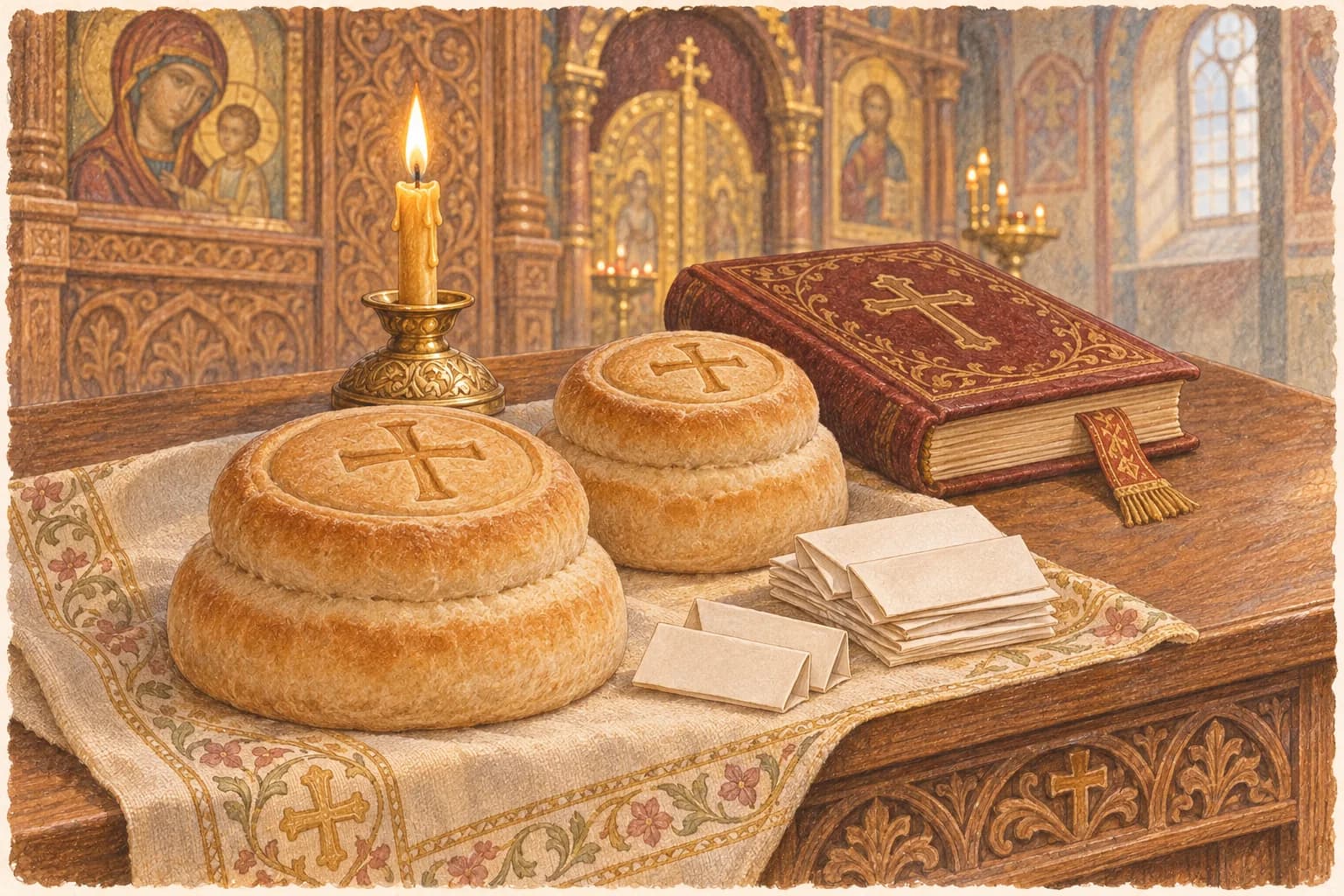
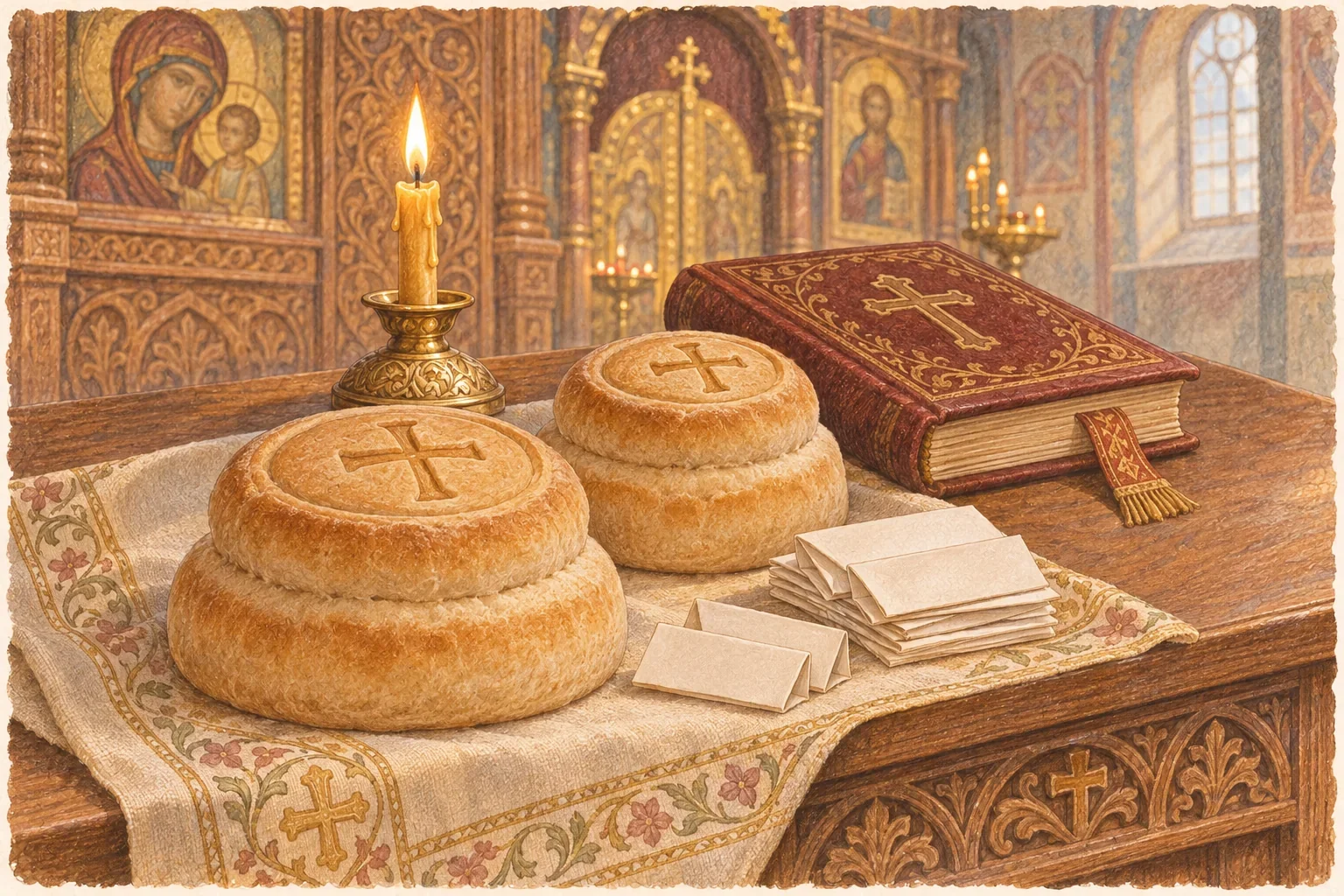
Proskomedia is the preparation within the Liturgy, including commemoration. A forty-Liturgy commemoration describes remembrance over a series of forty Liturgies. The terms concern different aspects of prayer: an action within the service and an extended sequence of commemorations.
Where the Liturgy is not celebrated daily, forty Liturgies do not necessarily coincide with forty calendar days. Ask about the period before submitting names. The parish’s information should make clear what kind of commemoration is being arranged.
The phrase forty Liturgies with proskomedia should not be understood as a more powerful paid prayer. The number of requests purchased does not determine God’s regard for someone. Commemoration does not replace personal prayer, reconciliation or care for others.
Ask how to write the name and for whom this form of church commemoration is offered. Speak with the priest if the person’s status is uncertain or circumstances are difficult. An ingenious wording on a note is not a substitute for that conversation.
Proskomedia: part of the Liturgy, not a subscription
Proskomedia takes place at the beginning of the Divine Liturgy and concerns preparing the bread and wine for the Eucharist. Its order includes commemorating members of the Church, with the priest taking particles from prosphora according to the appointed arrangement. Being commemorated at Proskomedia therefore identifies a particular place within liturgical remembrance, rather than the duration of a service purchased.
A visitor may not directly see Proskomedia because it takes place in the sanctuary, commonly while the Hours are read. That does not diminish its significance. The particle should not, however, be imagined as a private talisman belonging to the person who submitted a request. The action belongs within Eucharistic worship and the Church’s shared prayer, not an independent personalised ceremony detached from the Liturgy.
What a forty-Liturgy commemoration means
A sorokoust is an extended period of commemoration at Liturgies. In common Russian usage it refers to forty liturgical commemorations, but practical arrangements depend on how frequently the parish celebrates and how requests are recorded. Calendar duration therefore needs separate clarification. Where the Liturgy is not served daily, forty commemorations need not fit into forty consecutive calendar days.
The term primarily answers a question about duration, whereas Proskomedia identifies a place within worship. They can describe different aspects of the same request. Presenting them as competing levels of prayerful power is consequently misleading. Ask what the parish actually undertakes instead of comparing labels solely by the suggested offering.
Questions to ask when submitting names
Ask how to write the name and which form of commemoration matches the request. Baptism and ecclesial affiliation matter for liturgical commemoration; specific uncertainties should be discussed with a priest. Do not replace missing information with assumptions or enter a different name to circumvent an unexplained restriction. If this form of remembrance is not appropriate, ask about permissible personal prayer.
It is also useful to clarify when commemoration begins, how extensions work and whom to contact about the period involved. The parish may follow a timetable affected by feasts or other circumstances. Clear arrangements are preferable to assuming that a receipt guarantees identical practice in every monastery and church. The parish accepting the request can explain its actual procedure.
Why the number of churches guarantees no outcome
Online advice sometimes prescribes requesting commemorations at a particular number of churches to guarantee recovery, restored relationships or money. Such a formula does not follow from the meaning of liturgical remembrance. Asking different communities to pray is possible, but the number of requests cannot be turned into a means of controlling an outcome. God does not become contractually obliged once a required number of offerings has been reached.
Particular care is needed with people requesting prayer because they fear for a loved one. If the situation does not improve, that does not prove they selected an insufficiently expensive option or arranged the request incorrectly. Church prayer does not remove the mystery of human life, another person’s freedom or the need for treatment and practical assistance. Support must not become an accusation against someone who is suffering.
Personal prayer and parish participation
Submitting a name asks for the Church’s prayer, but does not remove your own responsibility to love that person. You can pray at home, call someone who is ill, help with a medical appointment, support a grieving person or offer another practical kindness. These actions neither replace the Liturgy nor compete with it; they show that the name represents a real relationship for you.
If you have long been absent from worship, do not limit the encounter to finding the correct desk for paperwork. Learn the timetable, attend the Liturgy and discuss your questions. Understanding Proskomedia develops within understanding the Eucharist. A clear distinction is enough to begin: sorokoust describes extended commemoration, while Proskomedia is a particular part of the Liturgy that includes remembrance.
A question for reflection
Do you understand what will actually be done after you submit the request?