
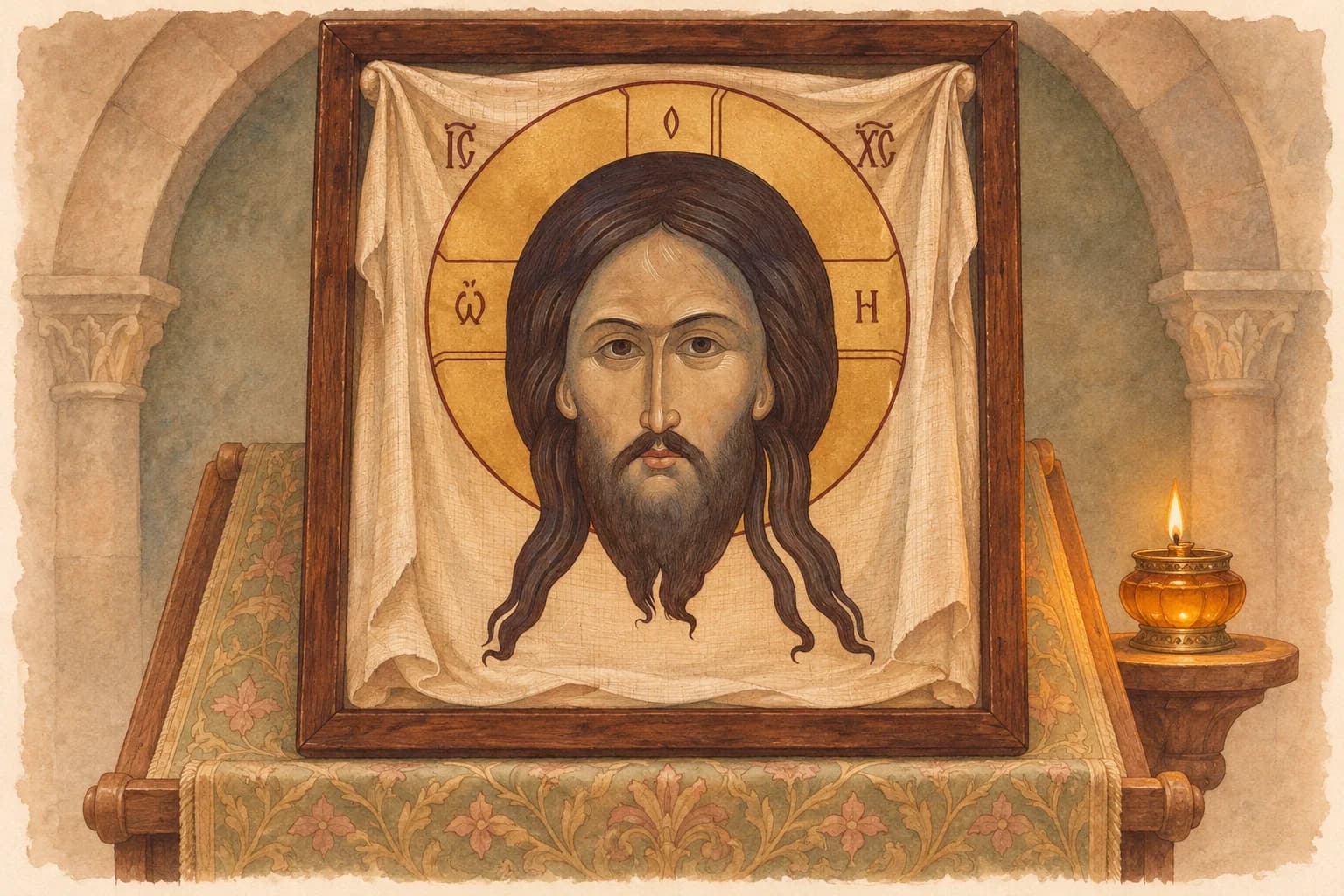
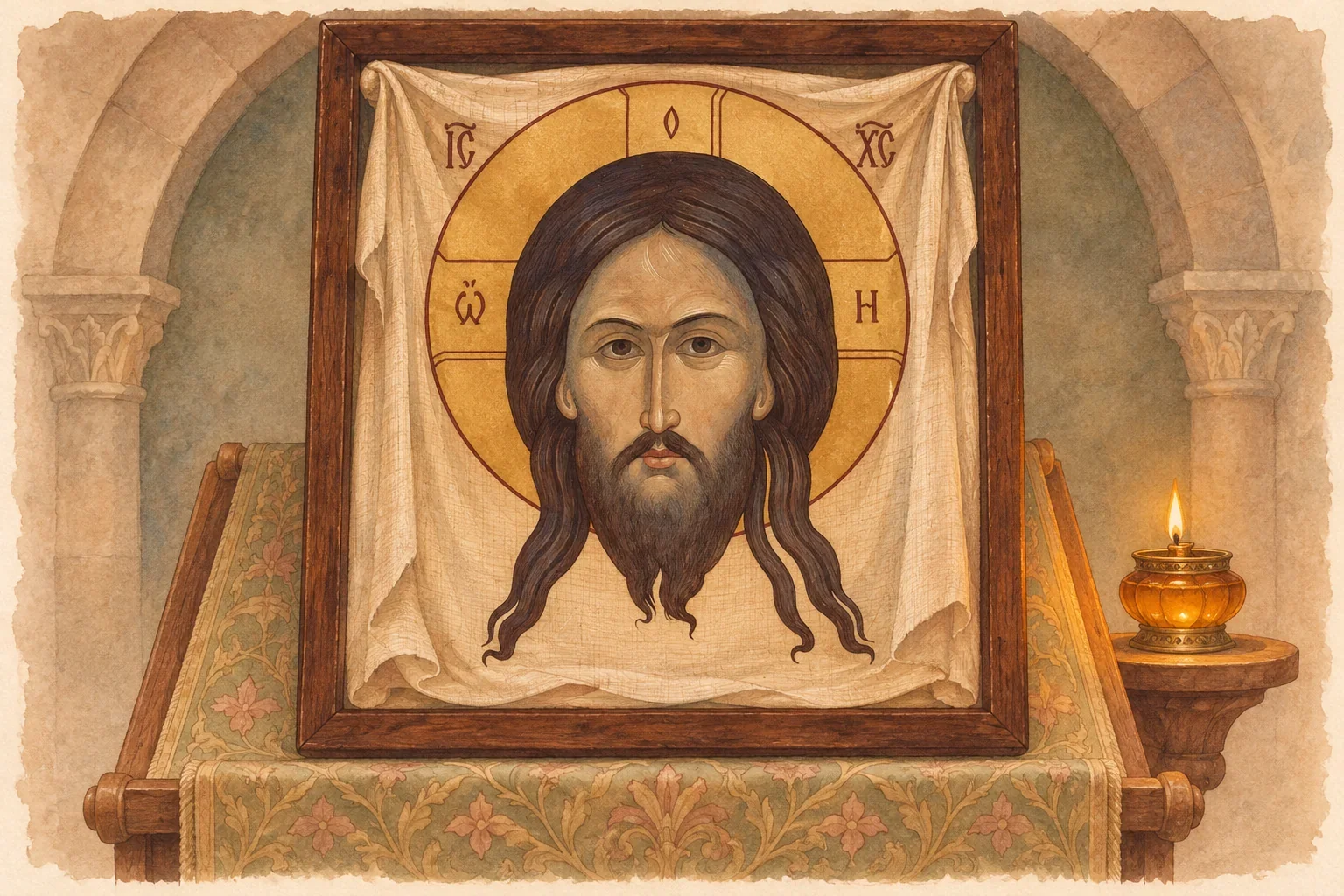
The image called Not Made by Hands depicts Christ’s face, often upon a cloth. Its name refers to the church tradition of the original image. It does not mean every modern copy appeared without an artist’s work or a printing process.
The composition focuses on the Saviour’s face rather than a particular Gospel action. Inscriptions and the cross within the halo identify him. The image concerns Christ’s real Incarnation, not the recovery of a photographic portrait.
Do not assess a copy by a seller’s claim that it is more powerful than others. Facial proportions are not a hidden code. Veneration is directed to Christ, and a reproduction’s material or origin does not determine the limits of his help.
Read the church account and look up unfamiliar inscriptions. For home, choose an image that can be placed respectfully for prayer. With an antique, consult a conservator about its condition rather than attempting to wash the painting yourself.
Edessa, Abgar and the cloth
Church tradition associates the image Not Made by Hands with Abgar, the ruler of Edessa. Having heard of Christ and seeking help in illness, he sent a representative to him. The narrative explains the appearance of the face on a cloth and the image’s delivery to Edessa. The Slavonic term for the cloth is ubrus, so the designation Saviour on the Ubrus identifies a particular form of depicting the sacred image.
The story does not appear in this form in the four canonical Gospels. It should be introduced as church tradition rather than attributed to a nonexistent Gospel verse. That distinction supports rather than obstructs study by clarifying where the information comes from. A first reading can focus on the central elements: Christ, the face on the cloth, Edessa and the image’s subsequent remembrance.
What Not Made by Hands means for a modern icon
The title refers to the tradition of the original image. A contemporary panel is painted by an iconographer, a paper reproduction is printed, and an embroidered version is made through a craftsperson’s work. There is no contradiction: the object reproduces the image known as Not Made by Hands without itself requiring miraculous material origins. Confusion arises when the type’s name is treated as a description of the manufacturing process of every example.
There is consequently no need to seek proof that paint appeared without a brush when purchasing a copy. Ask instead about the quality of the image and whether it can be respectfully placed. Claims that a particular reproduction has an extraordinary origin are separate assertions requiring evidence. An ordinary, honestly identified reproduction is not less suitable for prayer because its method of production is known.
Face, halo and inscriptions
At the centre is Christ’s face, commonly directed towards the person praying. The absence of hands and a full-length figure does not make it an incomplete portrait: the composition deliberately concentrates on the Saviour’s face. The cross within the halo and traditional inscriptions identify him. These signs belong to the Church’s confession rather than a decorative code reserved for initiates.
An icon’s face is not assessed by resemblance to a modern photograph or an actor in a film. Icon painting conveys a recognisable image through an established visual language, not a forensic reconstruction of appearance. This does not imply that Christ’s human appearance was irrelevant: the possibility of depicting him is connected precisely with the reality of his humanity. Artistic witness and photographic recording nevertheless remain different forms of representation.
Cloth and tile: why the supporting surface differs
Church history also contains an account of the image appearing on a clay surface or tile, traditionally called the keramion. Some depictions therefore show the face upon folded cloth, while others use a different or more schematic supporting surface. Such variation should not immediately be labelled an artist’s mistake: it may refer to a particular strand of tradition and an associated iconographic form.
When comparing images, notice the cloth’s edges, knots or figures supporting it where these are present. These features indicate that the work represents not only a face but also remembrance of a sacred object. Prayer is nevertheless directed to Christ rather than to fabric or clay. Distinguishing the person depicted, the traditional material image and a later icon prevents confusion between devotion and the literal properties of the supporting material.
The Incarnation and the possibility of depicting Christ
The Holy Face has an important place in Orthodox reflection on icons. God is not confined within paint and wood, but the Son of God truly entered human history and became visible to people. Depicting Christ should therefore not be understood as an attempt to paint the invisible divine essence. The image bears witness to the Person of the incarnate Saviour.
This helps direct attention in prayer. A person looks at the image but does not address its material. Read a Gospel account concerning Christ and pray quietly before the icon without trying to induce a special sensation from the eyes or facial expression. If an antique requires care, its painted surface should be preserved through professional conservation. Reverence does not justify washing it at home in a way that may irreversibly damage the object. Proper care and theological understanding both respect what the image represents.
A question for reflection
Are you distinguishing the tradition of the original from the history of a particular copy?