
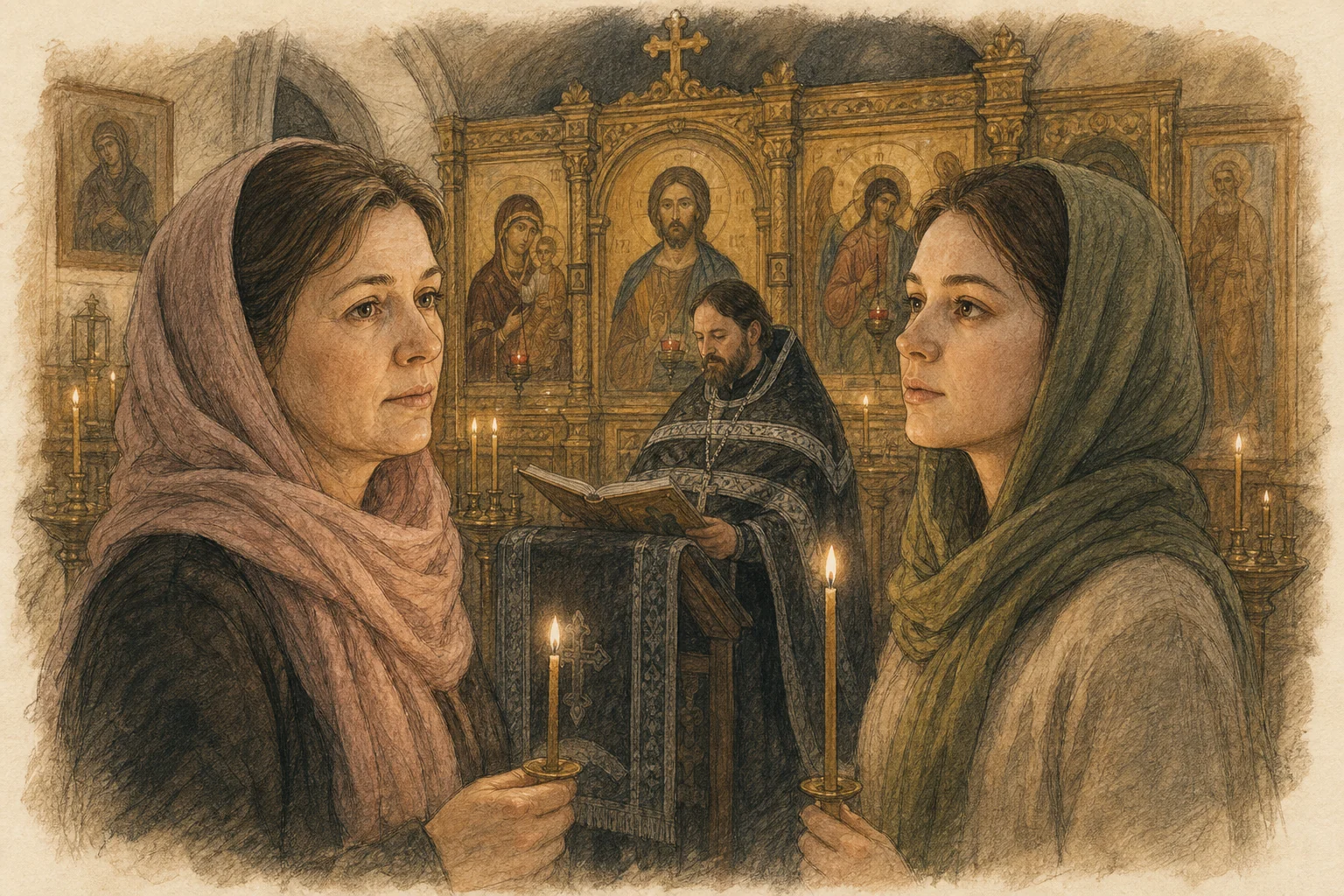
Holy Week is the final six days before Pascha, devoted to Christ’s last teachings, the Mystical Supper, His Passion, Crucifixion, burial, and rest in the tomb. In church language “the Passion” means His sufferings, not powerful human desires.
Every day has its own theme and liturgical order. The purpose is neither to complete every household preparation nor to watch a religious drama. The Church walks beside Christ through His freely offered love to the Cross and toward the Resurrection.
When does Holy Week begin?
It begins with Great and Holy Monday after Palm Sunday and concludes with Great and Holy Saturday. Lazarus Saturday and the Entry into Jerusalem prepare the way immediately but formally precede Holy Week.
The dates change each year with Pascha. Check the official calendar and parish schedule, since many services are celebrated on the evening before their calendar day.
Why are the days called “Great and Holy”?
The word “Great” concerns the magnitude of the events, not the length of the service or the achievement of the worshiper. The Church slows ordinary life so that the Gospel becomes the center rather than background noise.
This importance does not require attendance at every service at any cost. Illness, childcare, employment, and travel set real limits; an honest measure is better than exhaustion and anger.
Great Monday: Joseph and the fruitless fig tree
Monday remembers the righteous Joseph, sold by his brothers and understood as an image of the suffering Christ. The Gospel account of the fig tree without fruit is also proclaimed.
The theme is not fear that God irrationally punished a tree. It asks about the fruit of faith. External religion without justice, mercy, and faithfulness remains leaves without fruit.
Great Tuesday: vigilance and responsibility
Tuesday presents the parables of the ten virgins and the talents and teaching about the final judgment. They call for vigilance—not calculating the end of the world but living faithfully with what has been entrusted.
Notice what is continually postponed: reconciliation, honest work, care for someone weak, or Confession. Oil for the lamp cannot be borrowed at the final moment as an external religious gesture.
Great Wednesday: generous love and betrayal
The Church contrasts the woman who anoints Christ with precious myrrh and Judas, who decides to betray his Teacher for silver. One gives through love; the other places a price on relationship.
The day asks not only about another man’s betrayal but the price of our own compromise. Some parishes offer Confession or the final Presanctified Liturgy before Pascha; confirm the local order.
Holy Unction and Great Wednesday
Some places have a custom of celebrating general Holy Unction on Wednesday. The Mystery is not a mandatory “Paschal cleansing,” nor is it reserved exclusively for the final hour of life.
Participation requires understanding, prayer, and a genuine need, not a hope that forgotten sins will be erased automatically. Follow the parish announcement and ask the priest.
Great Thursday: the Mystical Supper
Thursday remembers the washing of the disciples’ feet, the institution of the Eucharist, prayer in Gethsemane, and betrayal. The Liturgy of Saint Basil is normally celebrated in the morning, and many faithful receive Communion.
Christ joins the Chalice to the commandment of service. We cannot honor the Mystical Supper while treating care for the vulnerable as humiliating labor reserved for someone else.
The Twelve Passion Gospels
At the Matins of Great Friday, usually celebrated on Thursday evening, twelve Gospel passages narrate Christ’s Passion. Worshipers stand with candles and listen from the farewell discourse through the burial.
The candle assists attention, but carrying its flame home is not magical protection. Safety in travel and at home is more important than preserving a flame at any cost.
Great Friday: the Cross and death of Christ
The ordinary complete Divine Liturgy is not celebrated that day. The Royal Hours are read in the morning; at Vespers the taking down from the Cross is remembered and the shroud depicting Christ in the tomb is brought into the church.
Friday is not a theatrical reconstruction and does not require manufactured tears. Silence, the Gospel, and prayer before the shroud allow us to behold love faithful to the end.
The lamentations and procession
On Friday evening or during the night, Matins of Great Saturday is celebrated with praises before the shroud; many parishes include a procession. Timing and local details differ.
Approach reverently without pushing or attempting a secret sequence of actions. A bow expresses love for Christ; it does not guarantee that a private wish will be fulfilled.
Great Saturday: the tomb and expectation
On Saturday the Church contemplates Christ’s rest in the tomb and His descent into Hades. Grief is already filled with expectation of victory, and light gradually appears in the worship.
Vespers with the Liturgy of Saint Basil includes numerous Old Testament readings, a change of vestments, and a summons to arise. It is not simply an “early Pascha” but a passage toward Pascha.
Blessing Paschal food
Many parishes bless Paschal breads, eggs, and other festal food during Great Saturday. Come at the posted time, keep entrances clear, and bring a reasonable amount.
Blessing food neither replaces worship nor ends the fast early. The meal is kept for breaking the fast after the Paschal Liturgy when health allows.
Fasting without harm
The appointed Holy Week food rule is austere, especially on Friday and Saturday, but an ill person must not make a condition worse. Pregnancy, treatment, childhood, demanding labor, and an eating disorder require another measure.
Do not cancel medicine or restrict water dangerously. Our guide to fasting during illness and treatment explains how pastoral and medical care work together.
Confession and Communion
Do not postpone a first Confession in many years until the minutes before the Paschal Chalice. Clergy are especially busy, so learn the parish schedule and arrange a conversation early.
Great Thursday, Great Saturday, and Pascha offer Eucharistic participation, but schedules differ. Agree on preparation for Communion in advance.
If only one or two services are possible
Choose what can realistically carry the journey: the Great Thursday Liturgy, the Twelve Gospels, the bringing out of the shroud, the Great Saturday service, or the Paschal Liturgy.
No single ranking binds everyone. Account for health and family, read the Gospel texts for missed days at home, and do not compare yourself with someone who has different duties.
Holy Week during an ordinary work schedule
Reduce optional appointments and digital noise while fulfilling work honestly. Put one evening service on the calendar and reserve fifteen minutes for the Gospel in the morning or before sleep.
Do not use church activity to fail colleagues, and do not allow office urgency to occupy the whole inner life. Small sustainable attention can transform the week.
Housework and “Clean Thursday”
A home may be cleaned beforehand to free time for worship, but Great Thursday receives its holiness from the Mystical Supper and the Eucharist, not mandatory washing of windows, floors, or bodies.
Cleaning, laundry, or cooking on another day is not a sin. Household labor serves people and the feast; it must not govern the conscience through omens.
What to tell children
Do not show a young child graphic images of violence. Explain that Christ did not answer evil with evil, remained faithful to love, and defeated death.
Choose a shorter service, look at a canonical icon, light a lamp safely, and read a few accessible verses. An exhausted child may be taken outside without shame.
Grief, trauma, and difficult memories
Texts concerning betrayal, violence, and death may strongly affect someone with traumatic experience. Do not force emotional overload or interpret a panic response as absence of faith.
Remain near an exit, attend for a shorter period, and ask a trusted person to accompany you. Pastoral conversation and qualified psychological care can support one another.
Superstitions to avoid
Neither candle color, a carried flame, the timing of cleaning, nor a broken object predicts the future. Sin cannot be washed away in a bath, destiny cannot be read in fire, and health is not guaranteed by walking around a church.
The Church offers the Mysteries, prayer, and repentance instead of magical control. Advice promising a guaranteed result from a household action is a sign of superstition.
A concise route through the days
On Monday seek the fruit of faith; on Tuesday remain vigilant and use entrusted gifts; on Wednesday reject betrayal; on Thursday give thanks for the Eucharist and serve; on Friday stand at the Cross; on Saturday preserve hope.
Read the corresponding Gospel passage each evening and write down one concrete action. This route is better than an endless list of domestic prohibitions.
Common questions
May I work and clean during Holy Week?
Necessary employment and household duties may be performed. Make room for prayer where possible and do not replace the week’s meaning with domestic omens.
When is the shroud brought out?
Normally at Vespers on Great Friday, often during the afternoon. Consult the exact parish schedule.
May I receive on Great Thursday and Pascha?
Yes, with proper preparation and according to parish order. Arrange Confession and the Eucharistic fast in advance.
What if I missed the whole week?
Do not attempt a panicked recovery. Read the Passion narrative, attend the service still available, and begin today.
Must everyone eat nothing on Great Friday?
The appointed rule is strict, but a personal measure depends on health and responsibility. Do not endanger life; discuss a relaxation.
The essential point
Holy Week leads from Christ’s final teaching through the Mystical Supper, the Cross, and the tomb to the threshold of the Resurrection. Every day reveals love that does not retreat before betrayal or death.
Choose sustainable participation, read the Gospel, seek reconciliation, protect health, and reject superstition. Pascha will then be the completion of a real journey rather than a sudden change of decoration.