
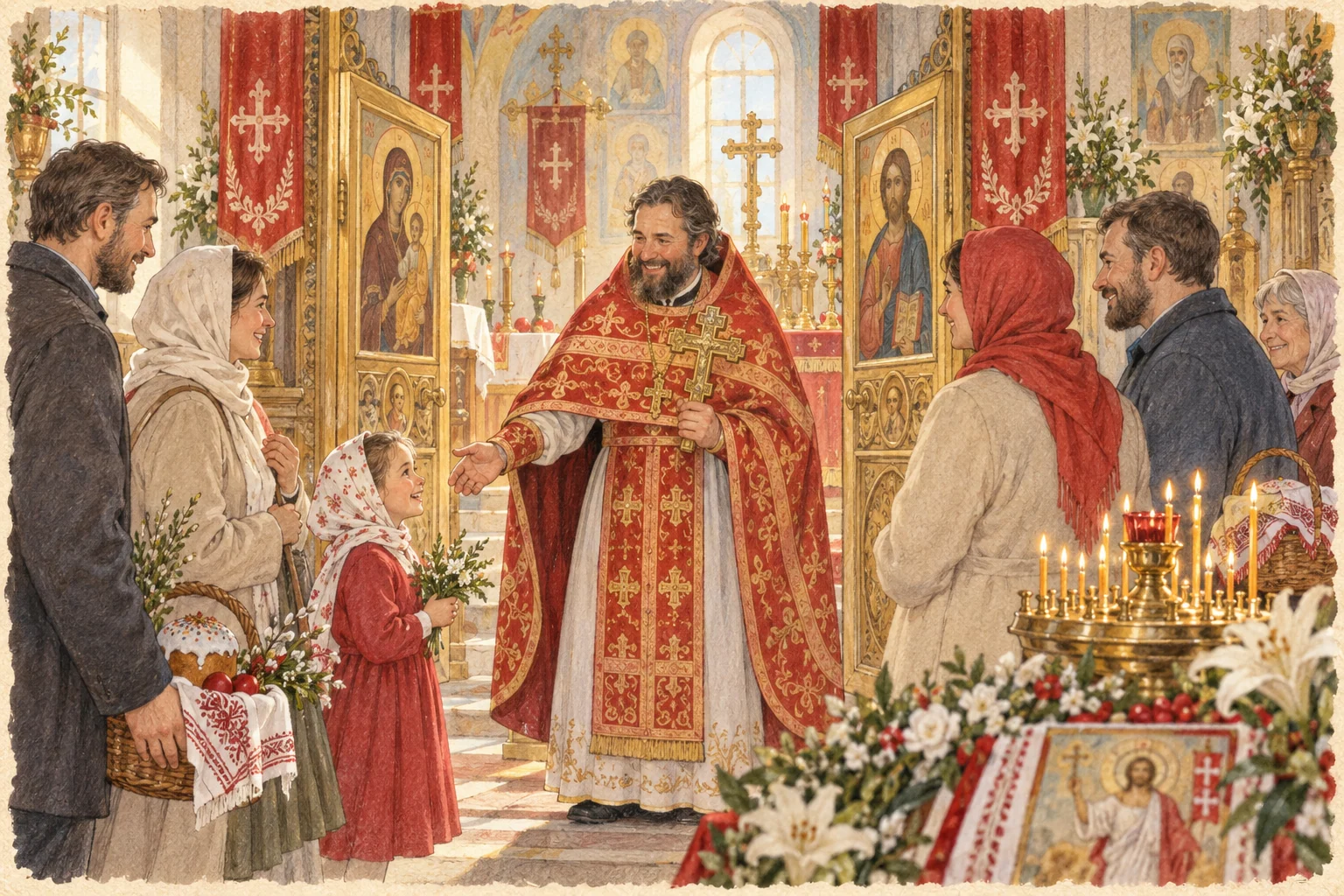
Bright Week continues the celebration of Christ's Resurrection through the days following Pascha. Church life does not end after one long overnight service. Worship repeatedly returns to the Paschal proclamation, offering an opportunity to hear it without the fatigue and bustle of the night. The week concludes before Thomas Sunday, but the wider Paschal season continues.
What Changes in Church?
Services are filled with Paschal hymns, and the royal doors of the iconostasis remain open. Ordinary weekday patterns give way to continued celebration. Parishes may hold processions, but their availability and timing depend on the local schedule. Open doors do not grant visitors permission to enter the sanctuary on their own.
If the choir's words were difficult to follow at Pascha, a weekday service can provide a quieter opportunity to hear the themes again. Read a translation of the Paschal canon beforehand, or begin with its principal refrain. Understanding everything immediately is unnecessary. Hearing one hymn attentively is more helpful than anxiously trying to copy every movement around you.
Prayer at Home
In Russian practice, the Paschal Hours commonly replace the usual morning and evening prayers during Bright Week. This is a short sequence of Paschal prayers and hymns, which a layperson can read at home without a priest. Use a reliable prayer book that clearly identifies the appropriate text.
This replacement does not forbid prayer in one's own words. Name loved ones, give thanks, and ask for help with particular difficulties. With children, a brief shared prayer may be more manageable than an ambitious programme. Do not turn festive prayer into a memory test or require everyone to experience exactly the same emotion.
Fasting and Holy Communion
Bright Week is free from the usual dietary fast, including Wednesday and Friday. This is not encouragement to overeat or to ignore medical restrictions. The quantity of food consumed does not measure joy. Nor does the absence of calendar fasting automatically abolish every aspect of preparation for Holy Communion.
Discuss your prayer rule, confession, and Eucharistic abstinence with your parish priest in advance. Do not independently invent a prolonged fast in the middle of Bright Week, but do not assume that an online claim that “no preparation is needed” replaces pastoral guidance. Clarification is particularly important when beginning to receive Communion or returning after a lengthy absence.
Artos and Care for Others
The artos is a special Paschal bread associated with the presence of the risen Lord. It is distributed according to parish practice, usually towards the end of Bright Week. It is not the Eucharist and does not replace Holy Communion. Receive it respectfully without assigning it a guaranteed therapeutic effect.
Visit someone isolated, contact a person unable to attend church, or bring necessities to someone ill. If a loved one dies during these days, grief need not be concealed: speak with a priest about prayer and burial, for which special Paschal forms exist. Bright Week does not erase human pain but brings hope into it. Exhaustion or tears do not exclude someone from the Resurrection's joy. A celebration capable of including the vulnerable is more faithful than a demand that everyone maintain a cheerful appearance.
After the overnight service, allow time to recover, especially when caring for children or driving. Rest does not cancel the feast. An accessible daytime service may allow more attentive and safer participation than continually fighting sleep.
A Festive Service on a Working Day
Bright Week may fall within an ordinary working schedule. First check which services are genuinely accessible, how long travel takes, and who can stay with a dependant. Do not promise to attend every Liturgy when doing so would require someone else's unagreed work or leave important responsibilities unmet. A plan should take account of the people affected by it, not just the person making it.
If attending a weekday service for the first time, ask a parish helper about arrangements before worship begins. Open doors, festive singing, and a possible procession do not remove the need to keep passages clear and notice children or people who find standing difficult. In a crowded place, making room for someone matters more than retaining a useful position for a photograph. Participation is not measured by the number of moments recorded.
Using the Text of the Paschal Hours
First check that you have the Hours themselves rather than a long collection of every Paschal hymn. The liturgical resources page in the sources lists this as a separate service. For reading at home, open the right place beforehand and explore a few unfamiliar words. Speed is not a reason to pronounce expressions confidently while having no idea what they mean.
If a household uses different languages, choose an understandable text or discuss its meaning beforehand rather than turning prayer into an argument about pronunciation. Someone who cannot yet sing can listen attentively or read. Questions about the precise form of a personal prayer rule belong in conversation with your own priest, rather than being settled by combining incompatible instructions from several random publications.
Paschal Visits Without Exhaustion
Before visiting someone older or unwell, ask whether the time is convenient and whether the food you intend to bring would be useful. Not everyone can eat festive dishes, sustain a long conversation, or receive a large group. A brief visit that includes practical help may be kinder than an extended gathering. Declining food should not be interpreted as rejecting the celebration or the person offering it.
At home, agree which visits are manageable and which should wait. Joy does not require one person to cook and clear up for everyone without rest. Share the work, leave time for sleep, and avoid comparing your table with other people's photographs. The continuation of Pascha can then be something a household shares, rather than a test of how much domestic work one exhausted member can carry.
Sources
- OCA: Bright Week and the artos
- OCA: Paschal Hours and special services
- OCA: Bright Week and the Sundays of Pascha