
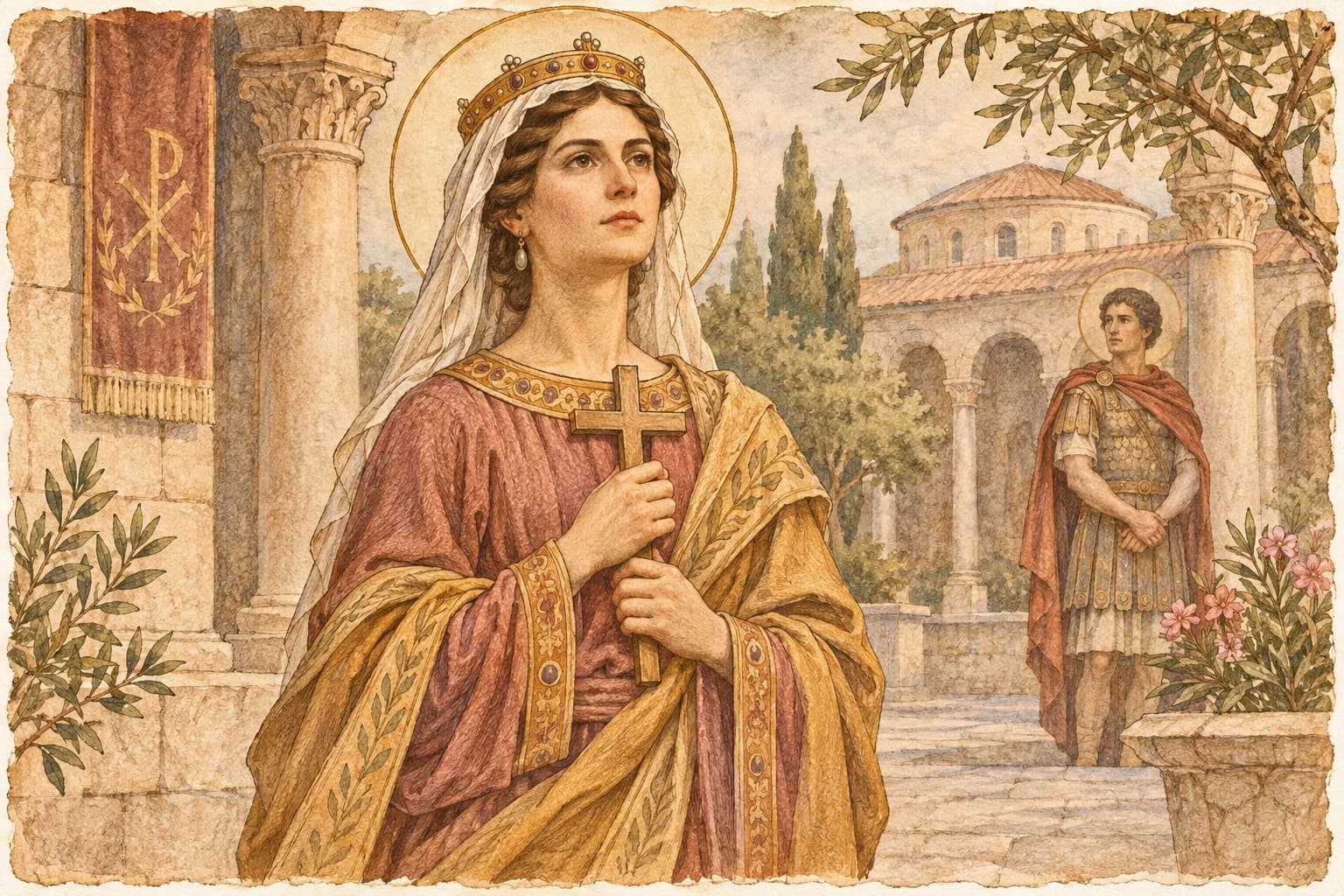
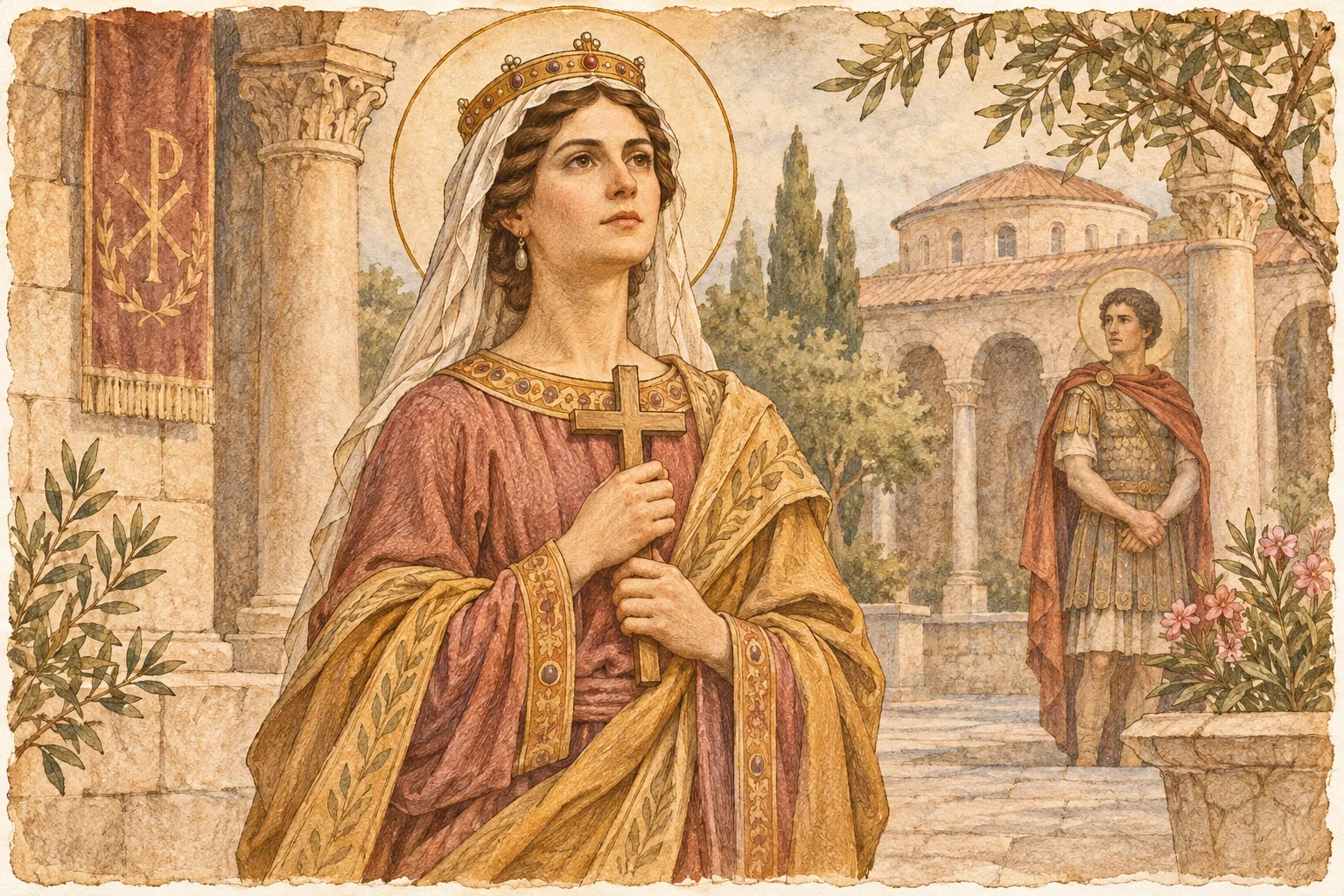
The martyr Empress Alexandra of Rome appears in the life of Great Martyr George. She should not be confused with the royal passion-bearer Alexandra Feodorovna or other saints named Alexandra. A shared name does not imply one biography or one feast day.
According to the life, George’s steadfastness moved Alexandra to confess Christ openly. Her remembrance concerns courage in faith. Present these details as the church’s hagiographic account, not as an independently preserved court record.
Royal clothing alone does not establish which Alexandra an icon depicts. The inscription and composition matter. Nor should a patron be assigned automatically simply because a modern name resembles the inscription.
For a name-day question or gift, establish the saint’s full name from the person or baptismal records. Then choose a life or icon. This prevents a beautiful but incorrectly identified gift.
Alexandra in the life of George the Victory-Bearer
The church account connects the martyr Alexandra with the persecution in which George suffered. Seeing his steadfastness, she openly confesses Christ and accepts the sentence. Versions differ in the final details: her death is described either on the way to execution or through beheading. A retelling should therefore identify the hagiographic tradition rather than manufacture false precision by combining details that do not agree.
An important aspect of her remembrance is that high social standing does not make confession safe. Alexandra does not merely sympathise with a believer from a distance but makes a personal decision. Readers should not, however, turn a martyr’s steadfastness into an instruction deliberately to seek conflict or danger. Martyrdom concerns fidelity to Christ under coercion, not a desire to reproduce the outward conditions of an ancient persecution at any cost.
Why identifying her as Diocletian’s wife requires caution
Popular versions of the life often call Alexandra the wife of Diocletian. Historical evidence about his family and different recensions of the life do not, however, produce a simple uncontested picture. Ancient sources name the emperor’s wife as Prisca, and attempts to identify her with Alexandra encounter differences in circumstances and chronology. The church reference article itself notes this problem.
It is consequently more accurate to say that one hagiographic tradition presents Alexandra as the ruler’s wife, without treating that identification as a fact established by all historians. This qualification does not turn an article into an argument against veneration. It distinguishes two tasks: conveying church remembrance and honestly identifying the limits of historical reconstruction. A text becomes more trustworthy when it acknowledges differences between sources instead of filling gaps with invented family names and unsupported chronological detail.
How she differs from Alexandra Feodorovna
The royal passion-bearer Alexandra Feodorovna was the wife of Nicholas II and lived in the late nineteenth and early twentieth centuries. She was killed with her family in Ekaterinburg in 1918. Many centuries separate her life from that of the ancient martyr Alexandra. Royal status, a cross in an image and a shared name do not permit the two biographies to be merged.
Passion-bearer also has a particular ecclesiastical meaning, concerning the Christian endurance of suffering and death; it is not merely another word for empress. Read the complete designation when choosing a life. If someone’s baptismal patron is Alexandra of Rome, finding an attractive icon of the royal family in a shop does not automatically change that patron. At the same time, veneration of one saint does not prohibit respectful remembrance of another. Accurate distinction and shared Christian reverence are compatible.
Venerable Alexandra of Diveyevo: another distinct life
Alexandra of Diveyevo, known in the world as Agafya Melgunova, is associated with the foundation of the Diveyevo community. Her path belongs to monastic life in Russia, not to the imperial court of late antiquity or the last Russian royal family. Venerable identifies the monastic character of her witness. Her complete name and place of veneration distinguish her even when a short label mentions only Saint Alexandra.
Other saints also bear the name, including new martyrs. The three examples here are therefore not an exhaustive calendar. Their purpose is to demonstrate a method of identification: name, ecclesiastical designation, period, place and principal events. When the question concerns a particular person, establish the patron before selecting an article, icon or date for congratulations. A list of search results cannot replace baptismal information or resolve every dedication merely by ranking the best-known names first.
Preparing a meaningful account for a name day
Once the saint has been identified, record the full designation and check the date in the calendar used by your church tradition. In the Russian calendar, Alexandra of Rome is commemorated with George the Victory-Bearer on 6 May according to the present civil reckoning. Old-style and new-style dates do not imply two different saints; when comparing calendars, first establish the system each one uses.
An explanation for a child or a name-day greeting for an adult can centre on one intelligible thought: Alexandra remained faithful when silence appeared outwardly safer. There is no need to state disputed historical details as unquestioned facts or recount torture at length. A name day concerns a person’s Christian path, not only the coincidence of a name. Biographical accuracy and considerate language make the remembrance meaningful without grand but empty promises of special protection from every difficulty in life.
A question for reflection
Have you established which Saint Alexandra is intended?