
Several saints bear the name Anna. Righteous Anna, mother of the Virgin Mary, and Anna the prophetess who encountered the infant Christ in the Temple are different people. Identifying a patron requires the full designation and baptismal information.
Luke mentions Anna the prophetess in the account of the Presentation. Information about the Virgin Mary’s parents belongs to church tradition. Recognising those different sources prevents separate accounts from being combined into one biography.
Choosing the nearest date to a birthday is insufficient if the patron is already known. An online list of saints named Anna does not change a baptismal dedication. If information has been lost, discuss the question calmly with the parish.
Check the baptism certificate, family records and an icon’s inscription. Do not decide solely from a random picture. Once clarified, read the corresponding life and record the full designation beside the calendar date.
Righteous Anna, mother of the Mother of God
In church tradition, Anna is Joachim’s wife and the mother of the Virgin Mary. The account of a long wait for a child and the birth of the future Mother of God belongs to the tradition reflected in worship and iconography. The canonical Gospels do not provide a separate detailed biography of Mary’s parents. An accurate article should therefore not present every hagiographic detail as a quotation from Luke or Matthew.
Joachim and Anna are called Ancestors of God because they are the parents of the Mother of the incarnate Christ. This does not claim that they originated eternal divinity. Their remembrance concerns the history of the Incarnation and faithfulness while waiting. People facing difficulties around parenthood may ask their intercession, but the life does not justify promising a child to everyone who follows a specified sequence of prayers. The story’s meaning cannot be reduced to a reproducible technique for securing a particular outcome.
Anna the prophetess in the Presentation narrative
Luke identifies this Anna as the daughter of Phanuel, of the tribe of Asher. She is a widow associated with prayer in the Temple and appears when the infant Jesus is brought there. Alongside the account of Simeon, her presence expresses expectation of salvation and recognition of God’s promise being fulfilled. She is not the Virgin Mary’s mother and should not be inserted into Mary’s family history merely because the name is the same.
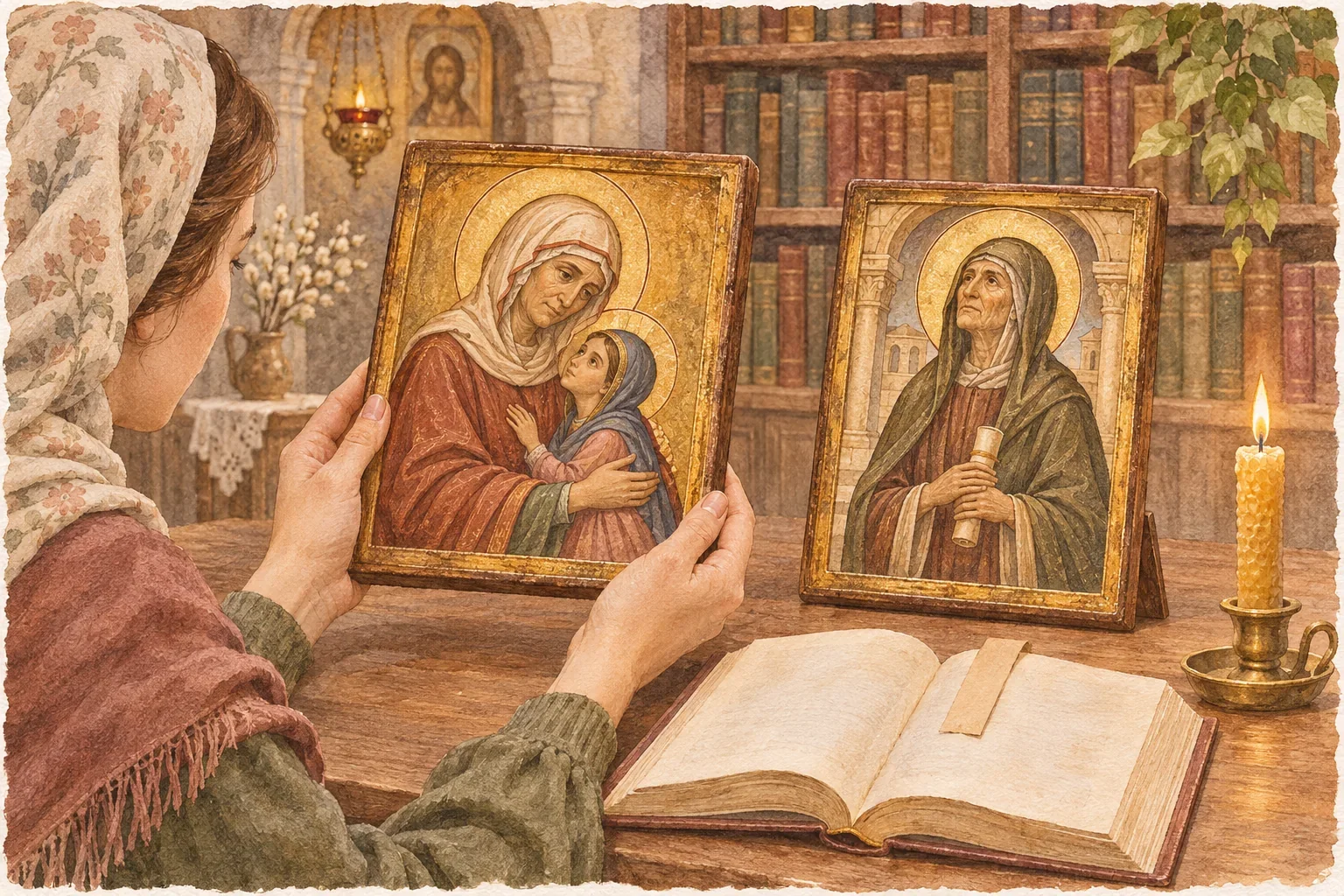
The distinction can be remembered through the event: Mary’s mother belongs to the remembrance of the Virgin’s birth, while Anna the prophetess belongs to Christ’s encounter in the Temple. The first concerns church tradition about Mary’s family; the second has a direct text in Luke chapter two. In an icon of the Presentation, Anna may stand with the other participants holding a scroll. Identification should rely on the whole composition and inscription rather than simply the depicted woman’s advanced age.
The holy princess Anna of Kashin
Anna of Kashin belongs to medieval Russian history. She was the wife of Prince Michael of Tver, experienced severe family bereavements and entered monastic life. Her biography differs in period, place and circumstances from those of the two Annas associated with the Gospel setting. Kashin in her full designation immediately helps identify the intended saint.
Her remembrance includes a complicated history of veneration, the suspension of general church commemoration in the seventeenth century and its restoration in the early twentieth. That subject belongs to particular ecclesiastical and historical controversies and deserves separate careful treatment. Identifying a patron saint does not require confusing it with the life of Mary’s mother. If a family icon identifies Anna of Kashin, an unrelated calendar list of saints named Anna is not a reason automatically to replace her with someone else.
Identifying a patron when records have been lost
Begin with what is actually known: the baptism certificate, the church’s name and location, the recollections of godparents or parents, and any old record of the name day. An icon can provide a clue, but a gift bought years later does not always reflect the original baptismal dedication. The saint’s full designation is more dependable than a chance correspondence between a calendar entry and a birthday.
Lost records do not make baptism invalid or mean a person should be baptised again. Explain the situation calmly at the parish and ask about the established way of identifying a patron. The custom of choosing a nearby commemoration should not mechanically cancel a patron who is already known. Once clarified, record the full designation and date among family documents so that children do not have to reconstruct the information later from arbitrary online lists.
Choosing an icon of Anna and explaining it to a child
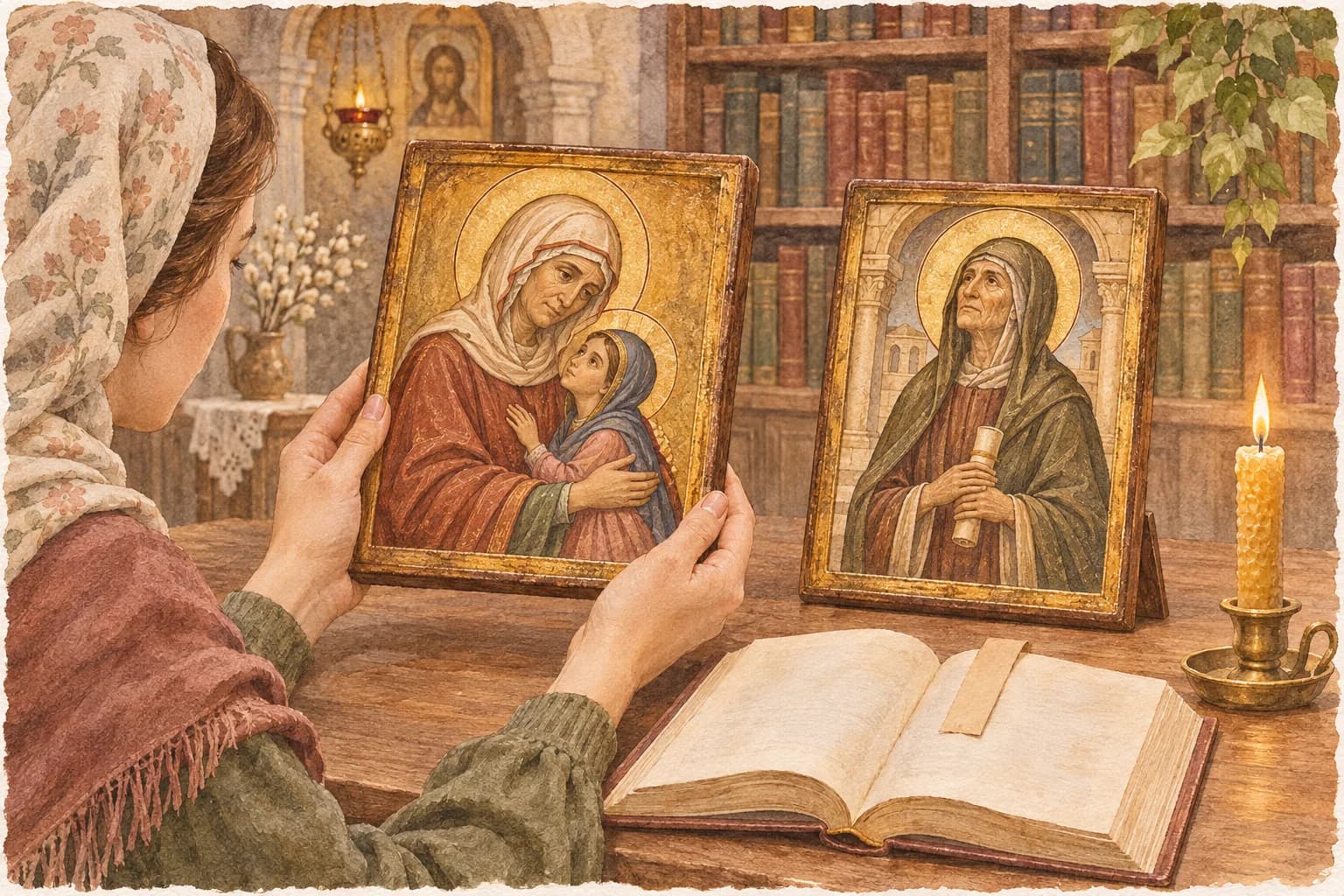
Ask for an image of the particular saint whose complete name you have established. Anna with the young Mary, Anna in the Presentation composition, and Anna of Kashin depicted as a princess or monastic belong to different subjects. Artistic variations exist, so clothing and posture do not provide an absolute answer without an inscription. A seller or artist should be able to explain whom the image represents.
For a child, describe two or three intelligible features of the patron rather than reciting every saint with the same name: the period in which she lived, the event associated with her and how her faithfulness appeared. A name day should not become a competition between supposedly more powerful saints. Patronage is not a usefulness ranking, and sharing a name does not prevent prayer to other saints. Accurate identification supports meaningful remembrance rather than restricting a person’s prayerful life.
A question for reflection
Do you know your patron saint’s full designation?