
Great Martyr Catherine of Alexandria is honoured for fidelity to Christ during persecution. Her life describes an educated Christian who openly defended her faith. Details of debates and suffering come through hagiographic tradition, not a verbatim court transcript.
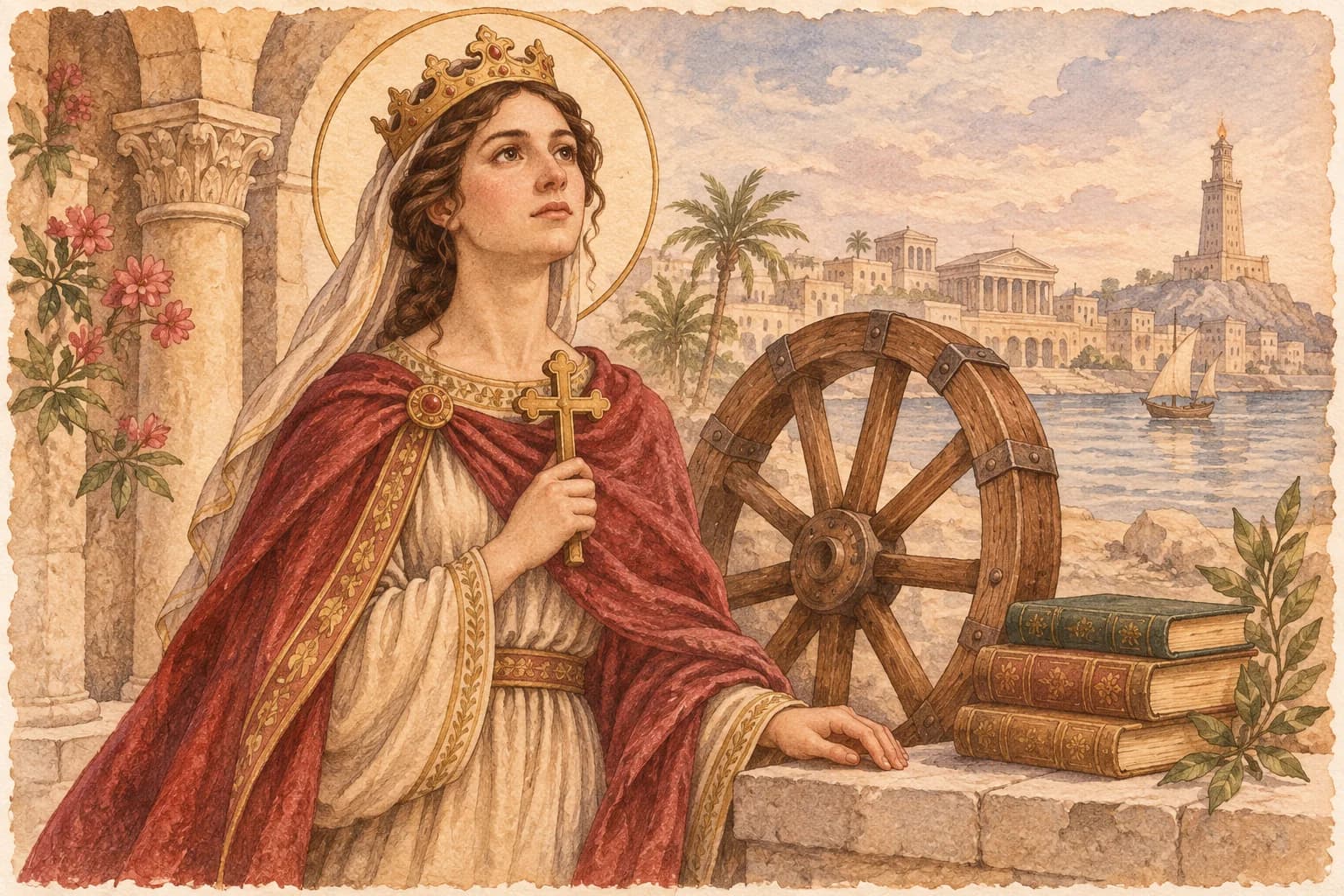
Catherine’s icons may include a wheel, cross and signs of royal dignity. These refer to her life and veneration. Read the inscription and compare the image with the church account to understand a particular icon.
The saint is not obliged to secure examination success or marriage. Asking her intercession does not replace study or personal responsibility. No outcome can be promised from a particular number of prayers.
If your name is Catherine, confirm your patron from your baptismal information. Read the life for the meaning of its witness as well as the name-day date. With children, discuss fidelity to convictions without humiliating another person.
Alexandria and the image of an educated Christian woman
Catherine is called Alexandrian because of her association with Alexandria in Egypt, a major centre of late antique culture. Her life portrays a young woman familiar with philosophy, literature and reasoned argument. This image matters to the narrative: faith is not presented as rejection of thought and learning. Education becomes part of witness without replacing inward conversion.
Long hagiographic lists of authors she studied should not, however, be presented as a surviving academic transcript. Early evidence and later literary forms have different degrees of historical certainty. An honest retelling identifies what the church life itself says. It can explain the value of learning without claiming to demonstrate every biographical detail through the methods of modern documentary history. That precision is particularly helpful when the readers are school or university students trying to distinguish a religious narrative from an independently documented curriculum.
Conversion to Christ and the language of spiritual marriage
The developed life gives an important place to Catherine’s conversion and dedication to Christ. It employs the imagery of a heavenly Bridegroom and spiritual betrothal. This language expresses wholehearted fidelity and belonging to God. It should not be read as an ordinary record of a civil marriage or turned into a romantic plot detached from Christian faith.
This explains her veneration as a virgin and martyr. Her path does not mean that family life is inferior to every other human calling or that women named Catherine must refrain from marriage. The Church recognises different vocations. Readers can attend to one person’s freely offered fidelity rather than extracting an instruction for everyone who shares her name. The image of spiritual marriage is understood through prayer and witness, not through a promise that devotion to Catherine must produce a particular outcome in someone’s earthly relationships.
Debate with learned men and steadfastness before authority
The life describes Catherine publicly opposing pagan worship and debating learned interlocutors assembled by the ruler. Within the church narrative, this scene demonstrates the power of witness and the possibility of turning towards truth. Detailed speeches and the number of participants should nevertheless be identified as elements of the hagiographic account, not presented as a surviving verbatim record of a public debate.
For a contemporary reader, the example is not humiliation of a less informed opponent or the obligation to win every argument. Intellectual preparation can serve an honest explanation of faith when it preserves respect and accuracy. Refusing coercion is also different from enjoying conflict. In the martyrdom narrative, Catherine remains faithful to Christ under threat rather than seeking danger for publicity. These distinctions allow her story to be discussed without converting it into instructions for aggressive religious argument.
The wheel, crown and cross in her icon
The wheel in Catherine’s iconography refers to the narrative of an instrument prepared for her torture, not to her occupation. The cross signifies martyrdom; royal attributes correspond to the received hagiographic description. Some images include a book and other references to learning. Together these features assist recognition, while the inscription remains the most important guide.
Explaining the icon to a child does not require a detailed description of torture. It is enough to say that people tried to force the saint to abandon Christ, but she remained faithful. Signs of martyrdom in church art speak of the victory of faith rather than inviting viewers to enjoy suffering. When choosing an icon as a gift, establish whether Catherine of Alexandria is the intended person’s patron. An attractive depiction cannot correct the mistaken identification of a saint, and decorative attributes alone should not decide the choice.
Sinai, her remembrance and prayer about learning
Catherine’s veneration is closely associated with the monastery on Sinai widely known by her name. Church tradition recounts the translation of her relics to Sinai. This explains why accounts of the saint often appear alongside the monastery’s history and pilgrimage traditions. A place of veneration should not, however, be confused with the location of her birth or earthly witness: the Alexandrian and Sinai associations concern different aspects of her remembrance.
People also ask her prayers in connection with study. Such a request does not remove preparation, honesty in examinations or responsibility for one’s work. The account of a learned martyr can instead encourage respect for knowledge and its conscientious use. One may seek help with fear or distraction without expecting a particular grade in exchange for a number of candles. Church veneration concerns Christ and personal transformation, not an exchange of religious acts for a guaranteed academic outcome.
A question for reflection
How can firmness of conviction coexist with respect for another person?