
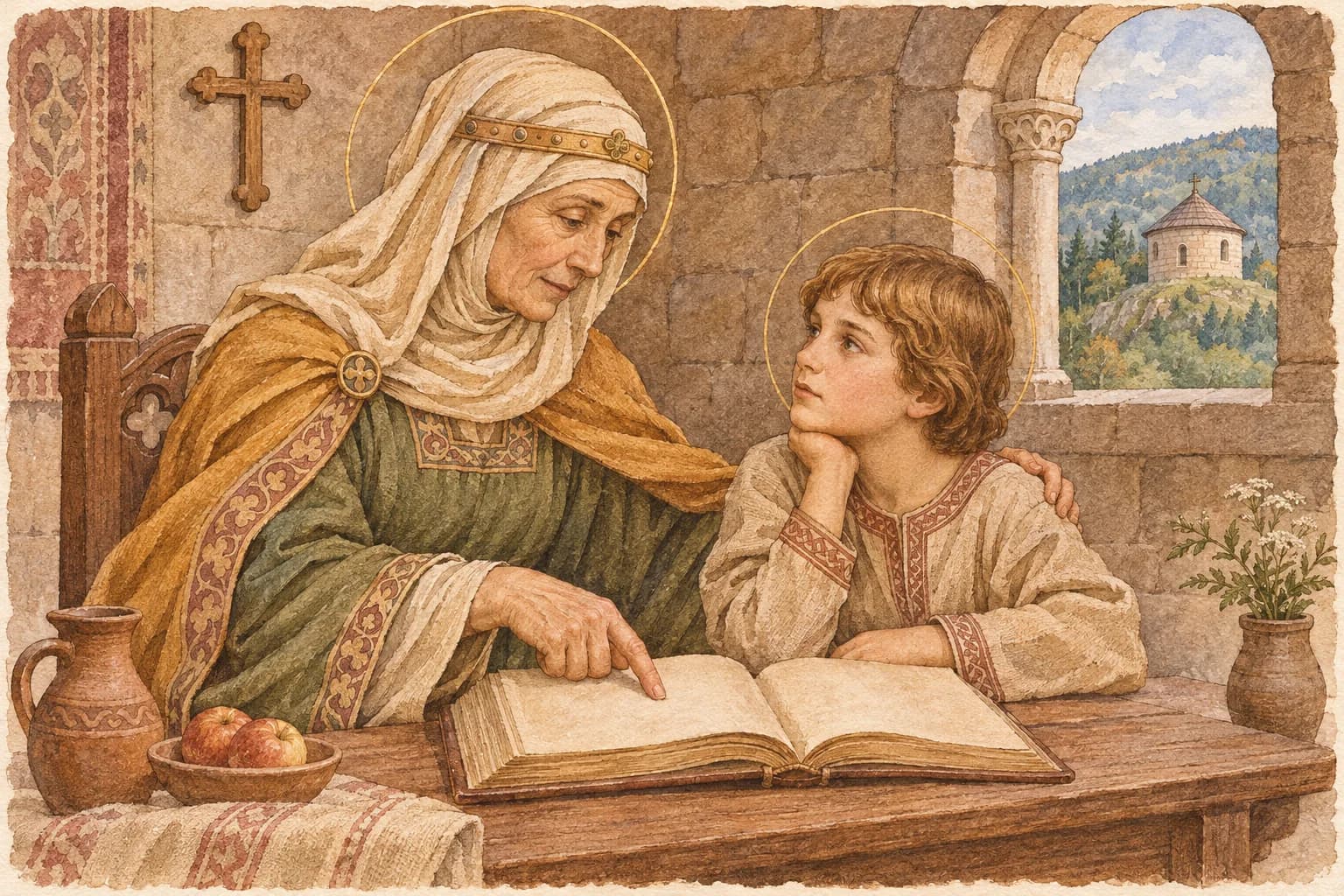
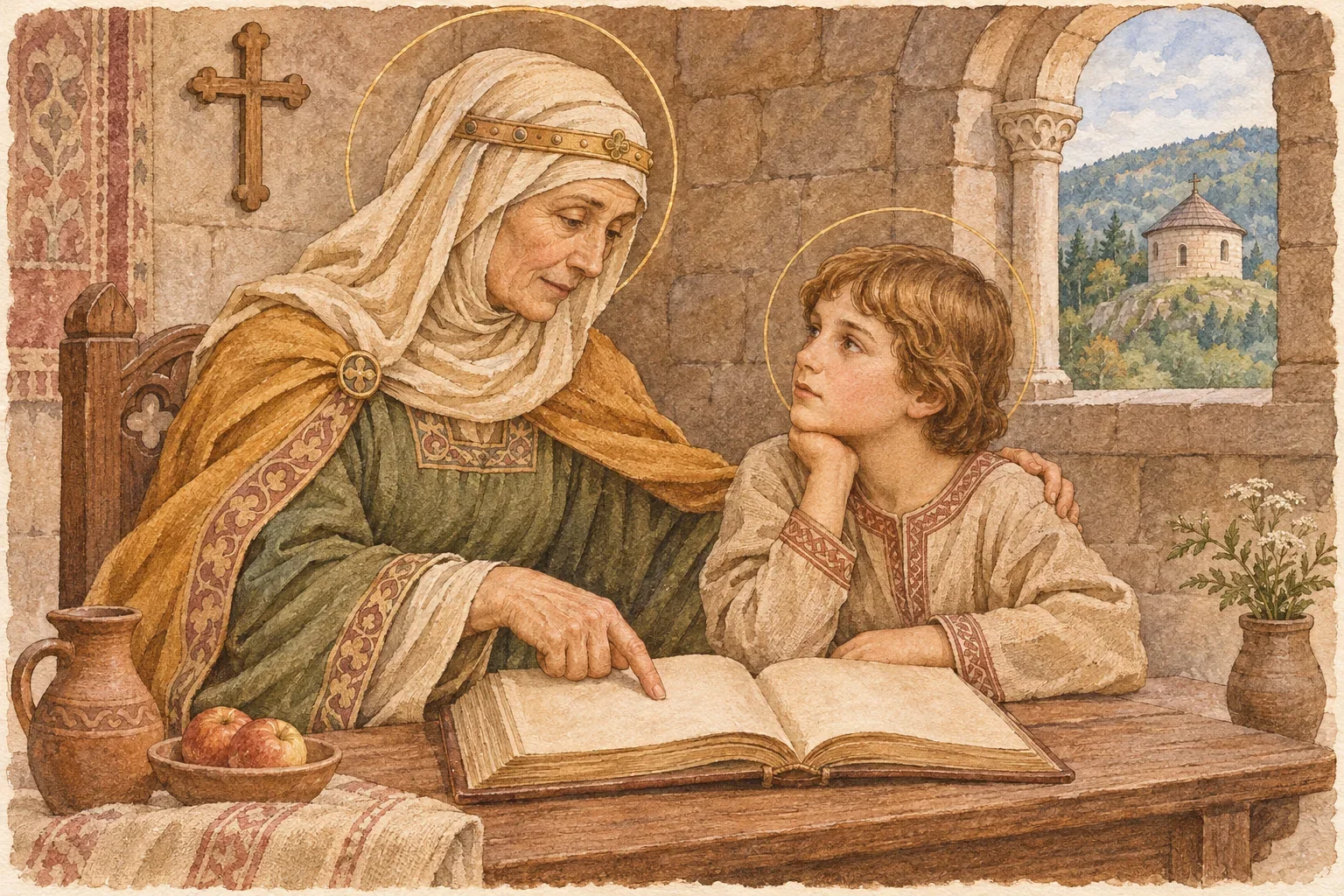
Princess Ludmila the martyr belongs to the early Christian history of Bohemia. Her life remembers her role in raising her grandson Wenceslas. Her example shows faith’s place in family life without pretending that relationships are simple or free from conflict.
Her story includes difficult court relationships and a violent death. Explain these circumstances with attention to the period. A child’s account can describe her martyrdom without graphic repetition of the violence.
The example of a holy grandmother does not justify a struggle for control over grandchildren. Passing on faith is not identical with intervening in every parental decision. Respect, patience and example differ from religious pressure.
Read the life and consider an appropriate way to support younger relatives: reading together, practical care or a calm answer. When parents and grandparents differ, begin by discussing agreed boundaries.
A princess in the beginnings of Christian Bohemia
Ludmila belongs to the early history of Christianity in the Czech lands. Together with her husband, Prince Bořivoj, she received baptism and supported the establishment of church life. Her hagiography associates their conversion with Saint Methodius, the enlightener of the Slavs. The account concerns more than the couple’s personal change: building churches and inviting priests made worship and instruction possible for others.
A society did not become Christian in a single day. The new faith entered a world of existing customs, political alliances and family interests. Read the princess’s biography within that historical setting rather than as a story in which baptism instantly removes every conflict. Fidelity involved sustained care for people and the church community, including during periods when the new religion’s place in public life remained contested.
The grandmother of Saint Wenceslas
Ludmila’s care for her grandson Wenceslas, also known in Russian as Vyacheslav, has a particular place in her remembrance. He too was subsequently recognised as a saint. Their connection shows that transmitting faith includes the living example of an older generation: a child notices how an adult prays, treats people in need and makes decisions.
The life does not, however, provide a universal instruction that a grandmother should replace the parents. The princely household had particular circumstances and struggles over influence. The contemporary significance lies in responsible involvement with younger people, not entitlement to control a family. Helping a child formulate a question about God and answering patiently may be more fruitful than demanding mechanical repetition of unfamiliar religious words. The relationship itself gives teaching credibility.
Martyrdom and remembrance in Prague
The hagiographic account connects Ludmila’s death with a conflict involving Drahomíra, Wenceslas’s mother. The princess was killed by men sent against her, and the Church honours her as a martyr. A careful retelling can explain the political and religious tensions and the saint’s fidelity without turning the story into a rule that every disagreement between a mother-in-law and daughter-in-law reproduces a battle between good and evil.
Ludmila’s veneration is associated with Prague and the church of Saint George, where her relics were transferred. Their translation shows how the memory of a person continues within a worshipping community. If you plan to visit, check present access arrangements and opening times. Information about a medieval burial does not establish the practical visiting conditions that apply today.
Icon, name and commemoration
Images of Ludmila may include princely dress, a cross and details recalling her martyrdom. These help interpret the biography, but the complete inscription remains decisive for identification. The designation of Bohemia or Czech distinguishes her from other saints called Ludmila, including modern martyrs. Sharing a personal name does not by itself prove that this particular saint is someone’s baptismal patron.
For a family calendar, record the full designation and the commemoration according to the parish’s calendar. If online sources give different dates, first check whether they use different calendar styles. When selecting a gift, ask the recipient about their patron. That is more considerate than purchasing the first icon matching the name and then telling the recipient whom they ought to regard as their own saint.
What her story can contribute to family life
One practical lesson concerns patient transmission of faith. Read a short Gospel passage together, explain an unfamiliar word heard in worship or let a child see you helping an elderly neighbour. Religious conversation should be accompanied by the same honesty and kindness that the adult expects from the child. Otherwise church language can begin to sound like another technique for obtaining obedience.
Where family members differ about religion, discuss church visits and a child’s religious activities openly in advance. Secret competition among adults for influence seldom brings peace. Ludmila is honoured for her witness to Christ, not as justification for everything an older relative might do. Remembering her can encourage care that is consistent, attentive and less concerned with securing personal authority over other members of the family.
A question for reflection
What good example can support a child without competing with the parents?