
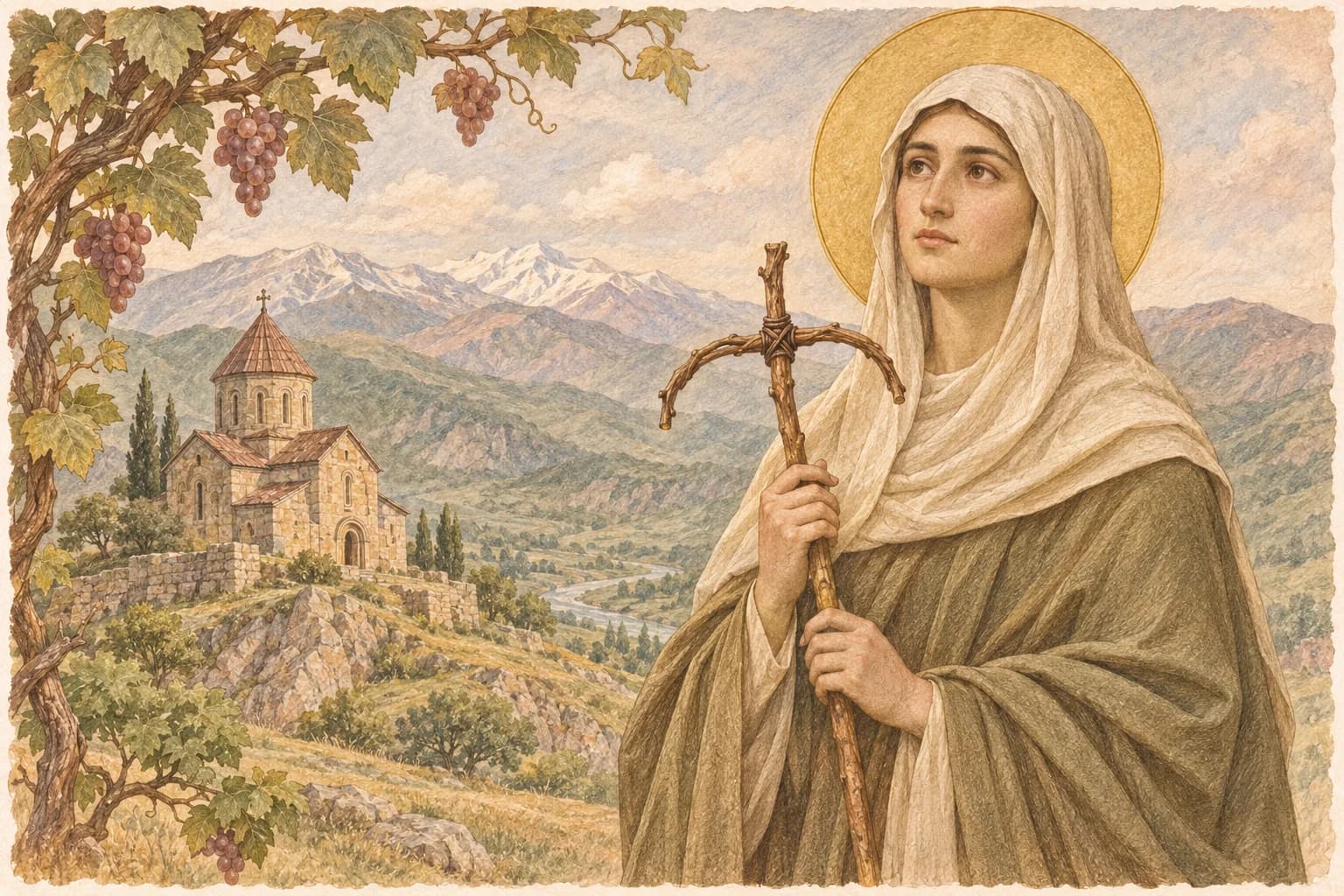
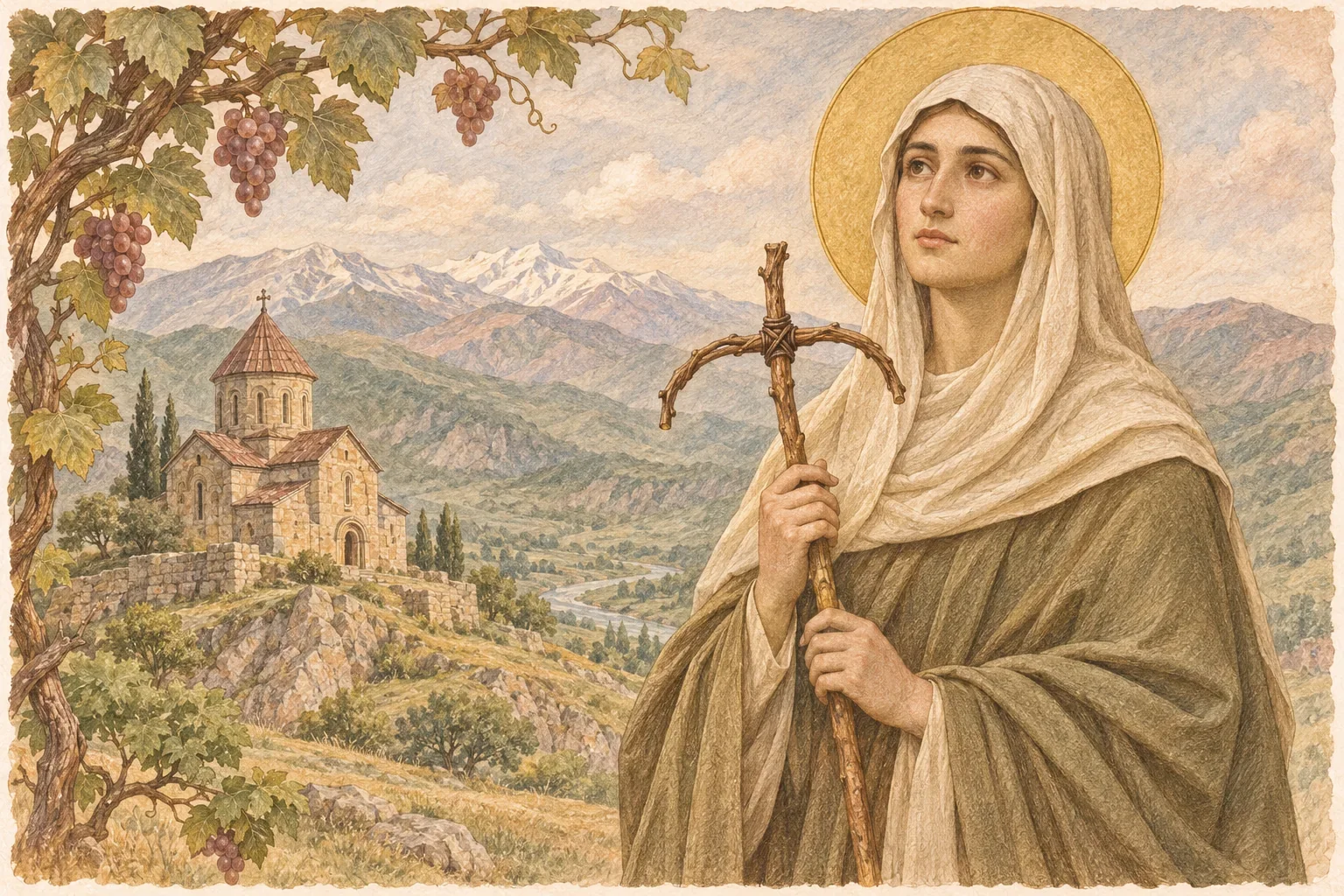
Saint Nino is honoured as Equal-to-the-Apostles and enlightener of Georgia. Her name is associated with the spread of Christianity in Iberia in the fourth century. Icons often show a cross with downward-sloping arms, connected with the tradition of the vine cross.
Her life tells of witness, prayer and people turning to Christ. Its meaning cannot be reduced to the unusual shape of an object. It concerns a person bringing the Gospel within a particular country and culture.
Georgian Iberia should not be confused with the Iberian Peninsula. Saint Nino’s cross is not a talisman with an exclusive protective function. Both the historical name and the church symbol need explanation rather than guesswork.
Begin with a church life and a map of historical Iberia. When identifying a patron saint, confirm the baptismal name and calendar commemoration. Respect for another church culture begins with accurate names.
Iberia, Kartli and Georgia: identifying the setting
In Nino’s life, Iberia refers to the ancient eastern Georgian kingdom associated with Kartli. It is not Spain and Portugal on the Iberian Peninsula, although historical geography uses a similar name for both regions. Clarifying this at the outset prevents confusion about travel routes and political setting. Church remembrance associates Nino with the Christianisation of Georgia in the fourth century.
Her ministry is understood in relation to local inhabitants and the royal court, not as an abstract journey through an unidentified country. The spread of Christianity involved communities, worship and connections with other Christian centres. Yet calling her enlightener of Georgia does not claim that nobody in the region had previously heard of Christ. It identifies the exceptional significance of her mission within the Church’s remembrance rather than making an exhaustive statement about every earlier contact with Christianity.
Personal witness and the conversion of others
The hagiographic account portrays Nino not as the director of a major state enterprise but as a person of prayer and assistance. She lives among local people, attends to those who suffer, speaks about Christ and gains trust. Accounts of healing belong to church tradition; their meaning concerns people turning towards God rather than a display of personal control over illness.
Her preaching is associated with King Mirian’s conversion and the subsequent strengthening of Christianity. An account should distinguish the establishment of a Christian kingdom from the detailed miraculous episodes of the life, because the sources have different characteristics. This need require neither mockery of tradition nor the conversion of every narrative detail into a modern transcript. It allows the central movement to remain visible: one person’s witness becomes part of the history of an entire ecclesial culture.
The vine cross and its recognisable shape
According to church tradition, Nino received a cross made from a grapevine from the Mother of God. In its familiar form, the ends of the transverse arms slope downward. That distinctive shape often helps identify the saint in an icon. It should be explained through the narrative and inscription rather than by inventing a separate hidden meaning for every curve.
Nino’s cross belongs within Christian veneration of the Cross; it does not represent a different faith or an alternative way of salvation. A purchased copy does not automatically protect a house, secure a marriage or make travel safe without ordinary precautions. When given as a reminder of Georgia, it can provide an occasion to explain the enlightener and her witness. That is more substantial than promising an object a special power detached from faith and the person’s actual life.
An Equal-to-the-Apostles woman: what the Church honours
Nino is honoured for evangelising ministry whose significance is related to apostolic proclamation. Equal-to-the-Apostles does not mean that she lived during Christ’s earthly ministry or belonged to the Twelve. Nor is it a designation of priestly ordination. In Christian life, witness, mercy and communicating the faith are not activities reserved exclusively to ordained ministers.
That distinction also helps contemporary readers. A woman can contribute greatly to others’ encounter with faith through education, care, personal example and honest conversation. This does not require claiming ecclesiastical powers entrusted to someone else. Nino’s story highlights the value of a particular gift and fidelity to it. It gives no reason to measure a person’s importance solely by an official position, public fame or the ability to direct other people. The historical scale of her influence should not obscure the personal character of her witness.
Name days and encountering Georgian church remembrance
In the Russian church calendar, Nino the Enlightener of Georgia is commemorated on 27 January in the present civil calendar. When using a calendar from another country, account for the calendar system and form of the name: Georgian Nino and Russian Nina refer here to the same saint. Someone already baptised should identify their patron from the available records rather than casually changing the dedication because a different date appeared in a search.
If visiting places associated with her veneration, first check current visitor arrangements, transport and opportunities to attend worship. Pilgrimage does not require collecting every available souvenir. Connecting the journey with learning about the Georgian Church and respecting local prayerful life is more useful. The saint’s name can then become more than a caption beneath an unusual cross: it opens a window onto a particular Christian tradition and its living remembrance.
A question for reflection
What have you learned about her witness beyond the appearance of her cross?