
Princess Olga is honoured as Equal-to-the-Apostles for the importance of her Christian witness in the history of Rus. She was baptised before the wider Christianisation associated with Prince Vladimir. Distinguish her personal journey from the later historical event.
Her life is known through chronicles and church sources, which require attention to date and genre. Historians do not establish every detail of her early biography with equal certainty. A popular retelling is not a substitute for considering the evidence.
Canonisation does not declare every political act of a person exemplary. The church account focuses on conversion to Christ and witness to faith. A saint’s name should not be used to justify the violence of an earlier age.
Read a church life and distinguish its spiritual meaning from political legends. If Olga is your patron, confirm your baptismal name and feast through your parish calendar. Do not establish a name day from an arbitrary list alone.
The princess before baptism: a life not beginning in perfection
Olga was the wife of Prince Igor of Kyiv and participated in governing Rus after his death. Chronicle tradition preserves severe accounts of her revenge against the Drevlians and of subsequent administrative arrangements. These episodes cannot be presented as models of Christian mercy merely because she was later venerated as a saint. The distinction between her earlier pagan life and reception of Christianity matters.
The question of how she can be a saint when her biography includes violence calls for discussion of conversion, not retrospective justification of every action. Church veneration concerns her Christian life and the significance of her witness. Chronicle details must also be read with attention to literary form and the time of recording. Historical caution and moral clarity belong together: neither mechanically reproducing a medieval account as a court transcript nor describing revenge as a virtue answers the question responsibly.
Baptism and the name Helena
Church tradition associates Olga’s baptism with Constantinople and records that she received the name Helena. In reconstructing the precise chronology, historians compare chronicle and Byzantine evidence; not every detail can be harmonised without difficulty. It is therefore useful to distinguish the broadly accepted fact of her Christianity from particular reconstructions of the date, place and circumstances of conversion.
The new name connected her with Helena, mother of Constantine and honoured as Equal-to-the-Apostles. Sharing a name does not mean sharing an identical biography or repeating every action of the patron saint. Olga’s conversion occurred in a setting where princely authority and much of her surrounding society remained attached to the earlier religion. She was not simply joining an already universally established Christian life in Rus. The distinctive significance of her early witness emerges from that setting.
Why Olga did not baptise all of Rus
Her son Sviatoslav did not follow his mother’s choice. Chronicle remembrance relates his attitude partly to his military retinue and established way of life. The history should not be reduced to a scheme in which one command from the princess would automatically have converted an entire country. Religious change involves authority, customs, personal trust and resistance within the surrounding society.
The larger-scale reception of Christianity under Vladimir belongs to a subsequent stage. Olga was his grandmother, but her influence does not make his conversion the guaranteed outcome of a single family conversation. Complex events separate the generations. Contemporary readers can recognise a familiar issue here: the faith of one family member does not give that person control over everyone else’s decisions. Witness may matter even when relatives do not immediately agree or when its effects cannot be measured within the witness’s own lifetime.
Equal-to-the-Apostles: understanding the designation
Olga is called Equal-to-the-Apostles because of her contribution to the beginning and strengthening of Christian life in Rus. The designation does not claim that she belonged to the disciples who witnessed Jesus’s earthly ministry. It recognises the evangelising significance of her life. Its concern is the substance of her witness, not merely her high political position.
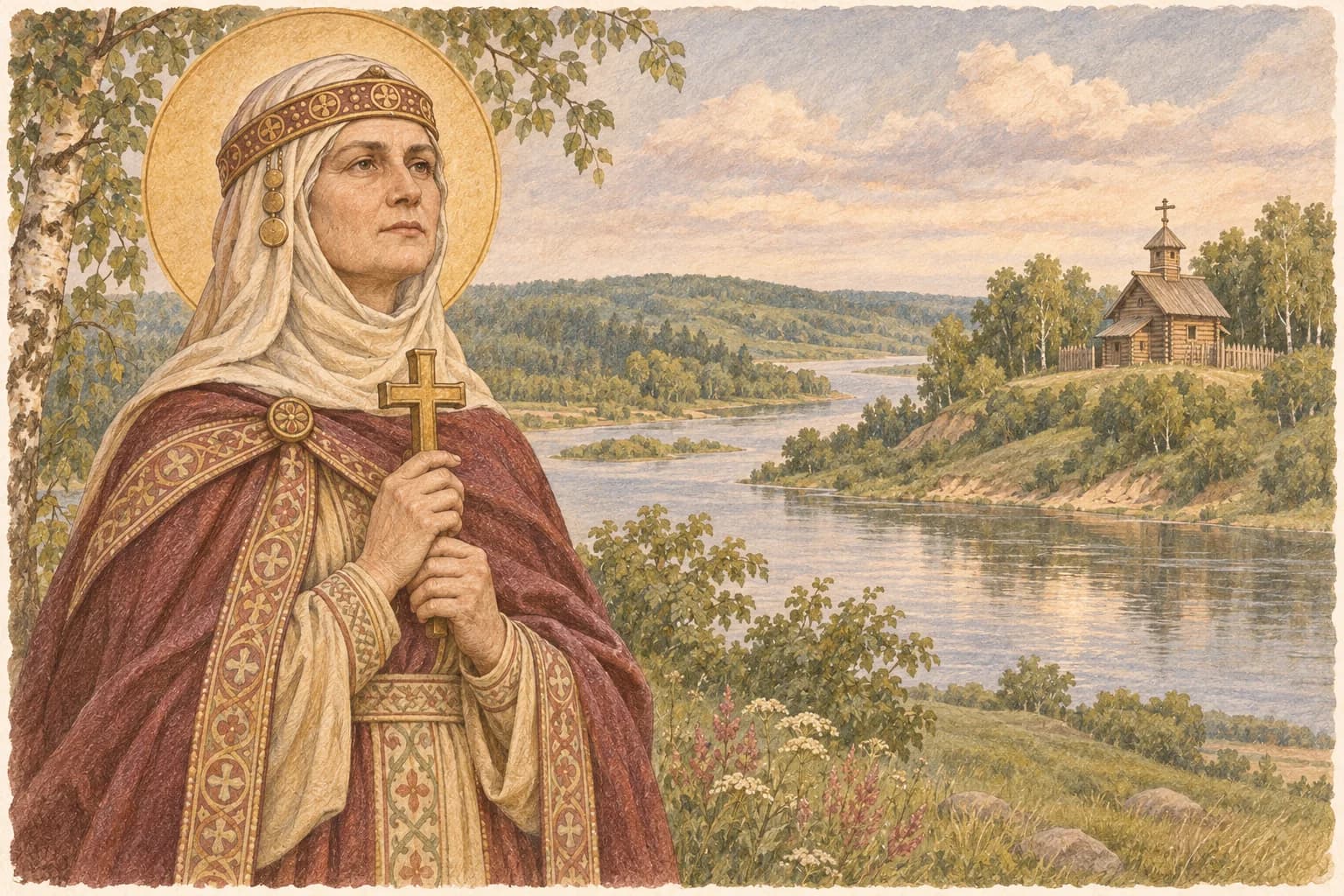
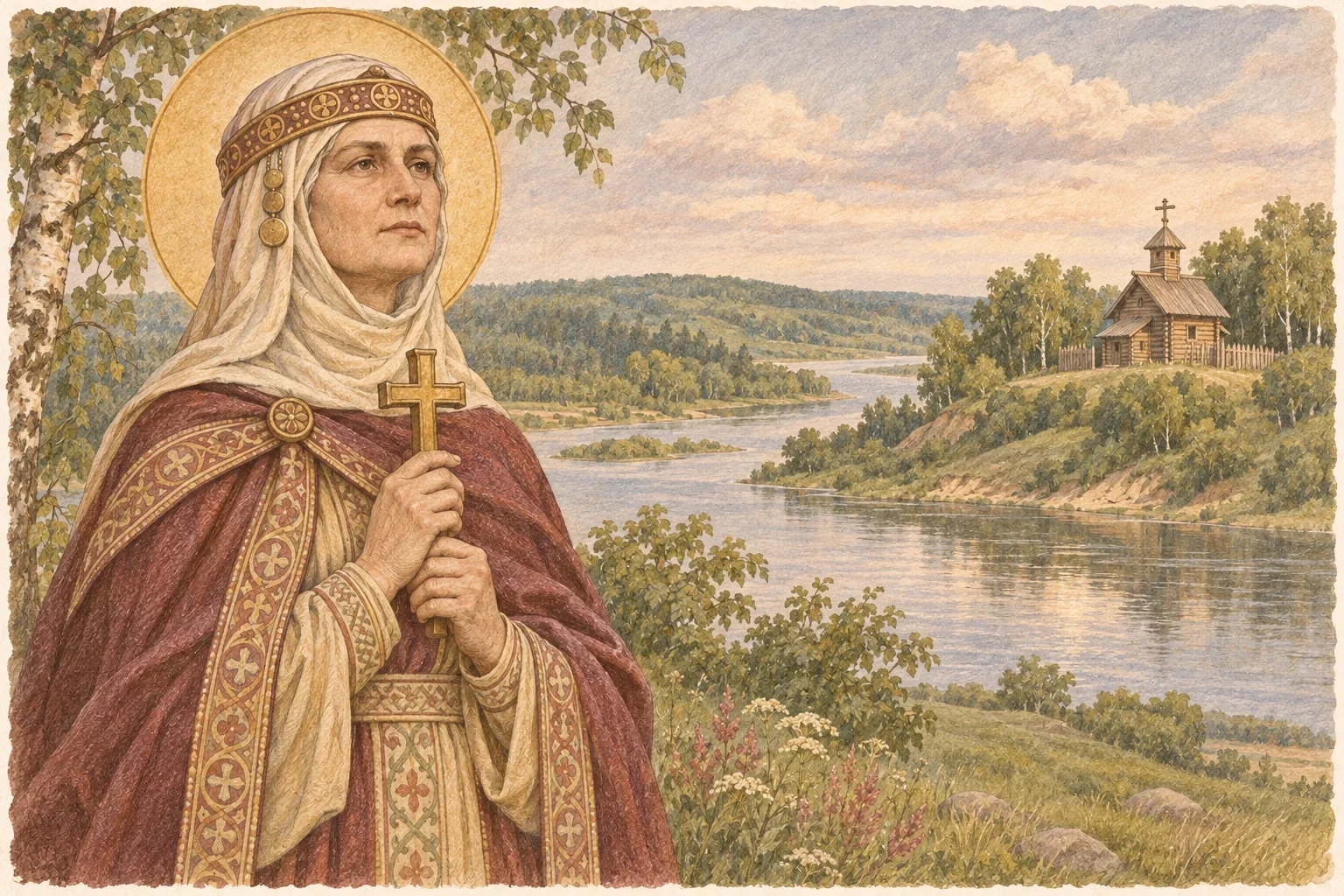
Icons often depict her holding a cross and wearing princely clothing. The cross concerns reception and confession of the faith; the garments recall her historical position. These signs do not identify political power itself with holiness. Encountering a church or chapel dedicated to Olga can prompt a useful question about the aspects of her Christian remembrance being expressed: personal conversion, witness among relatives who do not share the faith, and care for the beginnings of ecclesial life.
Reading her history responsibly today
Tenth-century Rus cannot be equated without qualification with a single modern state. Olga’s story connects Kyiv, northern territories and relations with Byzantium; its remembrance matters to different peoples. Turning her life into proof of national superiority impoverishes its Christian meaning and prevents the historical period from being understood on its own terms.
A good first reading distinguishes three questions: what events the source reports, how the Church understands the princess’s conversion, and what a contemporary person can learn without literally copying her position. The last question does not require justifying medieval violence. It may concern courage to reconsider an established life, patience with relatives who do not believe, and fidelity without the illusion of immediate success. Such distinctions produce a more substantial account than uncomplicated praise of a famous ruler.
A question for reflection
Which claims concern Olga’s Christian witness, and which need historical verification?