
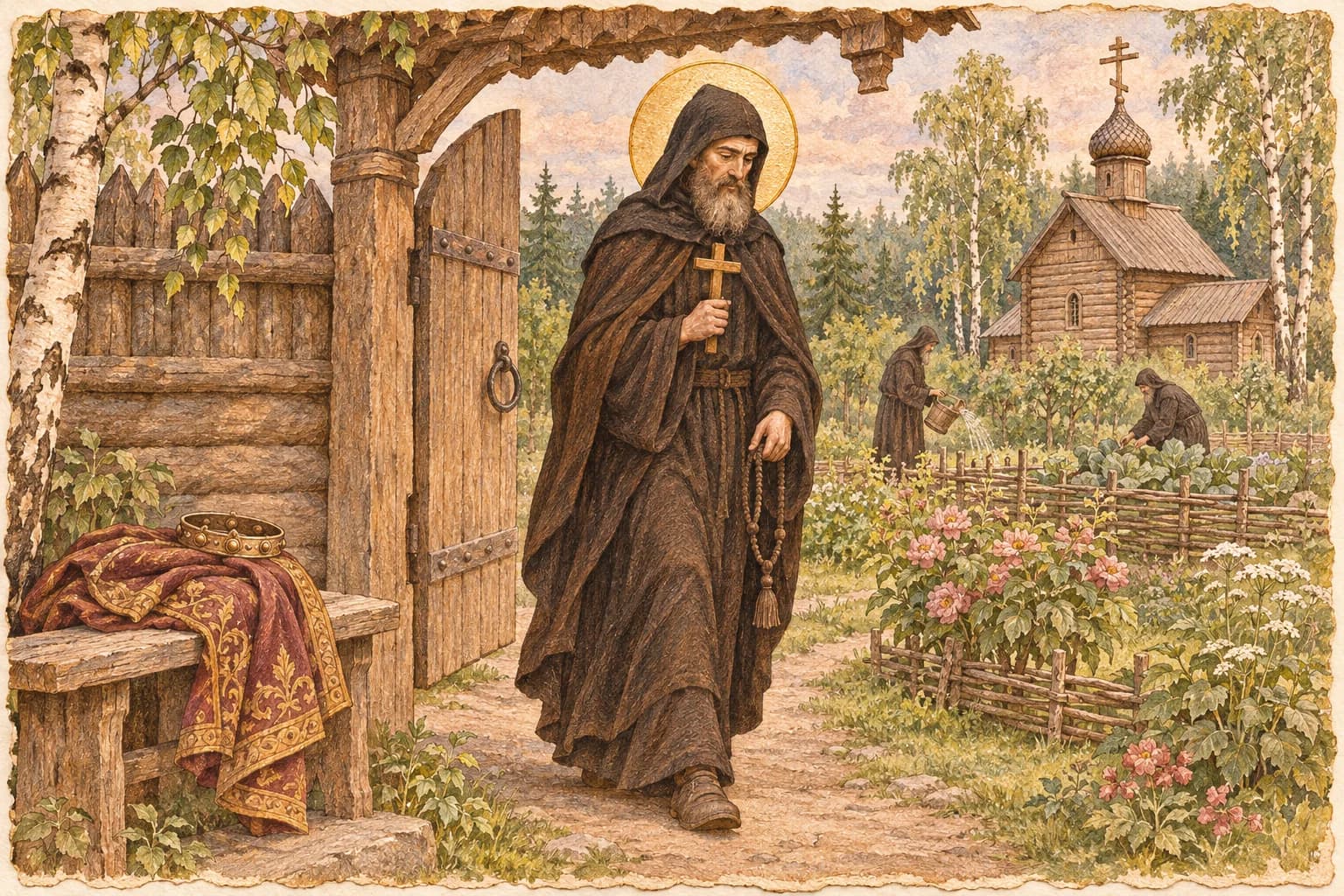
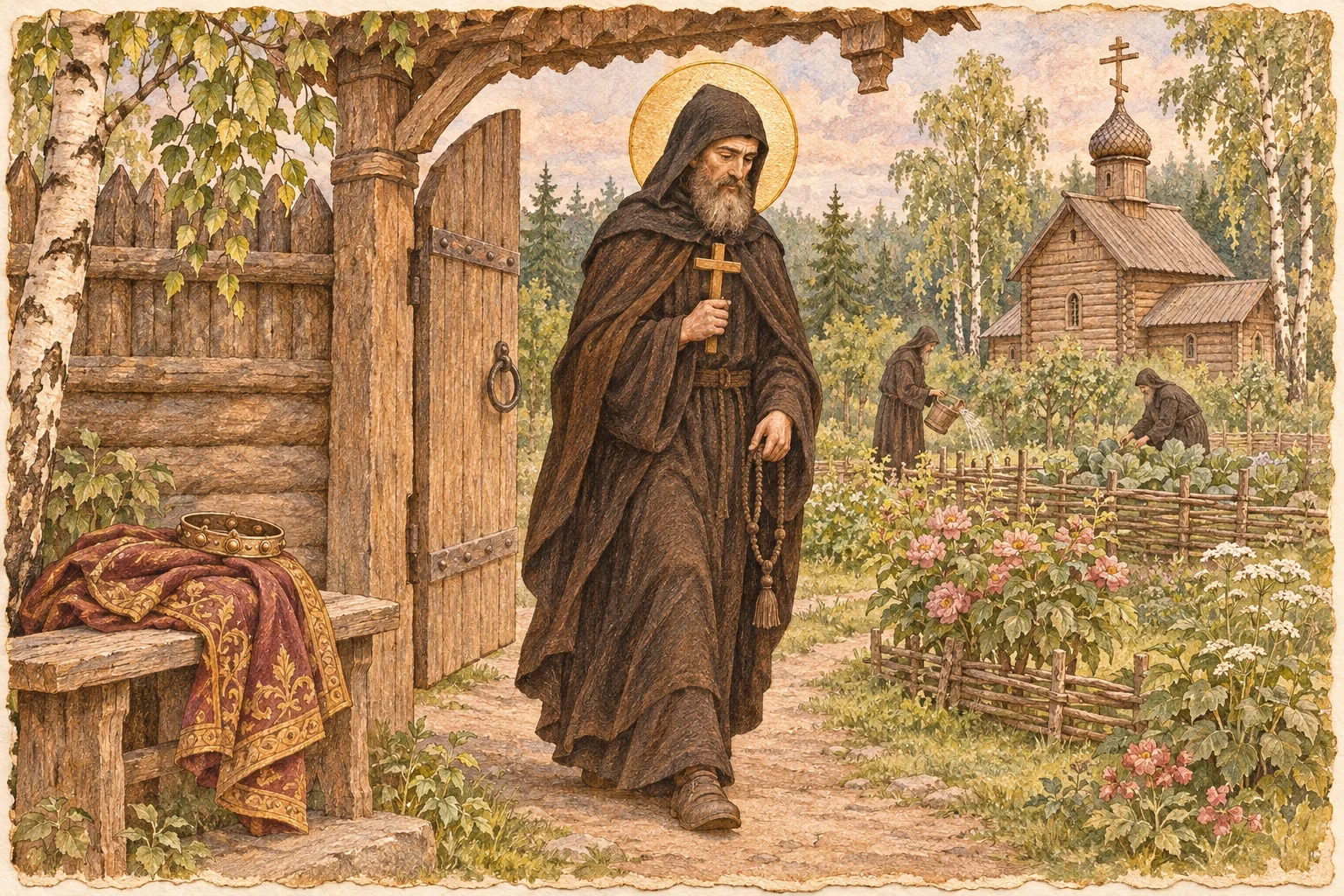
Saint Oleg of Bryansk was a prince who became a monk. His designation as a monastic saint matters because his remembrance concerns that vocation. He should not be confused with other historical princes merely because they share the name Oleg.
Concise accounts of a medieval saint cannot reconstruct every part of his life. The church life conveys what matters for communal remembrance. Where information is limited, respect that limit instead of adding attractive invented scenes.
A prince’s renunciation of status for monasticism does not tell everyone to abandon family and employment immediately. Monastic vocation requires ecclesial discernment and responsibility. A life can raise questions about values without making the reader’s decision for them.
If your name is Oleg, confirm the patron and feast in the church calendar. Read the life without demanding sensational details. A practical question for a layperson concerns the place of status, possessions and service in everyday life.
Princely background and historical setting
Oleg Romanovich of Bryansk lived in the thirteenth century and belonged to the princely family of Chernigov. The church account connects him with the family of Saint Michael of Chernigov. In that period, princely authority involved military campaigns, complicated relations between territories and responsibility for the people governed. Oleg’s monastic decision is therefore presented against the background of a real possible political career.
The brief hagiographic evidence does not allow every year of his life to be reconstructed. Where a source is approximate, an attractive narrative does not justify inventing a precise date, a detailed family conversation or psychological explanations for the decision. It is more dependable to identify the known sequence: princely background and participation in the affairs of his period, followed by renunciation of authority and life in a monastery.
The monastery of Saints Peter and Paul in Bryansk
According to the church account, Oleg used his resources to establish the monastery of Saints Peter and Paul and received monastic tonsure there himself. This differs significantly from making a donation: he changed not only the use of his property but also his way of life. His remembrance brings together provision of a place of prayer for a community and personal participation in the monastic calling.
The modern word founder can suggest an owner who continues to control an institution as private property. The monastic significance is different: the prince enters a life in which personal status is placed within a common ecclesiastical order. Specific administrative decisions should not be attributed to him without evidence, but the transition from princely rule to monastic life remains central to his veneration.
Why sources may contain different names
Princes could have different public, baptismal and monastic names. The appearance of another name in a life does not necessarily identify a different person. The church reference used here describes Oleg as receiving tonsure with the name Basil, while historical and liturgical materials contain naming variations that require careful attention.
For the ordinary question about Saint Oleg, the most dependable approach is to retain the established full designation, Oleg Romanovich of Bryansk, and explain the monastic stage separately. An academically precise account of the names would require comparing historical sources rather than mechanically combining every variant into one formula. When choosing an icon for home, the immediate concern is to avoid confusing him with another saint or a historical prince called Oleg. An unexplained difference in spelling or naming should prompt checking, not an invented resolution.
Understanding the renunciation of power
The life does not teach that every ruler must resign or that every layperson should immediately enter a monastery. The Church remembers saints who served God while continuing to govern, raise children and maintain a household. Oleg’s particular significance lies in his own calling, not in a universal prohibition on public responsibility.
His example becomes clearer when considered as freedom from status and wealth. If a title determines a person’s entire sense of worth, relinquishing privilege seems impossible. A monastic decision reveals another ordering of values. For readers living in families, a practical response might involve exercising authority honestly, refusing to use a position for vanity and being willing to serve where no public recognition follows. This application respects the difference between a saint’s vocation and the reader’s actual responsibilities.
What to look for in the icon and the life
Saint Oleg may be represented as a monk, emphasising the final form of his life. The princely designation preserves the memory of his background and decision. Monastic clothing therefore does not contradict an inscription identifying him as a prince. It indicates which aspect of the biography the image stresses, while the complete name connects that representation with a particular person.
Begin with a concise life and then investigate the history of the monastery of Saints Peter and Paul. If planning a visit to Bryansk, distinguish historical information about the community from current service times and access to sacred objects. A retelling for children can rest on three points: a princely family, the decision to become a monk and a life of prayer. There is no need to add military achievements or miracles absent from the source being used.
A question for reflection
What in your life serves others, and what is pursued only for status?