
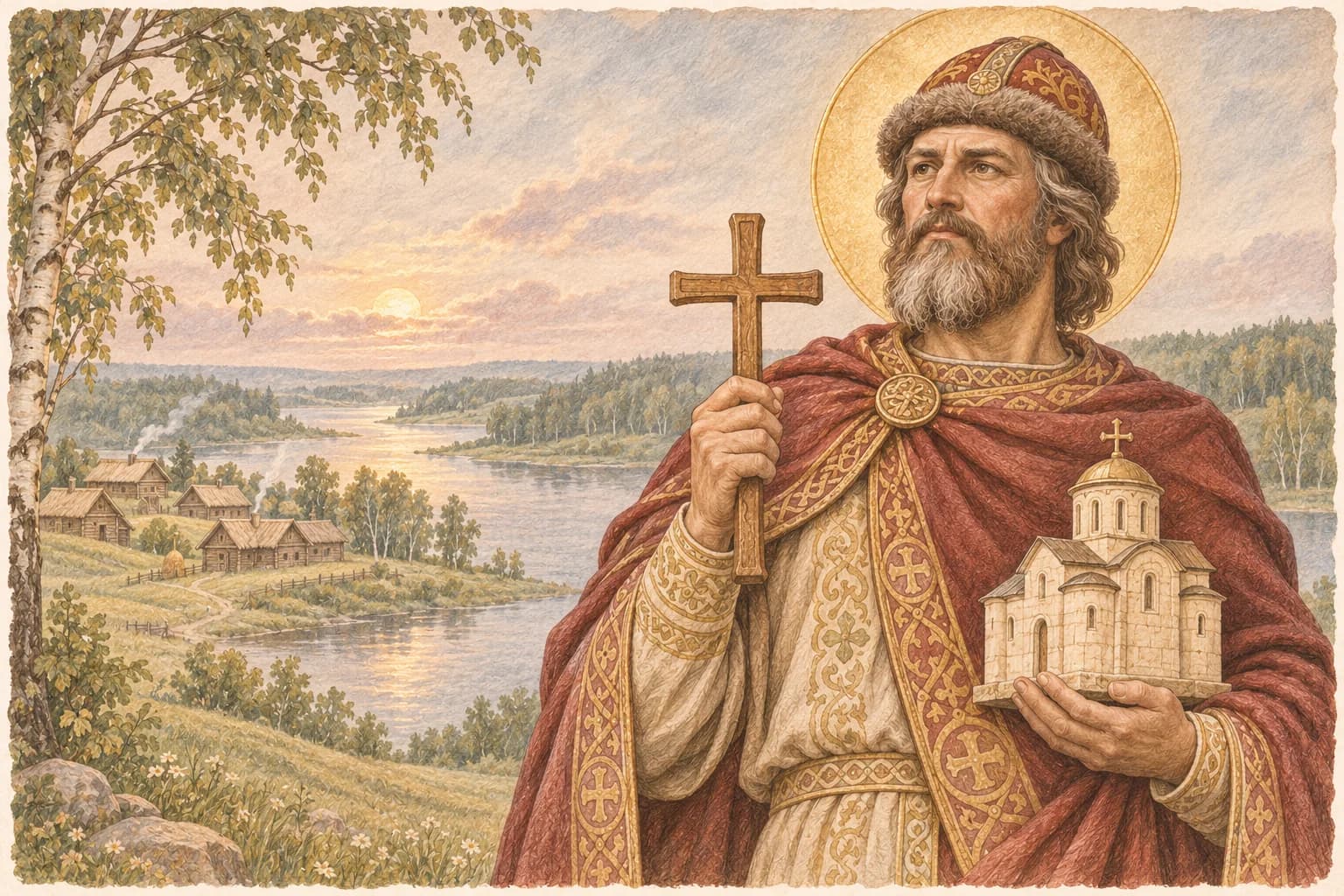
Prince Vladimir is honoured as Equal-to-the-Apostles for his connection with the Baptism of Rus and the spread of Christianity. Church remembrance also concerns his personal conversion. His life does not imply that every action before Baptism was exemplary.
The year 988 is the traditional reference point for the Baptism of Rus. The growth of Christian life was a lengthy process rather than an instant change in every custom. Churches, teaching and communities continued to develop after the princely decision.
A saint’s life should not become an assertion that one present-day people is superior to others. Historical territories do not map automatically onto current states. Veneration concerns Christ rather than compulsory acceptance of a political reading of history.
Compare a concise church life with historical explanation of the period. Also ask how faith changes a person’s actions after conversion. This reveals responsibility and a changed life behind the familiar date.
Vladimir before conversion: why his past should not be embellished
Prince Vladimir lived across the tenth and early eleventh centuries and belonged to the Rurikid dynasty. Before accepting Christianity, his life was associated with struggles for power, pagan worship and violent actions reported in the chronicle. A Christian account should therefore not imply that he was an exemplary ruler from the beginning.
Conversion concerns a change in the direction of life. This does not mean every chronicle detail is an independently preserved legal record; the sources require historical analysis. Yet the moral assessment of violence does not disappear because a person was later venerated. An Orthodox understanding of holiness makes room for repentance rather than justifying any biography on the grounds of a major political achievement. Distinguishing transformation from retrospective excuse provides a more useful starting point than either unquestioning praise or refusal to consider the possibility of change.
The prince’s baptism and the traditional date of 988
The year 988 is conventionally associated with Vladimir’s baptism and the beginning of the large-scale baptism of Kyiv’s inhabitants. The chronicle narrative includes Chersonesus, relations with Byzantium and marriage to Princess Anna. At baptism he received the name Basil. The precise sequence and dating of individual events, and the relationship between sources, remain matters of historical investigation.
A concise account should therefore distinguish a commemorative date from a claim that every territory and inhabitant was baptised on one day. Christian communities existed in Rus before Vladimir, and ecclesial life continued to develop after him. The account of choosing a faith also has a literary and theological structure; it should not be presented without qualification as a verbatim record of international negotiations. Recognising these distinctions does not diminish the event’s significance. It makes the description more accurate.
What changed after the reception of Christianity
Chronicle and church remembrance associate the new period of Vladimir’s rule with building churches, supporting clergy, education and assistance to those in need. The Church of the Tithes in Kyiv became an important symbol. Baptism involved more than renouncing an earlier cult: shared life had to be organised, requiring liturgical books, ministers and people willing to learn the newly received faith.
A change in religious allegiance cannot be expected instantly to remove every social conflict and inherited habit. Christianisation includes a long process of learning faith and practice. Vladimir’s significance therefore extends beyond one ceremony to the establishment of enduring ecclesial connections and conditions for later cultural development. At the same time, the achievements of several subsequent centuries should not all be attributed to the personal actions of a single ruler. The beginning of a process and its long-term unfolding are connected but distinct.
What Equal-to-the-Apostles means in his case
The designation concerns the exceptional significance of the spread of Christianity under Vladimir. It does not make him one of the Twelve or assert that state authority is holy in itself. His veneration centres on the relationship between personal conversion and the historical evangelisation of a people. Princely origin explains the scale of his opportunities, but it does not replace the Christian meaning of his life.
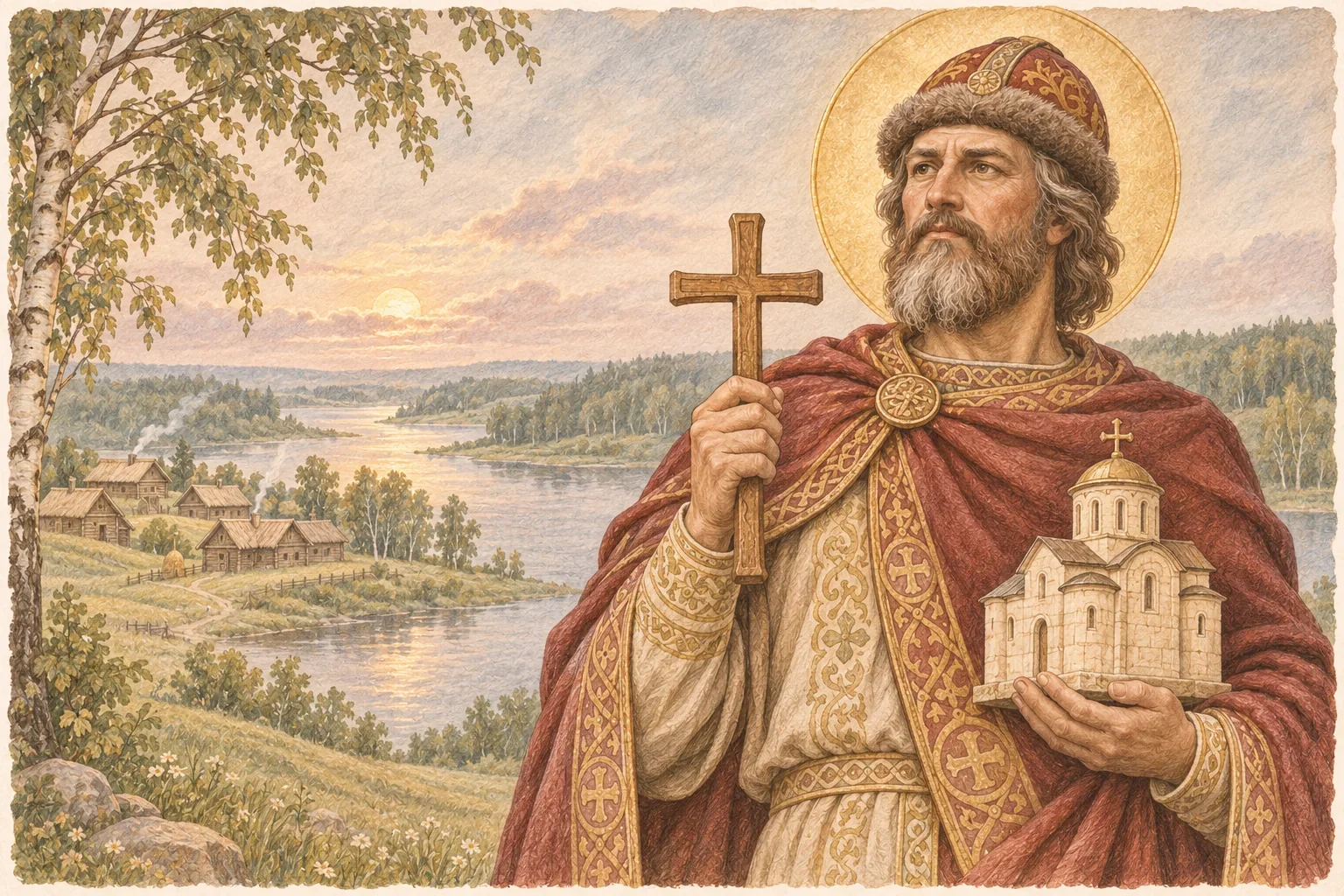
Icons commonly show Vladimir with a cross and sometimes a church building. These signs refer to baptism and the establishment of church life. The inscription remains important because princely garments also appear in images of other saints. In prayerful veneration, a believer asks for a saint’s intercession rather than reproducing a courtier’s relationship to a ruler. Depicting a prince in church is not an instruction to regard every political arrangement as a religious norm or to confuse allegiance to Christ with admiration for power.
Questions worth asking after reading his life
A first question concerns the source: where does a concise report of an event give way to the chronicler’s moral interpretation? A second concerns change: what does the account say about repentance and new actions, rather than simply a new religious label? A third concerns consequences: which developments occurred under Vladimir, and which emerged later? These questions help avoid both a naive retelling and a dismissive attitude adopted before examining the evidence.
At a personal level, conversion does not imply that political power is necessary to take an important step. It recalls that the past needs honest acknowledgement and new conviction needs corresponding action. Medieval Rus, moreover, does not coincide with the borders of one present-day state. Its Christian inheritance matters to different peoples. Respectful study does not require turning the saint into an argument against the dignity of neighbouring communities.
A question for reflection
What change of conduct matters more for understanding conversion than a biographical entry alone?