
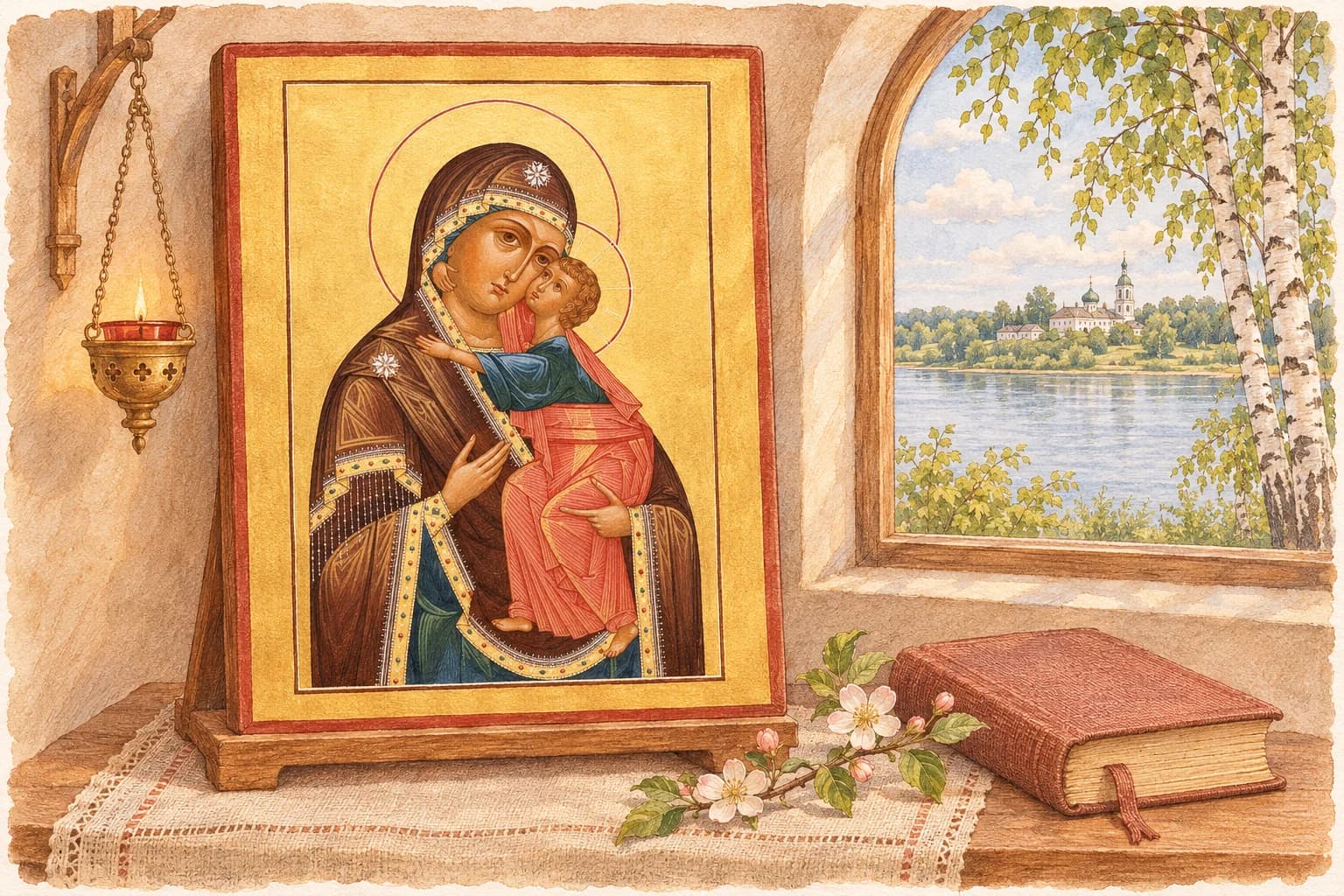
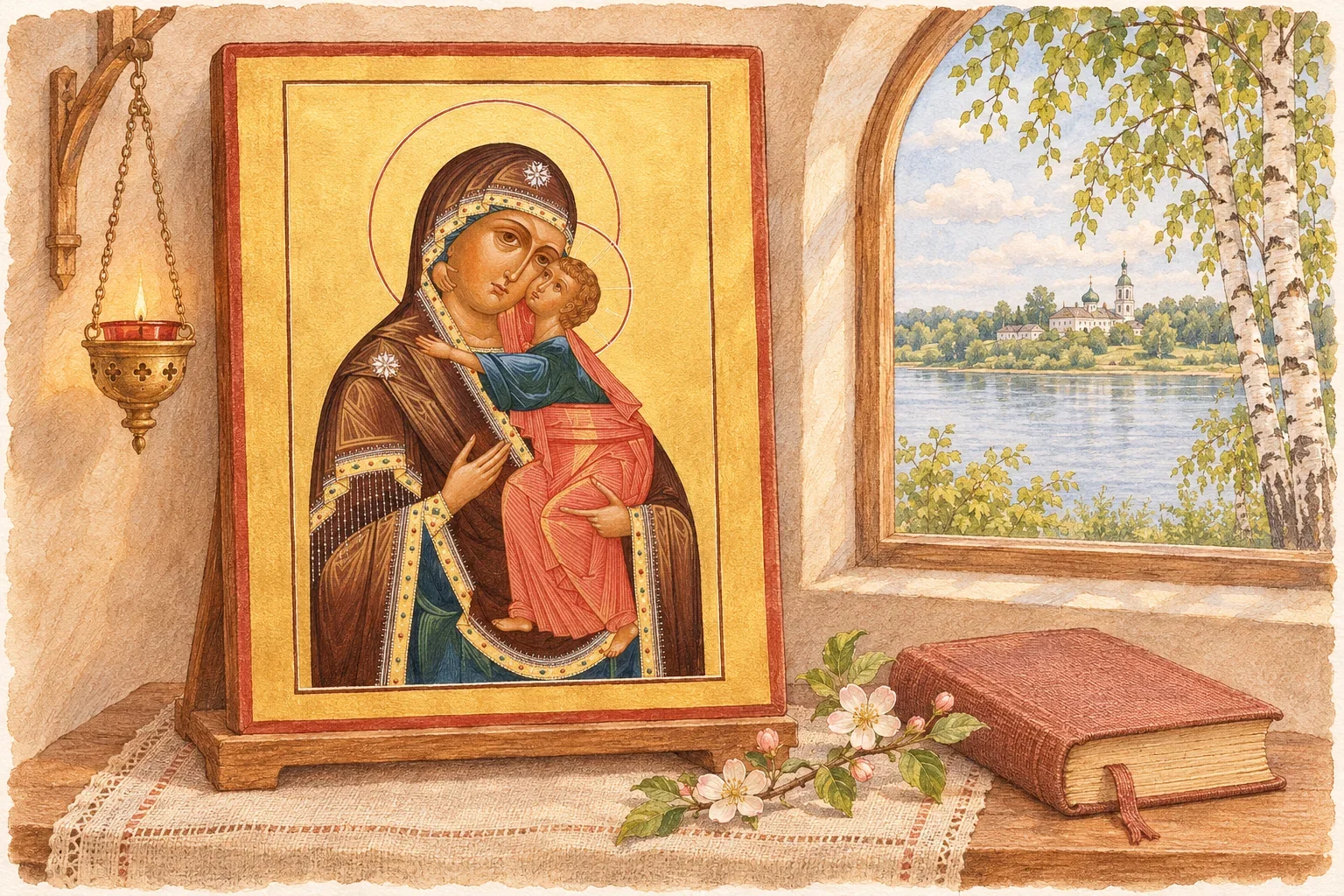
The Tolga Icon depicts the Mother of God with Christ and is associated with the Tolga monastery near Yaroslavl. Its name identifies a local history of veneration, not a different Mother of God or a prayer forbidden before other images.
Church tradition recounts the finding of the icon and the monastery’s foundation. Distinguish that narrative from the dating of particular surviving images. Different copies can share a title while having histories of their own.
Do not assess an icon through a seller’s promise that it helps exclusively with one problem. Christian prayer does not divide the Mother of God’s care into closed specialisms. Price, age of a reproduction and decoration do not determine access to prayer.
Read a church account and look at the image attentively. Before travelling, check the monastery’s current visitor arrangements. At home, begin with a brief prayer and thanksgiving without expecting a compulsory extraordinary sensation.
Tolga: a geographical name and a monastery’s memory
The Tolga icon takes its name from a place near Yaroslavl beside the Volga. It recalls Tolga and the monastic community established there. It is not the name of a separate Mother of God: geographical designations refer to the same Mother of the Lord while preserving the histories of places where particular devotion developed. Prayer before the Tolga and Vladimir icons is therefore not directed to two different persons.
A map and the monastery’s history make a useful starting point. They clarify accounts of a bishop travelling along the river, stopping overnight and the subsequent establishment of a community. The landscape is not an incidental backdrop: river routes shaped travel and ecclesiastical connections. Geography nevertheless does not make prayer less accessible to someone living far from the shrine or unable to travel there.
The tradition of the discovery
The church narrative associates the discovery with Bishop Prochorus of Rostov returning from a journey. Its nocturnal scene includes light, a crossing of the river and the appearance of an image of the Mother of God. The place is recognised the following day, and its memory is preserved; a monastery subsequently develops around the shrine. These details should be presented as church tradition rather than substituted for documentary reconstruction of every stage of the journey.
The account concerns attention to a gift: an unexpected encounter leads towards common worship and the establishment of a place of prayer. For a contemporary reader, that movement from an individual experience to ecclesial life is significant. The story does not instruct readers to seek night-time visions or treat every unusual natural sight as evidence of their own special election.
Tenderness in Tolga iconography
The Tolga image belongs to the Tenderness type: the faces of the Mother of God and Christ draw close, and the Child turns towards and embraces his Mother. The gestures express real human intimacy while also confessing the Incarnation. Mary does not hold an abstract symbol of an idea; she is depicted with the Son who truly assumed human nature.
Historical variations of the composition are known under the Tolga name, so detailed art-historical explanation requires identifying the particular object. The same date, dimensions and museum history should not be attributed to every copy. A household reproduction normally conveys a recognisable type, but its inscription alone does not establish which ancient image directly served as the model for the print. Identification and interpretation should therefore proceed together.
Monastic and museum history
The history of veneration includes twentieth-century events as well as the medieval narrative: the monastery’s closure, changes in the use of its buildings and museum custody of the sacred image. The church source dates the revered image’s return to the revived community to 2003. These events show why devotional history and the material history of an icon both need attention.
Preserving old paint involves temperature, humidity, the condition of the paint layer and safe handling. Such work does not contradict reverence; without it an object can be damaged. A protective case or limits on access should not immediately be regarded as an obstacle to faith. They may express responsibility towards the sacred object and towards future generations who will encounter it. Conservation and veneration can consequently require careful cooperation rather than rivalry.
What to notice on a visit and remember at home
On a visit to Tolga, allow time not only for photographs but also for learning about the church, its history and its worship. Check the current arrangements for approaching the icon and do not try to bypass restrictions. Objects brought home can preserve a memory, but buying them is not a condition for a pilgrimage to have been meaningful.
At home, record a few clear points: why the image is called Tolga, which iconographic type it belongs to and which place it recalls. With a child, look at the gestures of Mother and Child and then explain the distinction between the persons depicted and the monastery’s name. This small exercise preserves the encounter’s meaning more effectively than a shopping list or promises of exceptional assistance attached to a particular reproduction. It also gives future reading a definite starting point.
A question for reflection
Are you looking for the shrine’s history, its iconography or visitor arrangements?