
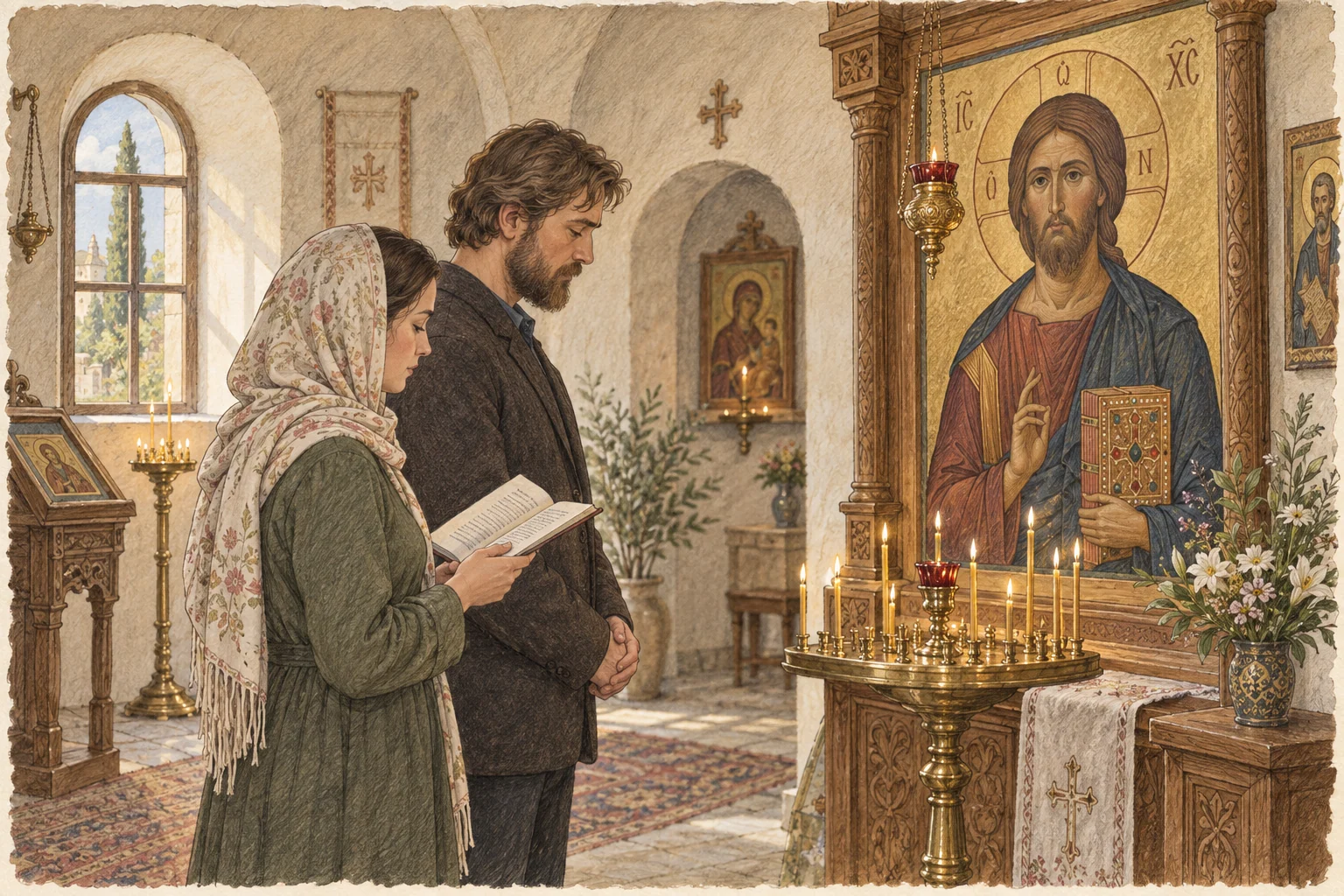
The Trisagion is a short prayer heard at the Divine Liturgy and used at the beginning of many prayers at home. Its name refers to the word “Holy” occurring three times. The prayer itself is one sentence.
The complete prayer
Holy God, Holy Mighty, Holy Immortal, have mercy on us.
In the usual opening prayers this whole sentence is said three times. The instruction to repeat it does not refer only to the final request.
Whom we address
In Orthodox worship the Trisagion addresses the one God in Trinity. We confess His holiness, power and immortality, then ask for mercy. The words do not describe three separate gods or divide God into parts.
The words explained
“Mighty” speaks of divine power, not physical strength. “Immortal” names God as the source of life, not subject to death. Asking mercy “on us” includes others in our prayer rather than limiting concern to ourselves.
A short prayer or a longer sequence?
A prayer book may say “Trisagion prayers” to indicate a whole opening sequence, not just this line. It includes the doxology to the Trinity, the prayer to the Most Holy Trinity, “Lord, have mercy”, and the Lord’s Prayer in their appointed order. When an abbreviated service uses this direction, consult the complete opening in the prayer book. Do not read the heading instead of the prayers.
In church and at home
The choir may sing slowly while a reader at home speaks without music. The prayer remains the same. Certain liturgical days prescribe a different hymn at the corresponding place in the Liturgy. This is not an invitation for a visitor to correct the choir; the appointed service determines the order.
Learning it
You may read from the page. First establish where the prayer ends and what the repetition instruction means. During prayer, address God; study unfamiliar terms at another moment. Familiar words then become something understood, not merely a sound associated with church.
Praise and petition in one sentence
The opening names God; the ending brings human need before him. Hearing only the request for mercy can obscure the praise, while treating the words solely as a solemn anthem can obscure the request. Read the sentence as a whole and notice their connection. We neither announce our own faultlessness nor seek help from an undefined force. Its brevity allows the entire address to remain in view without reducing its meaning to one emotional impression.
What we mean by mercy
Everyday language can suggest that mercy is the indulgence of someone powerful toward a person they could easily punish. You need not construct that human scene in prayer or try to guess God's mood. Ask forgiveness for a particular wrong, help to put it right, and support for someone who suffers. A detailed mental list need not accompany the words, but their meaning is wider than a wish for unpleasant consequences simply to disappear.
After an argument, for example, asking for mercy does not remove the need to acknowledge harsh speech. Before a difficult day, it does not guarantee that every person you meet will be accommodating. In either situation, you can address God without replacing prayer with a demand to control others. This distinction matters particularly when you are tempted to repeat a short sentence only until a desired outcome appears. The prayer remains an address, not a means of putting pressure on God or other people.
The significance of “us”
The plural moves attention beyond one private concern. You may be alone at home, but you are not the only person who needs help. Remember someone with whom conversation is difficult without reducing the request to making them change according to your plan. This does not excuse harmful conduct. A shared appeal for mercy leaves room for both protection and amendment, without authorizing a final judgement that another person is beyond hope.
Repetition without haste
Saying the prayer three times does not require three different mental assignments. Speak the whole sentence and address God again in the same words. If you were distracted the first time, the next gives an opportunity to return to the meaning rather than calculate mistakes. Do not add further sets from fear that a verbal slip cancelled the prayer. In shared reading, follow the established pace so others have room to hear and respond. There is no advantage in finishing before everyone else.
Using an abbreviated prayer book
First distinguish words to be prayed from editorial instructions describing the order. “Three times” is ordinarily a direction, not part of the address to God. If only the name of the opening prayers is printed, find the complete sequence and mark the page. You need not reconstruct it from memory using several unrelated websites. One understandable prayer book can resolve more uncertainty than continually searching for an allegedly perfect version. Differences in typography need not become differences in faith.
When explaining the prayer to a child, begin with whom we address and what we ask: we turn to God for mercy upon us. Explore the three descriptions gradually. Do not require an immediate explanation of the Trinity in the child's own words. If an adult cannot answer either, acknowledge that the question deserves discussion with a priest or in a class. Keeping a genuine question open is better than filling it with a picture of three separate gods.
Text reference
Azbyka: traditional prayer text (Russian)