
Trinity Sunday and Pentecost are two names for the same feast, celebrated on the fiftieth day after Pascha. The Church remembers the descent of the Holy Spirit upon the apostles and the revelation of the saving action of the Father, Son, and Holy Spirit.
It is often called the birthday of the Church because the disciples receive power to proclaim the Gospel openly to different peoples. Yet the Church does not appear without Christ in one isolated minute: Pentecost reveals and activates the community already gathered by the Savior.
What happened at Pentecost?
The Acts of the Apostles says that the disciples were together when a sound like a mighty wind was heard and divided tongues as of fire appeared. They were filled with the Holy Spirit and began to speak in other languages.
Pilgrims from many lands were in Jerusalem, and each heard the message in his own language. Peter interpreted the event through prophecy and proclaimed the crucified and risen Christ.
Why is it called Pentecost?
The name means the fiftieth day after Pascha. In the Old Testament, the feast was connected with thanksgiving and the giving of the Law; the Christian event reveals the gift of the Spirit and the law written in the heart.
Its civil date changes with Pascha and always falls on Sunday. The following Monday is dedicated to the Holy Spirit.
Why is it called Trinity Sunday?
The Son promised to send the Comforter from the Father, and the promise is fulfilled at Pentecost. The feast reveals the united saving action of the three Persons of the one God.
Orthodox faith does not teach three gods. Father, Son, and Holy Spirit are distinct as Persons and one in divine nature; the mystery exceeds simple household analogies.
Who is the Holy Spirit?
The Holy Spirit is not impersonal energy, a mood, or an atmosphere of kindness. He is the third Person of the Holy Trinity, the Giver of life, who sanctifies, unites the person with Christ, and acts in the Church.
His presence cannot be measured by emotional intensity during worship. Quiet faithfulness, repentance, love, and spiritual fruit may be deeper than a dramatic experience.
What do the tongues of fire mean?
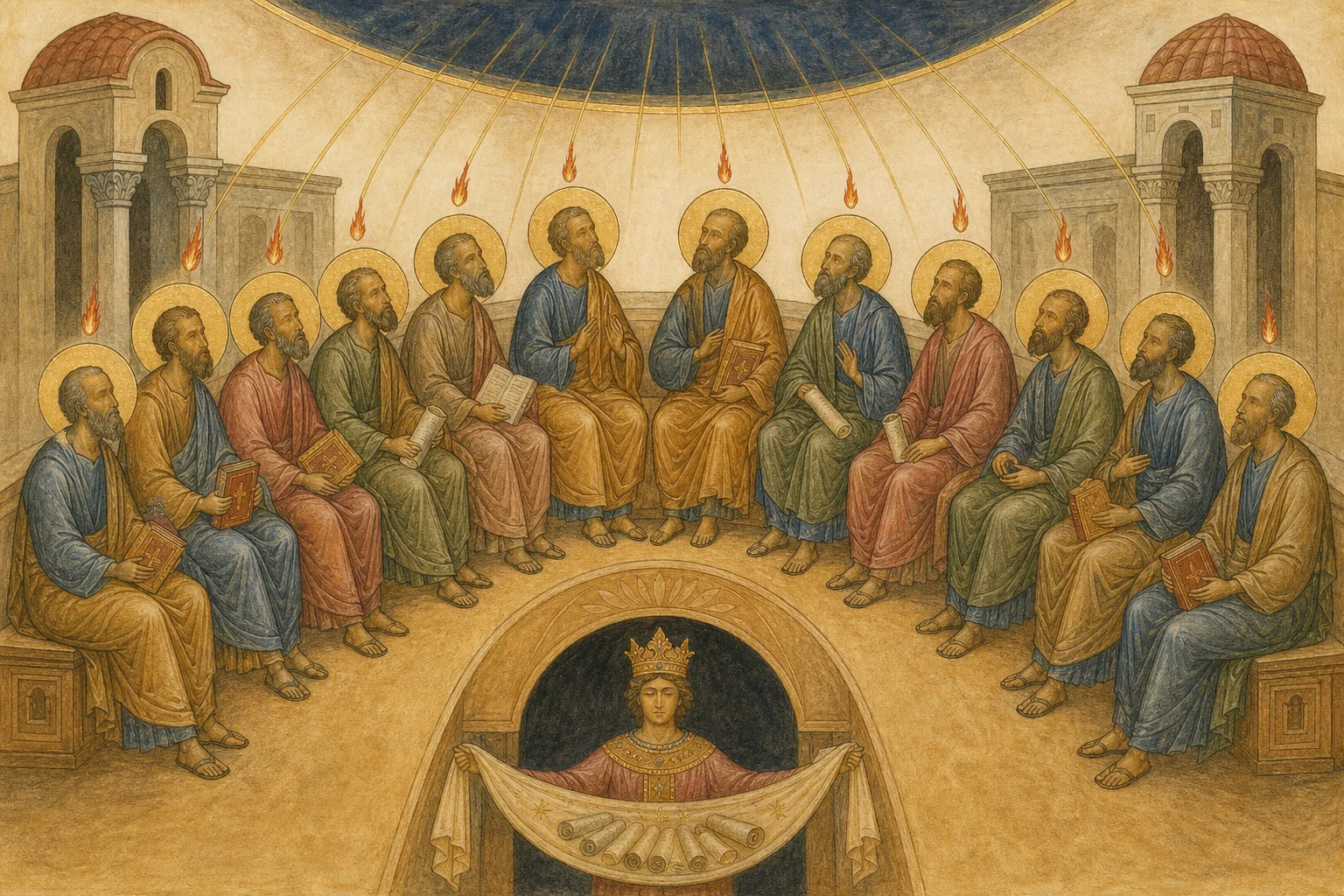
Fire in biblical language is associated with light, purification, and divine presence. A distinct tongue rests upon each disciple while the gift gathers them into one community.
This is not an ordinary fire and not a promise that every believer will see physical flames. The icon expresses spiritual reality symbolically.
Why were different languages given?
The gift enables proclamation among many peoples. If the Tower of Babel represents division through pride, Pentecost unites difference without destroying languages and cultures.
The Church’s unity does not require everyone to become identical. It is formed around Christ and allows every person to hear the Gospel intelligibly.
Why call it the Church’s birthday?
Disciples who had locked doors in fear now go out and bear witness. Baptism of new believers, common prayer, Eucharist, and care for the needy become the visible life of the community.
The expression is helpful unless reduced to a date of legal registration. The Church’s roots lie throughout Christ’s ministry, and the Spirit brings His work into fullness.
Reading the Pentecost icon
The apostles sit in a semicircle and leave an open central place for Christ, the unseen Head of the Church. Rays or tongues descend from above; books and scrolls represent teaching received and proclamation to come.
A crowned figure may appear below in a dark arch holding twelve scrolls. He symbolizes the cosmos, the world awaiting the Gospel, and is not a historical participant.
Why the Theotokos is sometimes absent from the icon
Acts mentions Mary praying with the disciples before Pentecost. Some images include her, but the classical Byzantine composition often presents the apostolic circle without her.
Neither choice denies her participation. An icon selects a theological emphasis rather than listing every person like a group photograph.
How the services unfold
A vigil is celebrated on the eve and the Divine Liturgy in the morning. It is commonly followed immediately by Great Vespers with three special kneeling prayers.
Check the exact time in the parish schedule. Vespers may begin directly after Liturgy, so do not assume that it is an accidental addition.
Why kneeling returns after Pascha
During the Paschal season the Church expresses resurrection joy through standing and omits ordinary kneeling. The kneeling prayers return at Pentecost Vespers.
They contain repentance, thanksgiving, petitions for the Spirit, and remembrance of the departed. If health prevents kneeling, pray seated or standing without shame.
The prayer “O Heavenly King”
From Pascha until Pentecost, this prayer is ordinarily absent from its familiar place at the beginning of home prayer. On the feast it returns, addressing the Holy Spirit as Comforter and Giver of life.
The liturgical pause never means that the Spirit was absent. It allows the words to be heard anew within the event they proclaim.
Why churches are decorated with greenery
Green branches, grass, and flowers express life, renewal of creation, and the Old Testament background of the feast. Birch is especially visible in Russian custom.
A plant does not become an amulet. There is no need to keep a branch for guaranteed protection, divine the future from leaves, or damage trees for excessive decoration.
What to do with parish greenery
If branches are distributed, one may place a small branch near the icons as a memory of the feast. When it dries, burn it in a clean place or return it according to parish practice.
Do not remove decorations without permission or collect an armful. A symbol of life is contradicted by needless destruction.
Trinity Memorial Saturday
The Saturday before Pentecost is devoted to a broad commemoration of the departed. The community prays for Orthodox Christians who have died and submits names according to parish order.
Remembrance does not require leaving food at a grave or performing secret actions with branches. Liturgy, a memorial service, home prayer, and almsgiving form its Christian content.
Monday of the Holy Spirit
On the day after Trinity Sunday, the Church gives particular honor to the Holy Spirit. This continues Pentecost; it is not a festival of earth spirits or a day when touching soil is magically forbidden.
Do not declare gardening or necessary labor spiritually dangerous. Attend worship when possible and treat the earth with gratitude throughout the year.
The fast-free week
The week following Pentecost is fast-free, so the ordinary Wednesday and Friday food fast is omitted. The next Sunday commemorates All Saints, and the Apostles’ Fast begins afterward.
Its dates change with Pascha. Our guide to the Apostles’ Fast explains the pattern and practical measure.
Holy Communion at Pentecost
The festal Liturgy naturally leads to the Chalice. Preparation includes prayer, the Eucharistic fast, repentance, and the parish’s order of Confession.
A green branch neither replaces the Eucharist nor makes a person ready or unready. Discuss personal circumstances with the priest beforehand.
Explaining the feast to a child
Say that Christ sent the Holy Spirit and the frightened disciples could speak about God without fear. Find the apostles, rays, and the symbolic world with scrolls in the icon.
Plant something or help care for parish grounds without promising magical properties to leaves. Let greenery teach gratitude for life.
Unity without erasing difference
Pentecost is especially important wherever languages divide and people fear the unfamiliar. The Spirit does not erase personality; He creates communion in which truth can be heard without humiliation.
A practical fruit is to listen, stop using faith as a weapon, translate important information for a guest, and make the community accessible to a newcomer.
Superstitions to avoid
Do not divine with wreaths, search for destiny in a birch branch, treat rain as a guaranteed omen, or prohibit bathing and work out of fear of mythical beings.
Folk poetry can be beautiful, but it does not replace Acts and the Church’s worship. Test advice by the Gospel rather than its promise to control the future.
A practical plan
On the eve, read Acts chapter two, confirm the Liturgy and Vespers times, and prepare for Communion if desired. During worship listen to the prayers for the Church, the world, and the departed.
After the feast, perform one action that crosses a division: ask forgiveness, help a visitor from another culture, support a common work, or explain faith without pressure.
Common questions
Are Trinity Sunday and Pentecost different feasts?
No. Pentecost identifies the fiftieth day; Trinity Sunday emphasizes the manifestation of the Triune God’s action.
Why does the date change?
It is always the fiftieth day after Pascha and therefore follows Pascha’s movable date.
Must I bring birch branches?
No. Greenery is a beautiful symbol, not a condition for participating in the feast.
May I remain standing because of illness?
Yes. Pray in a safe position; physical inability does not remove anyone from common prayer.
Is the Holy Spirit a force?
He acts with divine power but is not impersonal energy. The Church confesses Him as a Person of the Holy Trinity.
The essential point
Pentecost shows that the risen Christ does not leave His disciples orphaned. The Holy Spirit gathers the Church, gives witness, and sanctifies life.
Meet the feast through Liturgy, prayer, and openness to a person of another language or experience. Greenery will then become a sign of real renewal rather than seasonal decoration.