
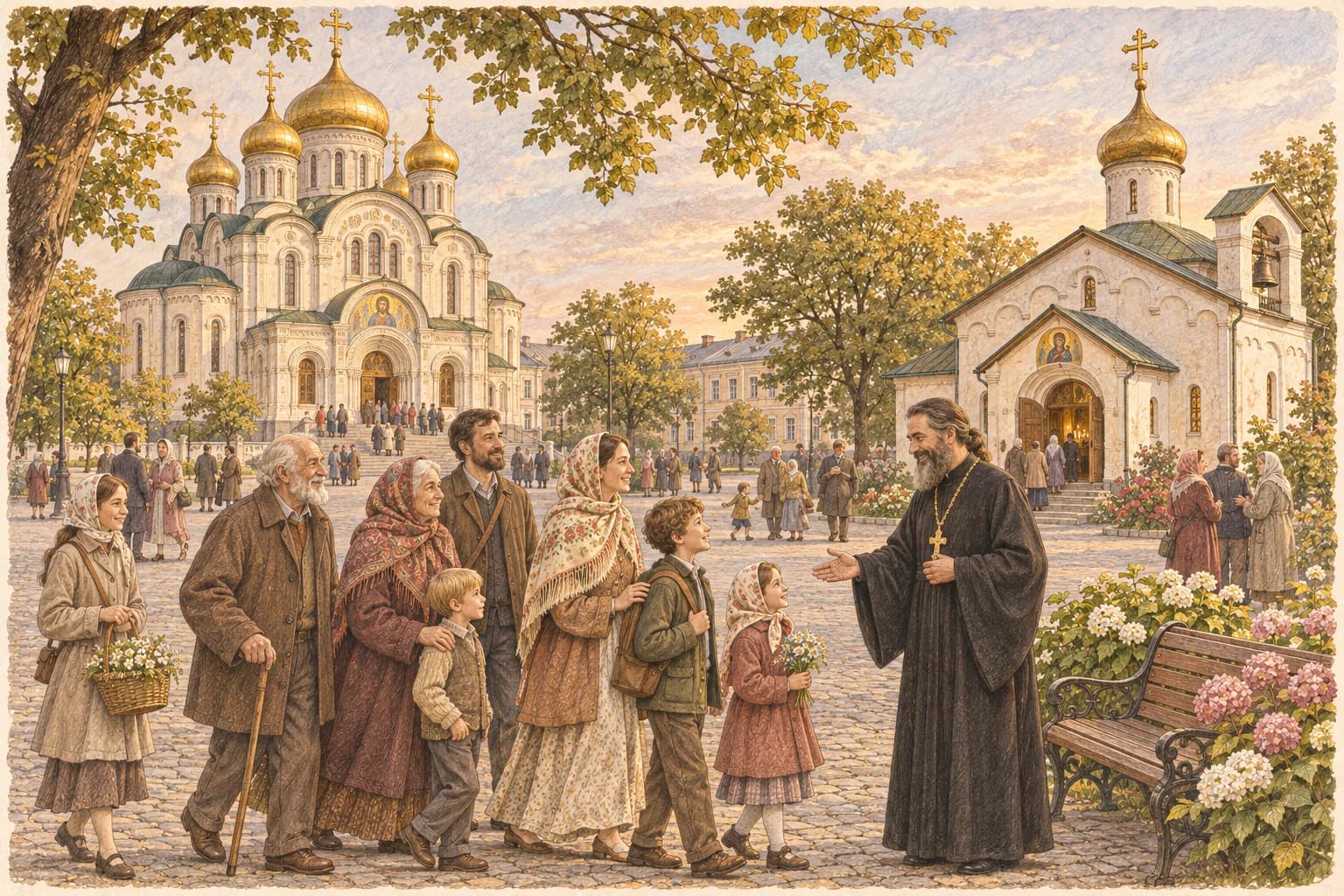
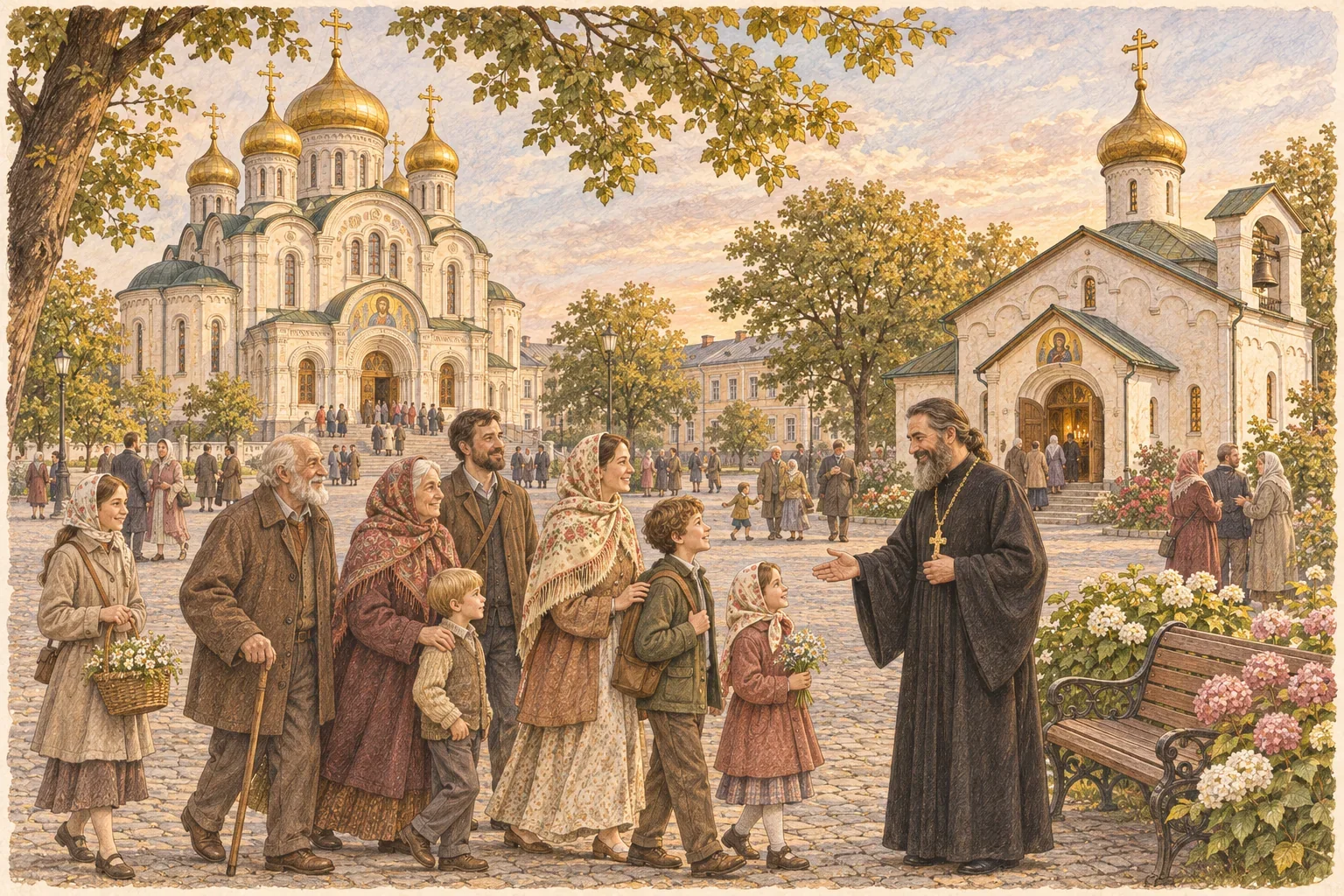
In everyday Russian, khram and tserkov often refer to the same church building. Tserkov, like the English word Church, also has a wider meaning: the community of believers in Christ. A sobor is a church with a particular ecclesiastical designation; size alone does not establish that designation.
A cathedral is associated with a bishop’s see. The historic designation of another sobor may reflect its role in a town or monastery. Read the particular building’s history rather than inferring its status from the number of domes.
A monastery is a community with a particular way of life, not another name for an impressive church. It can contain several churches. Visiting a cathedral does not automatically make prayer more valuable than participation in a small parish.
When choosing where to visit, consider current services, accessibility and opportunities for conversation. Use the official name when making arrangements. Understanding the vocabulary helps navigation but should never become a barrier to a first visit.
The word church has several meanings
In everyday speech, church often means a building: going into a church or the church on the square. In that usage it can closely resemble the Russian word khram. In Christian teaching, however, the Church is the community of believers united with Christ in faith and sacramental life. Saying that the Church teaches therefore refers to ecclesial witness and teaching, not to walls or architecture.
The question itself helps identify the meaning. Someone asking for a church’s address needs a location. Someone asking what the Church is needs more than an account of a building’s shape. Names of local Churches, such as the Russian or Serbian Orthodox Church, refer to ecclesial communities and their organisation. One word can describe connected but distinct realities, and confusion begins when those meanings are treated as identical.
What the Russian word khram describes
Khram describes a building or specially arranged place for worship. In Orthodox usage it normally means a consecrated ecclesiastical space where a community gathers to pray and participate in the sacraments. Architecture serves that purpose by providing places for the congregation, readings and liturgical ministry. An exterior shape alone does not establish whether a building currently functions as a church or has become a museum.
The Russian word also appears in descriptions of other religions, so outside a church context the tradition should be specified. In English, translating it mechanically as temple may be unfamiliar to a reader expecting church building. The best word depends on context; the important point is to preserve the meaning of a place of Orthodox Christian worship, rather than accidentally suggesting a religion separate from Christianity.
Why a church may be called a cathedral or sobor
In Russian usage, sobor can name a church with particular importance in the life of a city, monastery or diocese. A cathedral in the strict sense is associated with a bishop’s see. Nevertheless, the presence of sobor in a Russian building’s name does not always establish its present administrative status: a historic designation may remain after circumstances change.
Size is not a sufficient criterion. A large modern church is not automatically a cathedral, while a small historic cathedral may retain special significance. Cities also do not have to possess an identical number of such churches. If you want to know where the ruling bishop serves, check current diocesan information. A tourist description calling something the city’s main church helps orientation but does not replace a precise ecclesiastical description.
Chasovnya, chapel and parish: important distinctions
A Russian chasovnya is a particular kind of prayer building, commonly without a sanctuary and holy table arranged for regular celebration of the Liturgy. Certain services can take place there, but its timetable should not automatically be assumed to resemble a parish church’s. A parish, meanwhile, is a community with an ecclesiastical structure. One building and one parish are not always the same thing: a community may use several church spaces.
English chapel is broader than Russian chasovnya. It can also describe a space with an altar where the Liturgy is celebrated, such as a side chapel or a church within another building. The English name therefore does not automatically imply the absence of a holy table. Here the discussion of chasovnya concerns the Russian ecclesiastical category; a particular site’s actual status must be established separately.
Before travelling, establish the practical status as well as the attractive name. Is the Liturgy celebrated there, are clergy regularly present, when is it open, and does the chapel belong to a neighbouring church? These questions are more useful than debating which term sounds more impressive, especially when the visit concerns confession, baptism or speaking with a priest.
Using the terms clearly
In ordinary conversation, calling an Orthodox worship building a church is not a mistake. Precision matters especially when a distinction changes the meaning, as in theological explanation, historical description or visitor information. A sentence saying that a sobor is closed for restoration concerns a building; one saying that a sobor reached a decision may refer to a council of bishops. That Russian word also has several ecclesiastical meanings determined by context.
When explaining this to a child, begin concretely: we come to a church building to pray with the Church, and our parish belongs to a particular diocese. The meaning of cathedral can follow. This sequence connects terminology with people’s lives and helps show that the ecclesial community does not end where the walls of a familiar building end.
A question for reflection
Are you seeking architectural information or a living congregation you can visit?