
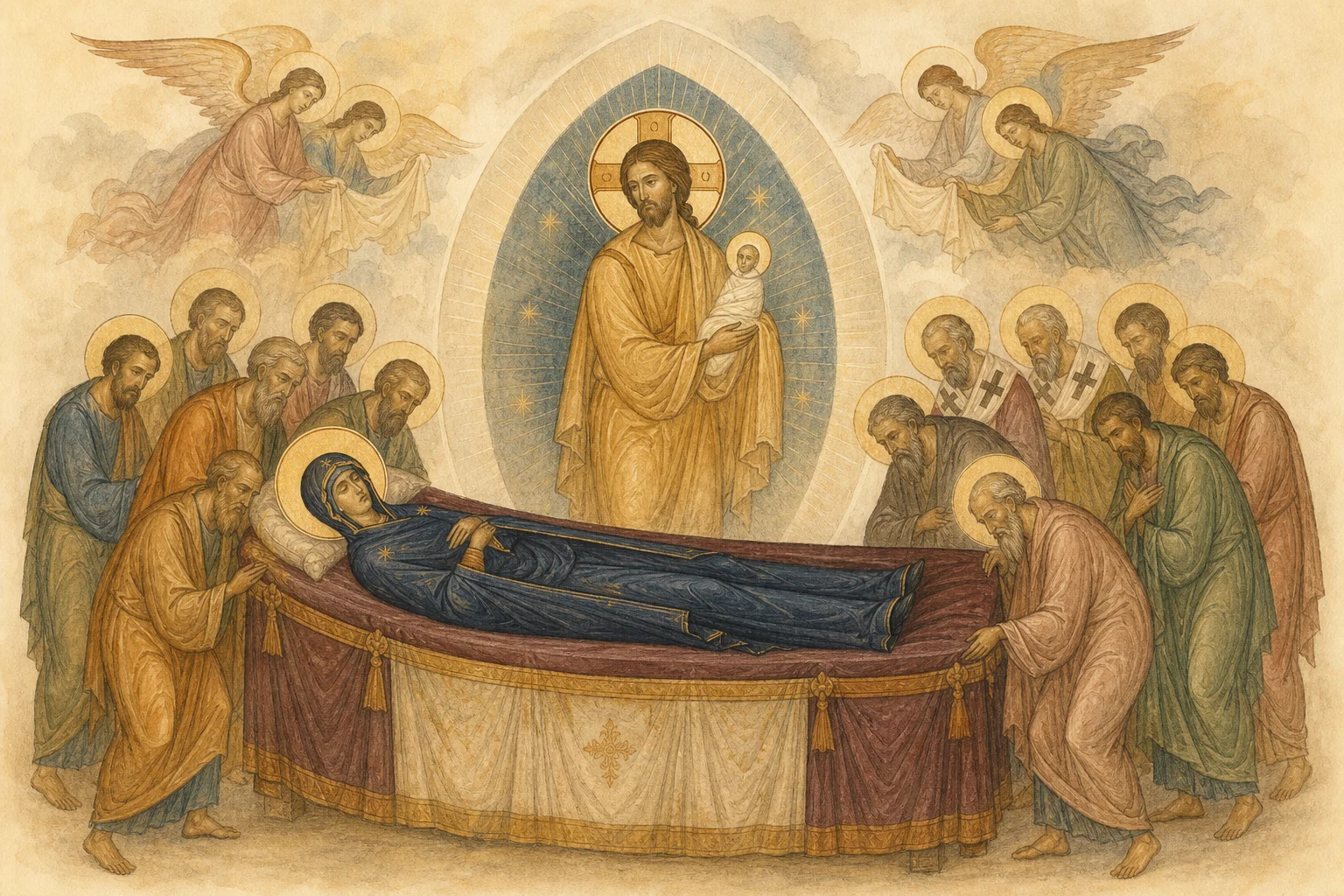
The Dormition of the Mother of God is the Great Feast celebrated on August 28 in the Russian Orthodox calendar, marking the completion of her earthly life and passage to God. The church word Dormition means falling asleep and expresses Paschal hope: death is real and brings grief, but after Christ’s Resurrection it does not have the final word.
In the icon, the Theotokos lies upon a bier, the apostles grieve, and Christ receives her soul as a small figure wrapped in white. The image reverses Nativity: there Mary held the infant Christ; here the Son receives His Mother.
What does Dormition mean?
The Church does not avoid the word death or consider the body unimportant. Sleep points toward the expected resurrection and the conviction that separation is not final.
This does not require a believer to face loss without tears. The apostles in the icon grieve, and their sorrow does not contradict hope.
Do the Gospels describe the Dormition?
The canonical Gospels do not narrate the completion of Mary’s earthly life. The account is preserved in Church Tradition and expressed particularly through ancient liturgical texts and iconography.
It is important to distinguish biblical narrative from Tradition honestly and not present a later household legend as a line of Scripture. The Church receives the feast within a complete liturgical memory.
What the Church believes about the Theotokos
Mary is the Mother of the Lord Jesus Christ and first among the saints in her closeness to the mystery of the Incarnation. Her life reveals a free response to God, humility, courage, and faithfulness at the Cross.
Orthodox Christians do not worship her as a goddess. Worship belongs to God alone; the Mother of God is venerated and asked for maternal intercession.
Why the feast contains joy
The worship joins burial and triumph. The woman who bore the Source of life is not abandoned to the dominion of death; the Church recognizes in her destiny a confirmation of the Paschal promise to humanity.
Joy does not erase tragedy. It is born within sorrow as trust in the risen Christ.
The tradition of the apostles
Church Tradition says that the apostles were brought together at the bed of the Theotokos and buried her. The icon places them on both sides, showing the whole Church gathered in farewell and prayer.
Details should not become sensational claims or a secret geography. The central meaning is the unity of the community and faithfulness to the Lord’s Mother.
Reading the Dormition icon
The horizontal bier with Mary’s body forms an earthly level. Christ’s vertical figure in glory connects it to heaven. In His hands the small white-wrapped person represents her pure soul.
Angels, apostles, and hierarchs surround the center. The icon is not a realistic funeral portrait; it reveals the event’s invisible dimension.
Why Christ holds a small child
The white bands evoke a newborn person and birth into eternal life. They do not claim that a soul literally possesses an infant body.
The composition answers the Nativity icon: the Mother received the Son into earthly life, and now the Son receives His Mother. This reciprocity gives the image tenderness.
Dormition and Christ’s Ascension
Christ ascends by divine authority as the risen Lord. The Theotokos remains a saved human being who receives everything from God.
Mary is never an independent source of resurrection or equal to the Trinity. Her glorification bears witness to Christ’s power.
Orthodox Dormition and the Western term “Assumption”
Western Christianity commonly uses the name Assumption. Orthodox worship emphasizes Mary’s actual death, burial, and glorification without simply reproducing later dogmatic formulations from another tradition.
For parish readers, polemics are less important than the shared Christian center: hope rests on Christ’s Resurrection, and Mary is not deified.
When it is celebrated
The Russian Orthodox Church keeps August 15 in the Julian calendar, corresponding to August 28 in the current civil calendar. The feast has a fixed date.
Another Orthodox Church may use a different civil day because of its calendar system. The event and theological content remain the same.
Preparation through the Dormition Fast
A two-week fast runs from August 14 through August 27. It joins prayer, repentance, abstinence, and imitation of the Theotokos’ faithfulness.
The food rule is austere, but health, pregnancy, age, and labor require a personal measure. See our full guide to the Dormition Fast.
How the feast is celebrated
A vigil is normally served on the eve and the Divine Liturgy in the morning. The troparion joins Mary’s virginity, passage to life, and intercessory prayer.
Check the parish schedule. When the feast falls on a workday, the evening service may be the accessible entrance.
The shroud of the Mother of God
Some churches bring out a shroud depicting the Dormition and celebrate a special burial office with praises and a procession. The history and order of this rite differ from the ordinary service of the feast.
It may occur on the eve, the feast, or a later day according to local practice, and some parishes do not celebrate it. Its absence does not make the Dormition incomplete.
Holy Communion
The festal Liturgy naturally leads toward Communion. Preparation includes prayer, the Eucharistic fast, repentance, and the parish order for Confession.
Completing a two-week food fast does not replace inward preparation. If you are returning after a long absence, arrange a conversation beforehand.
How the Dormition speaks to bereavement
The feast does not answer every question about why a loved one died now, and it does not remove the emptiness after a funeral. It gives an image: Christ is beside the bed, and the community surrounds grief with prayer.
A person may weep, seek psychological care, and need a long time. Hope in the resurrection is not measured by absence of tears.
Do not search for signs from the departed
Dreams, birds, clocks, and coincidences are not reliable communication with the dead or information about their state. Constantly searching for signs can intensify anxiety.
The Christian path is prayer, commemoration at Liturgy, almsgiving, and trust in God’s mercy. Seek pastoral and professional support when grief becomes unbearable.
May a cemetery be visited?
A person may visit a grave, pray, and care for the place, but the feast primarily gathers the community at Liturgy. There is no requirement to go to a cemetery specifically on August 28.
Do not leave food “for the dead” or hold an alcohol-centered meal at the grave. Express love through prayer and help for someone living.
Folk names and omens
Regional names and weather sayings belong to folk calendars. Prohibitions against walking barefoot in dew, touching sharp objects, or doing any work are not Church teaching.
Necessary labor is permitted. Reduce unnecessary haste for worship when possible, but do not fear a household action as punishable magic.
May a wedding be crowned?
The fast concludes before the feast, but Crowning is generally not celebrated on a Great Feast or its eve. The parish calendar also accounts for weekdays and other restrictions.
Agree on the church date before booking a venue and vendors. Civil registration is considered separately.
Explaining the feast to a child
Say that the earthly life of Jesus’ Mother ended, the apostles grieved, and Christ received her. Find the bier, apostles, and white figure in the Savior’s hands on the icon.
Do not frighten a child with death or demand an adult understanding. When a loved one recently died, answer honestly, allow questions, and preserve a stable routine.
Prayer to the Mother of God
One may read the troparion, a canon, or simply ask, “Most Holy Theotokos, pray to God for us.” Every appeal assumes that God is the source of salvation.
Prayer is not a spell against death. It teaches trust in Christ and asks the support of the Church.
A practical plan for the feast
On the eve, read Gospel passages about the Annunciation, Nativity, and Mary standing at the Cross, then examine the Dormition icon. Confirm the vigil, Liturgy, and any burial office.
Remember the departed according to church order, support a grieving person, and complete the fast without overeating. Preserve one fruit: prayer, reconciliation, or sustained help.
Common questions
Does Dormition mean that Mary did not die?
No. The feast speaks about an actual death and Paschal hope together, which is why it uses the image of sleep.
Why does Christ hold a child in the icon?
It symbolizes the soul of the Theotokos and birth into eternal life, not a literal portrait of a soul.
Must I attend the burial office?
No. It is a special local practice whose time varies; the Divine Liturgy remains the center.
May Christians work on August 28?
Necessary labor is permitted. Make room for prayer when possible and reject superstitious prohibitions.
What should someone in fresh grief do?
Choose a short prayer and a safe measure of attendance, and ask for support. Tears and qualified care do not contradict faith.
The essential point
The Dormition joins honest grief before death to hope in the Resurrection. Christ receives His Mother, and the Church sees in her destiny a promise addressed to all humanity.
Attend the Liturgy according to ability, pray without magic, support the grieving, and trust God. The feast does not force anyone to forget loss, but it refuses to let death speak last.