The Valaam icon emerged from a nineteenth-century monastic artistic setting. Its history shows that a venerated image need not come from remote antiquity or claim an apostolic painter. A known artist, a date of creation, and a traceable later journey can be discussed without diminishing an icon's place in the Church.
Painting and Rediscovery
The image was painted in 1878 and is associated with the Valaam artist Alexei Konstantinov, later Hieromonk Alipy. Its wider veneration is linked with events in 1897 and Natalia Andreyeva's account of help through the Mother of God. Creation and the growth of public veneration are separate milestones; saying simply that the icon “appeared” can confuse them.
In ecclesiastical language, finding or rediscovering an icon does not necessarily mean that it was produced in an unknown way. An existing image may be recovered after storage, neglect, or relocation. This vocabulary concerns a community's renewed encounter with the image. Reading it automatically as the date of painting creates an unnecessary chronological contradiction.
The Composition
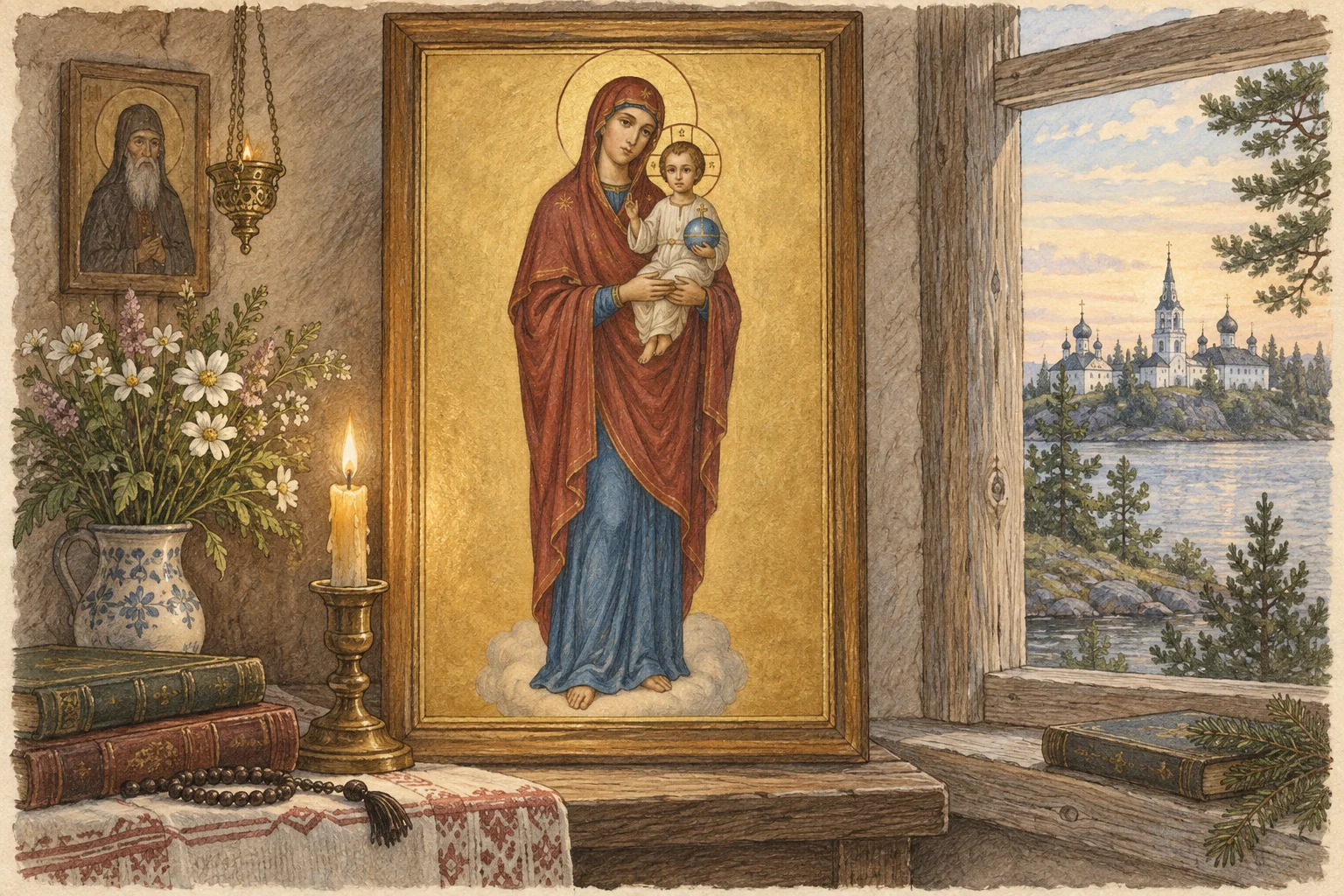
Mary is represented as a full-length figure carrying the Child. Christ blesses and holds an orb topped by a cross. The full-length arrangement distinguishes the image from familiar half-length Marian icons, while its painting reflects a late nineteenth-century style. Such a style does not by itself reduce an icon to a secular portrait.
The orb points to Christ's kingship. It should not be treated as a representation of a particular modern state or a coded political programme. Look at the composition as a whole: the Mother's gesture, the presence of her Son, and the invitation to prayer. Description of colour and technique is useful but cannot exhaust the meaning of the image.
Valaam, New Valamo, and Copies
During wartime upheaval the brotherhood took the historic image to Finland, and its subsequent story belongs to New Valamo Monastery. The Russian Valaam community venerates copies with their own histories. The name “Valaam” therefore does not identify which physical object a viewer is seeing.
A parish or family copy may have documented information about a donor, painter, or blessing. Present that separately from the prototype's general history. Without evidence, a particular panel should not be declared to have come from Athos, belonged to a famous elder, or become associated with a specific miracle. Unknown provenance does not prevent prayer, but it does require restraint when writing a caption.
Commemoration and Personal Prayer
Russian practice places the celebration on the first Sunday after the feast of Peter and Paul, observed on civil July 12. Finnish practice also has a commemoration on August 7. This difference concerns calendar custom, not competing rights to ask for Mary's prayers. For a visit, consult the schedule of the particular monastery.
At home, read about the painter and then pray without trying to reproduce the circumstances of someone else's testimony. A healing account does not impose an obligation to undertake a certain journey. For a person with limited strength, attentive prayer at home and a manageable act of kindness can be a truthful way of honouring the image. The value of that encounter is not measured by the number of miles travelled.
When photographing a parish copy for publication, record its exact label and ask about permission. Its genuine local story may be modest beside a famous monastic narrative, yet it explains the image's place in that particular community.
The Painter Before His Monastic Name
The OCA description clarifies the sequence: the image was painted before its attributed artist's monastic tonsure and priestly ordination. Calling it an icon by Hieromonk Alipy uses the name by which the painter became known later. It does not mean that he already held every title when he painted it. This distinction prevents an unnecessary conflict between dates in his biography.
The same description notes the combination of tempera and oil used in the work. That gives readers a reason not to oppose prayerful meaning to knowledge of craft. An icon is made through particular materials, labour, and artistic experience. A testimony of help before it does not erase its history of production, and knowing the painter's identity does not make veneration less genuine.
What the Full-Length Figure Contributes
Compare the Valaam composition with a half-length icon and notice how the apparent distance between viewer and image changes. The whole figure is visible, yet attention still turns towards Christ held by his Mother. Look beyond the faces to the overall silhouette, the position of the hands, and the relationship between the figures. This makes the arrangement clearer without searching for hidden messages in every fold of clothing.
A family discussion can keep three questions separate: who painted the image, how its veneration developed, and where its subsequent history unfolded. Answering one does not answer the other two. For example, a photograph of a copy at the Russian monastery does not disprove the account of the historic panel being taken to Finland. It reveals another part of the image's continuing life. This approach allows discussion of both Valaam and New Valamo without competing claims about whose prayer is genuine or confusing different physical objects that share a familiar name.
Sources
- OCA: Valaam Icon
- Valaam Monastery: sacred images and copies (Russian)
- Valaam Monastery: the iconographer Alipy (Russian)