
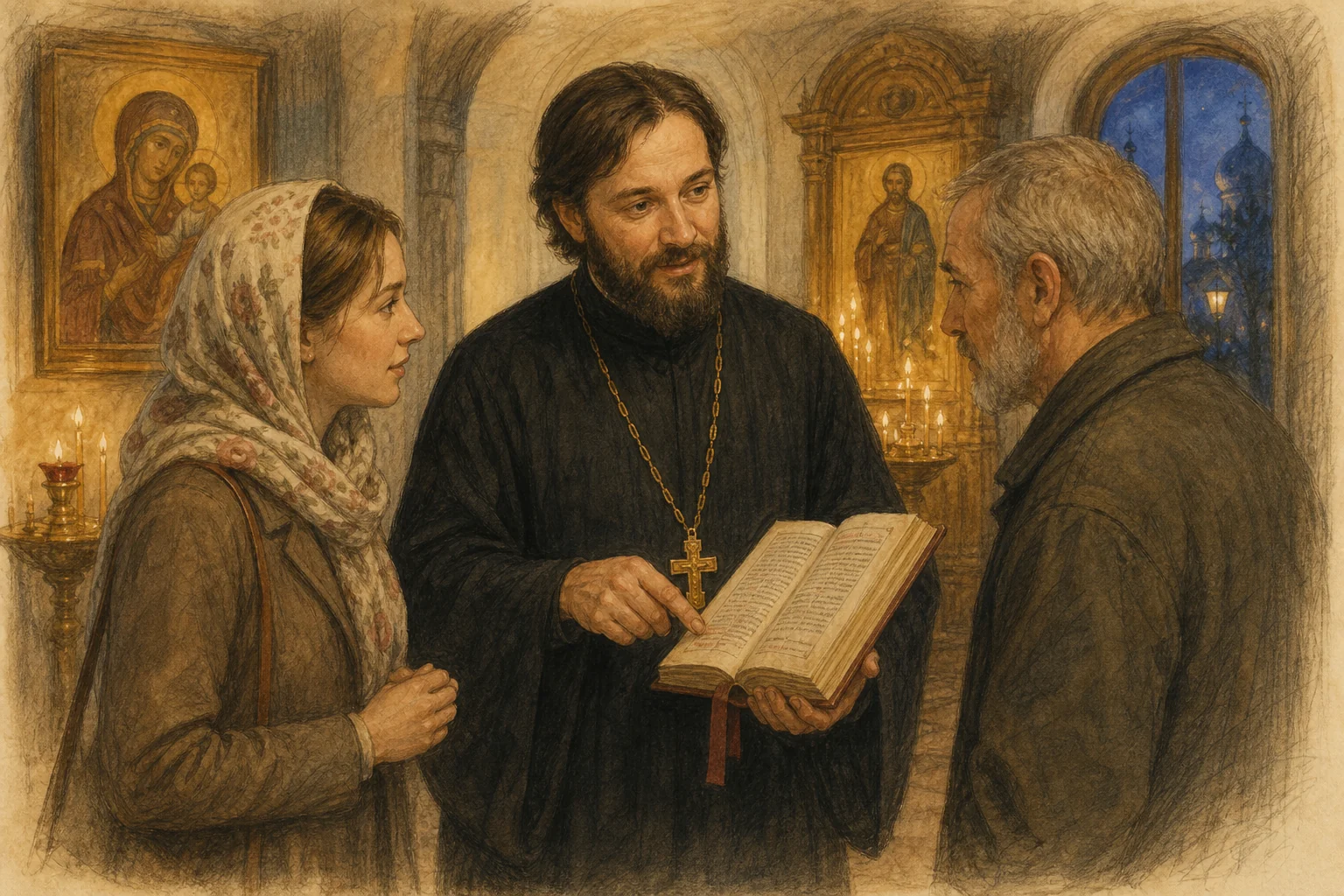
Vespers and Matins are distinct services in the Church’s daily cycle. Vespers closes the passing day in prayer and opens the new liturgical day. Matins unfolds the meaning of the coming Sunday, feast, or saint’s commemoration and calls a person to spiritual wakefulness. Because parishes often celebrate them one after another in the evening, a newcomer may experience them as one long service.
Learning the difference is not an examination in liturgical terminology. A simple map makes it easier to hear the psalms and hymns, notice a change of theme, and remain peaceful when the actions are unfamiliar.
Why does the liturgical day begin in the evening?
The Church follows the biblical rhythm of “evening and morning.” Sunday prayer therefore begins on Saturday evening, and a feast begins liturgically on the evening before its civil-calendar date. Vespers does not merely finish Saturday or a weekday; it opens the event the Church will celebrate the next morning.
This is why a parish schedule may place the name of a feast beside the evening service on the previous date. It is not a calendar mistake. The community has already entered the new liturgical day.
What is Vespers?
Vespers gives thanks for the day that has passed and asks for God’s help. Its psalms and actions lead worshippers through the images of creation, humanity’s fall, expectation of the Savior, and the coming of Christ as the Light of the world.
The hymn “O Gladsome Light” is one of its most recognizable moments. At the boundary between day and night, the Church gives thanks to Christ. Vespers also includes litanies—common petitions for peace, the Church, people, and the needs of the world—and, on certain days, readings from Scripture called paremias.
The exact form depends on the day. Festal Great Vespers differs from a shorter weekday service, and Lent has its own order. An online outline can help you orient yourself, but it cannot predict every service.
What is Matins?
Matins is historically connected with dawn and the sanctification of the beginning of the day. In contemporary parish life it is often served in the evening immediately after Vespers. Its meaning remains: to call us out of spiritual sleep, announce the feast, and lead us into praise.
Matins includes psalms, troparia, and the canon; on Sundays and feasts it may include the Polyeleos and a Gospel reading. The service gradually moves from a sober, penitential beginning toward praise. At Sunday Matins, the Resurrection of Christ is central.
The word “Matins” therefore names more than a time on the clock. It may be celebrated in the evening while remaining the prayer of the coming morning.
The main difference in plain language
- Vespers opens the liturgical day, gives thanks for creation, and directs expectation toward Christ.
- Matins reveals the Sunday or feast through psalms, Gospel, and hymns of praise.
- Vespers is normally shorter; Matins often forms the larger part of a combined evening service.
- At Sunday Matins one of the Resurrection Gospels is read; this is not a normal element of ordinary Vespers.
These are landmarks, not a reason to follow the service with a stopwatch. Exclamations and new prayers mark the boundary, but a newcomer is not required to recognize it immediately.
How do Vespers and Matins belong to the All-Night Vigil?
Before Sundays and major feasts, Vespers and Matins may be joined in the All-Night Vigil. The First Hour is usually read after Matins. The whole service then moves from evening toward morning and from expectation toward the joy of the feast.
Not every combination of Vespers and Matins is called an All-Night Vigil. Weekdays and lesser commemorations may have a different order. The reliable name is the one published in the parish schedule.
What can I notice when the language is still unfamiliar?
At Vespers, notice the change of light, the incense, and “O Gladsome Light.” At Matins, listen for the troparion, the Gospel, the Polyeleos, and the canon. These landmarks gradually reveal the structure.
Do not try to remember everything at once. Carry away one phrase and one image. After the service, you might read a translation of a hymn or a short commentary on the day’s Gospel. The next visit will contain more familiar moments.
Difficulty with Church Slavonic is a normal part of beginning for many Russian-speaking worshippers. Not understanding every word does not make a person an outsider to common prayer.
What should I do when one service moves into the other?
No special action is normally required from a worshipper. Remain where you are, listen, and pray. Make the sign of the cross and bow attentively rather than anxiously copying every movement nearby.
If you arrive after the service has begun, enter quietly and stay near the back at first. It is best not to move around or light candles during the Gospel or another especially attentive reading. Practical questions can be asked before the service or after it ends.
When are Vespers and Matins celebrated?
Vespers normally begins in the evening, though the time changes by parish and season. Parish churches often attach Matins to it that same evening. In monasteries and on certain occasions, Matins may be celebrated during the night or in the morning.
During Great Lent, Holy Week, and major feasts, the order changes significantly. Names such as “Great Vespers,” “Polyeleos Matins,” or “Matins with the Great Doxology” describe the liturgical form. They do not rank one prayer as more powerful than another.
How do Vespers and Matins shape personal prayer?
Home prayer does not require recreating the full church office. Its rhythm can continue simply: in the evening, give thanks for the day, ask forgiveness, and entrust the night to God; in the morning, give thanks for waking and ask for help to live attentively.
This makes the inner logic of the services clearer. Vespers teaches us not to carry endless agitation into the night, while Matins prevents the day from beginning as a random list of tasks. The Church’s prayer restores direction to time.
What should I do after a first visit?
Do not judge the service only by “I understood” or “I did not understand.” Recall one moment that helped you slow down, one hymn that remained, and one question that arose. Write down that question, read one translation, and return.
Regularity matters more than an information sprint. After several weeks, familiar exclamations form a framework within which new texts no longer feel chaotic. Ask whether the parish offers talks or a guided explanation of worship.
Frequently asked questions
May I attend only Vespers?
You may attend the portion your circumstances allow. If the question concerns your personal preparation for Holy Communion, discuss it with a priest instead of turning one choice into a universal rule.
Why is Matins celebrated in the evening?
Parish practice combines services so the community can pray together, while the meaning of a liturgical service is not limited to the modern clock hour.
How long do Vespers and Matins last?
A short Vespers may take less than an hour, while a festal service may be longer. Matins is usually the longer part. Exact times depend on the day and parish.
Must I know where Vespers ends and Matins begins?
No. Understanding the structure can deepen attention, but it is not a condition for joining the prayer of the Church.
May I sit during the psalms?
A healthy person normally prays standing, but pain, fatigue, pregnancy, age, or illness are sufficient reasons to sit. Caring for health is not disrespect for worship.
What should I confirm with the parish?
Check the beginning time, the full name of the service, and its usual duration in the official schedule. If you are preparing for Communion or cannot attend the whole service, ask a personal question through the parish contacts.
Vespers and Matins become clearer not by memorizing a diagram but by returning attentively. First we notice light and a familiar refrain; then we hear the theme of the feast; in time, the single path of prayer from evening to morning becomes visible.