
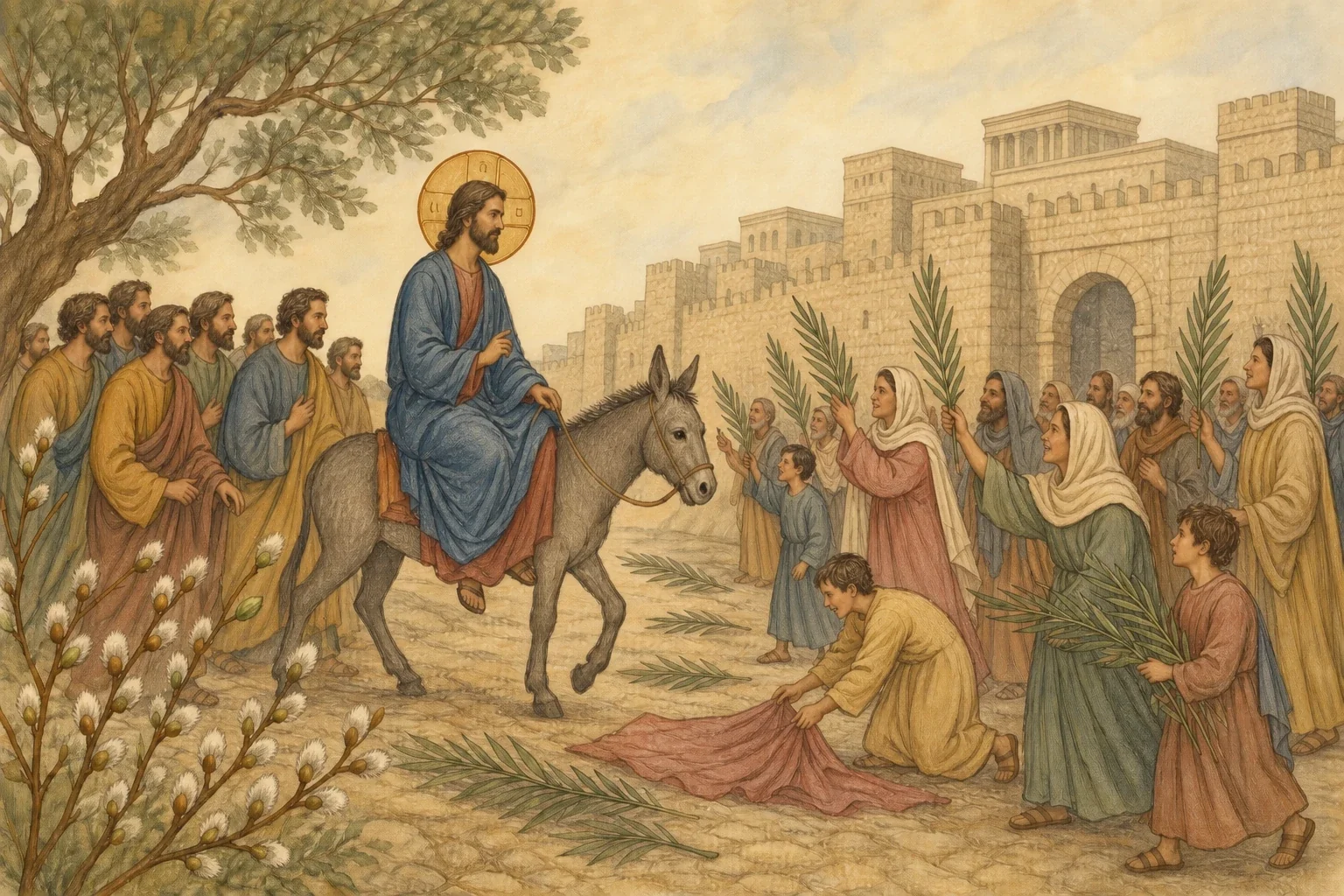
Palm Sunday is the popular name for the Great Feast of the Entry of the Lord into Jerusalem, celebrated one week before Pascha. Christ enters the city on a young donkey, the people greet Him with branches and “Hosanna,” but He goes not toward a political throne but toward His voluntary Passion, Cross, and Resurrection.
In colder climates, budding willow branches replaced palms. The branch gives a bodily way to join the Gospel welcome, but it is not an amulet, medicine, or a means of predicting the future.
The Church’s name for the feast
The complete name is the Entry of the Lord into Jerusalem. Liturgical books also speak about the Sunday of Palms or the Flower-bearing Sunday.
The Russian name “Willow Sunday” reflects the local plant without changing the content. The Church welcomes Christ as the King who defeats death through humble love.
When Palm Sunday is celebrated
The date changes each year because the feast always falls on the final Sunday before Pascha. It concludes the sixth week of Great Lent and opens the entrance into Holy Week.
Check the official calendar and parish schedule. Branches are commonly blessed during the vigil on Saturday evening, not only on Sunday morning.
What happens immediately beforehand?
The preceding day is Lazarus Saturday, remembering Lazarus raised after four days in the tomb. News of this sign intensifies public attention toward Jesus.
The two days form one passage: Christ reveals authority over death and then enters the city to pass through death Himself and open the universal resurrection.
What the Gospels narrate
All four Gospels describe the entry. The disciples bring a colt, Christ sits upon it, people spread garments and branches, and the multitude greets Him as the coming King.
Details differ according to each author’s emphasis and prophetic connections. The accounts are not merely news reports; they reveal who Christ is.
Why Christ rides a donkey
The donkey emphasizes a peaceful and humble King. Christ does not enter as a conqueror on a war horse and does not promise victory through violence.
He fulfills the prophecy of a gentle King. This corrects the crowd’s expectation and our own attempts to use God for triumph over an opponent.
What “Hosanna” means
The word contains an appeal to save and becomes an exclamation of praise and hope. The people call Jesus Son of David and bless the One who comes in the Lord’s name.
The Church repeats it not because every mystery has already been understood but in recognition of the need for salvation. Hosanna must not become a slogan against another people or political group.
Why the joy contains tension
It appears to be a triumph, but Christ knows that betrayal, judgment, and the Cross are near. The crowd expects one kind of kingdom; He brings another, without coercion or revenge.
The feast asks whether we remain with Christ when He does not fulfill our script. Faith is tested not by the intensity of first excitement but by faithfulness through Holy Week.
Did the same people later shout “Crucify”?
Preaching sometimes identifies everyone who welcomed Christ with every participant in the Friday trial. The Gospels do not provide a list proving complete identity between the crowds.
The lesson concerns the changeability of every human heart, not an accusation against an entire people. Anti-Jewish hostility contradicts the Gospel and history: Christ, the apostles, and the first disciples were Jews.
Why palms are used
Palm branches in the ancient world expressed welcome of a victor and festal joy. People spread them and their garments on the road in recognition of royal dignity.
Warm-climate Orthodox communities continue to use palms. The species depends on climate, not the correctness of the feast.
Why Russian parishes use willow
Willow is among the first plants to awaken after winter and became an accessible substitute for palm. Its buds naturally recall the return of life and nearness of Pascha.
The Church blesses branches as a sign of welcoming Christ. Blessing does not change the plant’s biology or turn it into magical matter.
How the services unfold
A vigil is celebrated on the eve; after the Gospel at Matins, branches held with candles are blessed. The festal Divine Liturgy is served on Sunday morning.
The exact distribution practice belongs to the parish. Do not arrive only at the final moment for a branch; the meaning appears in the prayers and Eucharist.
Must I bring a branch?
You may bring a few carefully cut branches or receive those prepared by the parish. Do not damage a young tree or cut on someone else’s property.
A large bouquet carries no additional blessing. One branch is sufficient for the symbol.
Keeping the willow at home
Place it near the icons as a memory of the feast. When it dries and is no longer needed, it may be burned cleanly, buried where people do not walk, or returned to the parish.
There is no need to keep it forever through fear of punishment. Ask about local practice when disposal is difficult.
May willow be used to strike “for health”?
The Church does not teach that blows from a blessed branch bring health, fertility, or protection. Even a playful custom must respect consent and safety.
Never strike a child, animal, or ill person and never attach a threat. A blessed branch invites the welcome of Christ, not pain.
May a branch be rooted and planted?
It may be rooted when the species and conditions permit, but this is horticulture rather than spiritual prediction. Whether it grows says nothing about a family’s destiny.
Do not plant where roots will damage a building or utilities. Reverence and responsible care belong together.
Fasting and festal relaxation
Palm Sunday comes near the end of Great Lent, and fish is normally permitted. Lazarus Saturday has its own food rule.
Relaxation does not turn the day into a feast of excess before an austere week. Eat gratefully and moderately, and follow medical requirements without guilt.
Holy Communion on Palm Sunday
The Liturgy leads to the Chalice, not only to blessed branches. Prepare through prayer, the Eucharistic fast, repentance, and the parish order of Confession.
A first-time visitor may remain for the whole service without receiving unprepared. Contact the parish through the contact page afterward and ask questions.
Participating with children
Explain that people welcomed Jesus as King and He chose a peaceful path. Give the child one branch and find the donkey, gate, and children in the icon.
Do not demand that a child hold a candle and branch without movement for hours. Choose a safe place, step out when tired, and never use the willow for punishment.
Living the rest of the day
Read the Gospel account, greet relatives without superstitious promises, and make the home quieter for Holy Week. Finish optional shopping and entertainment.
Visit someone lonely, support an ill person, or seek reconciliation. The welcome of the King then continues outside church.
Entering Holy Week
By Sunday evening the hymns already turn toward Christ’s final days. Do not try to preserve only spring joy and do not fear the change in tone.
Choose realistic services and use our day-by-day Holy Week guide. The willow remains nearby as a promise that the Cross leads to Resurrection.
Common questions
When are branches blessed?
Normally at the Saturday vigil and according to local practice on Sunday. Consult the parish schedule.
Is a branch required?
No. A person can participate fully without one; it is an expressive custom, not a condition of the feast.
How should an old branch be disposed of?
Burn it cleanly, bury it in an undisturbed place, or return it to church without fear.
Is fish permitted?
Normally yes. Check the calendar and keep a medically safe measure.
May Christians work?
Necessary work is permitted. Attend the Liturgy when possible and avoid reducing the feast to ordinary distraction.
The essential point
The Entry into Jerusalem joins Christ’s royal glory to His humble movement toward the Cross. He receives praise without becoming the leader of human revenge.
Hold the branch as a sign of faithfulness, not an amulet. Welcome Christ through prayer, Communion when prepared, and readiness to walk through Holy Week with Him.