
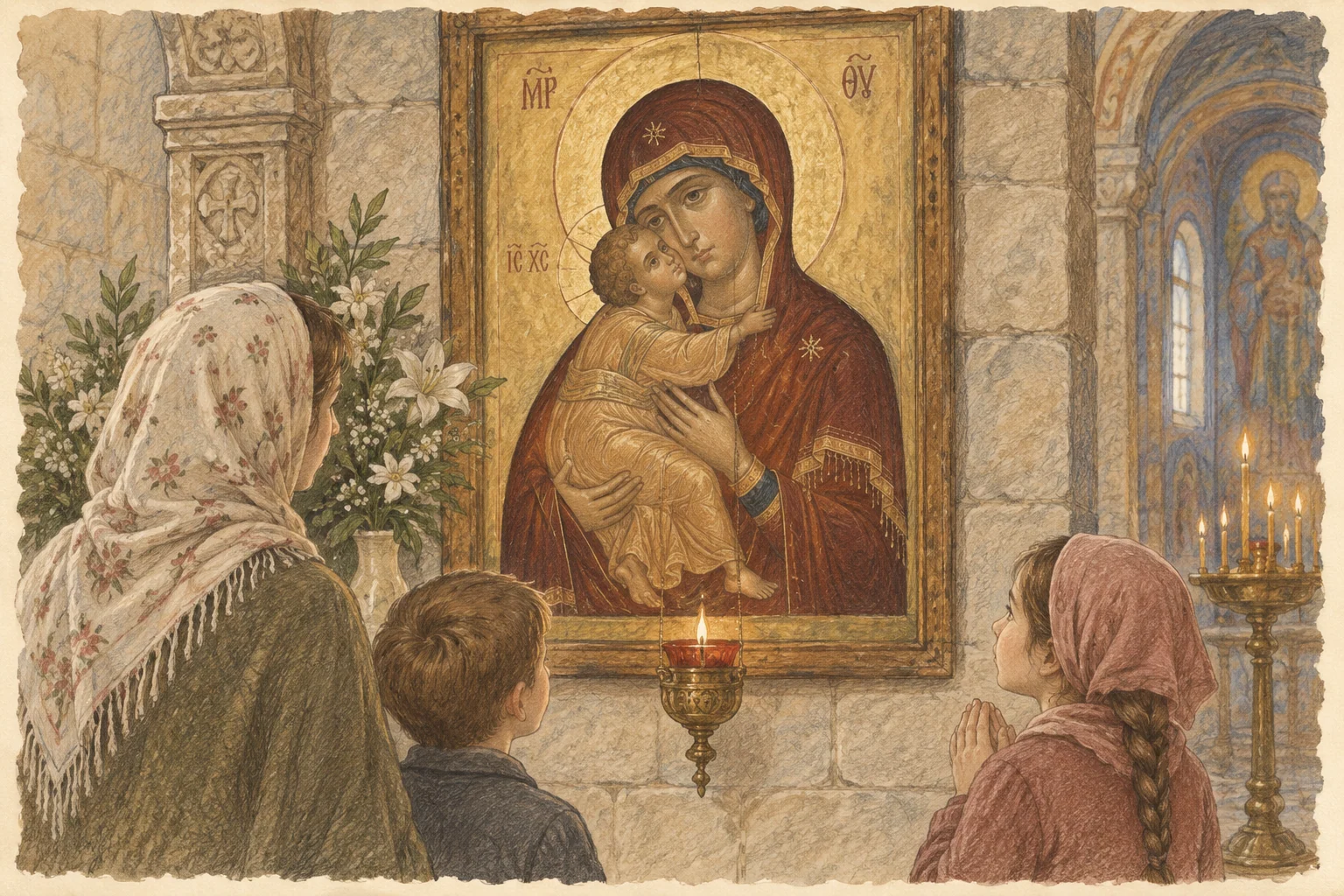
The Vladimir icon takes its name from a Russian city, but its history begins in the Byzantine artistic world. Here a geographical name describes the later journey of a sacred image rather than necessarily its place of manufacture. Its most recognisable feature is the meeting of the Mother's and Child's cheeks, the gesture associated with the iconographic type called Tenderness, or Eleousa.
How the Name Developed
The ancient panel is dated to the twelfth century. Its story connects Constantinople, Vyshgorod, and Vladimir; Prince Andrew Bogolyubsky's northward transfer belongs to 1155. Its veneration subsequently became closely associated with Moscow. The original painting must nevertheless be distinguished from later restoration and from the numerous copies produced over succeeding centuries.
A tradition connecting Marian icons with the Evangelist Luke should not automatically be read as a museum attribution of every surviving panel. Ecclesiastical tradition addresses the continuity of the image and its veneration; artistic dating asks when a particular material object was made. These are different questions, and a responsible account should not silently substitute one answer for the other.
Understanding Tenderness
In this composition the Child presses close to his Mother. Their embrace and Mary's gaze towards the viewer hold intimacy and seriousness together. The image invites attention to the reality of the Incarnation: Christ is not merely an abstract principle or a teacher appearing fully grown. He truly became human and was carried by his Mother.
It is therefore more than a domestic portrait of contented motherhood. Within the Church's reading, love includes faithfulness through suffering. Yet the icon is not a psychological test. A person need not produce a prescribed feeling in order to pray honestly. Weariness, distraction, or the absence of strong emotion does not make respectful attention worthless.
Several Days of Remembrance
Russian Julian-calendar observance gives three principal civil dates: June 3, July 6, and September 8. Their Julian equivalents are May 21, June 23, and August 26. These commemorate historical occasions associated with the Mother of God's intercession; they are not celebrations of three different persons represented by similar images.
The remembrance of wars in earlier centuries does not justify hostility towards present-day people of any ancestry. Thanksgiving in church belongs alongside prayer for peace and human salvation. When reading an old narrative, retain its historical setting rather than using it as a ready-made explanation of every later conflict.
Looking and Praying Attentively
One may pray before the icon for a troubled household, for the sick, for reconciliation, or for the ability to love more faithfully. It is misleading to call the Vladimir image “stronger” than other icons, or to imply that prayer is effective only in front of the original panel. Prayer addresses the Mother of God, not the antiquity or monetary value of an object.
A useful introduction is to compare a view of the whole icon with a close view of the faces, then read the Gospel account of Christ's birth. This connects visual attention with the Church's faith instead of turning the exercise into collecting unusual details. For a journey to the historic icon, check current access arrangements with the receiving church or institution. A historical article should not be mistaken for an exhibition timetable or a service schedule.
An old, darkened icon should not be judged solely against a bright screen reproduction. Lighting, photography, and restoration history affect its appearance. A good catalogue helps with visual study; prayer does not require expertise in art conservation.
Looking Closely at the Embrace
For an introduction to the Vladimir image, put military history aside briefly and look at the relationship between the figures. The Child turns towards his Mother, while her gaze also addresses the person before the icon. Their closeness is not confined to a private domestic scene. A simple question can guide attention: how does the painter combine an embrace with an opening towards the worshipper?
When comparing reproductions, begin with the faces and hands rather than the precise shade of the background. Screen colours depend on photography; the relationships within a composition remain easier to recognise across different lighting conditions. Do not redraw indistinct details on an inherited icon to make it match a photograph. A good image is sufficient for visual study. Intervention in old paint is a separate matter for someone qualified to assess its condition.
When Tenderness Is Difficult to Understand
In everyday speech, tenderness may suggest a pleasant feeling on seeing a child. The iconographic name does not demand that particular mood. Someone experiencing bereavement or a difficult relationship with a parent may look at the embrace with grief rather than uncomplicated happiness. Do not tell them they are seeing the icon incorrectly. Conversation can leave room for a question or for silence instead of prescribing an emotional response.
At home, look at the image alongside the Nativity account suggested above. Who is depicted, why is Christ shown as an infant, and what does closeness to his Mother convey? There is no need to discuss every historical commemoration at once. An adult might continue by noticing relationships in which care is difficult to express: listen patiently, avoid demanding immediate reconciliation, or keep a promise to help. This is a personal application of the theme of love, not an attempt to extract a hidden command for someone else's life from the position of painted hands.
Sources
- Tretyakov Gallery: historical note on the twelfth-century icon (Russian)
- OCA: the transfer of the Vladimir icon and the Bogolyubov icon
- OCA: educational material on the Theotokos