
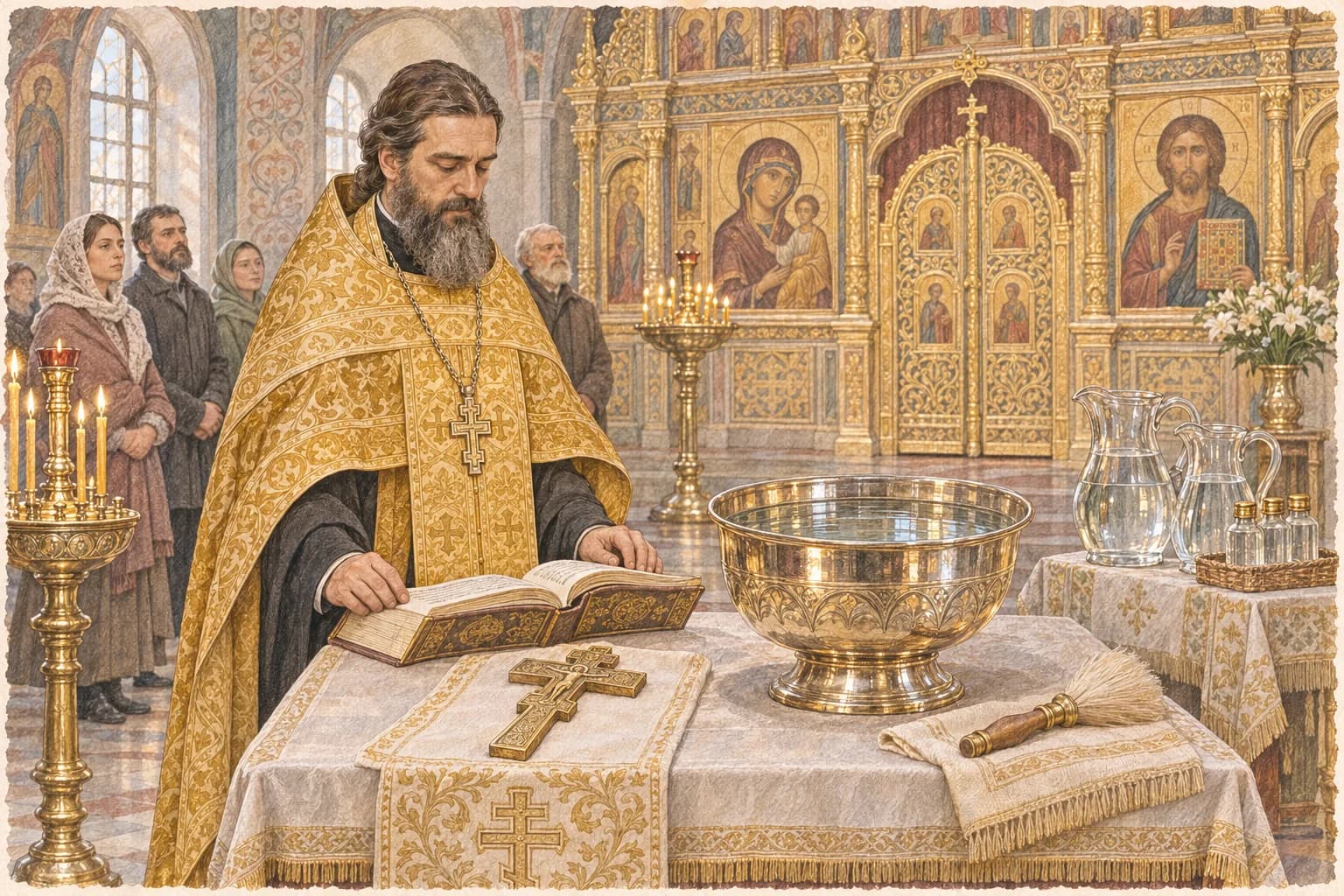
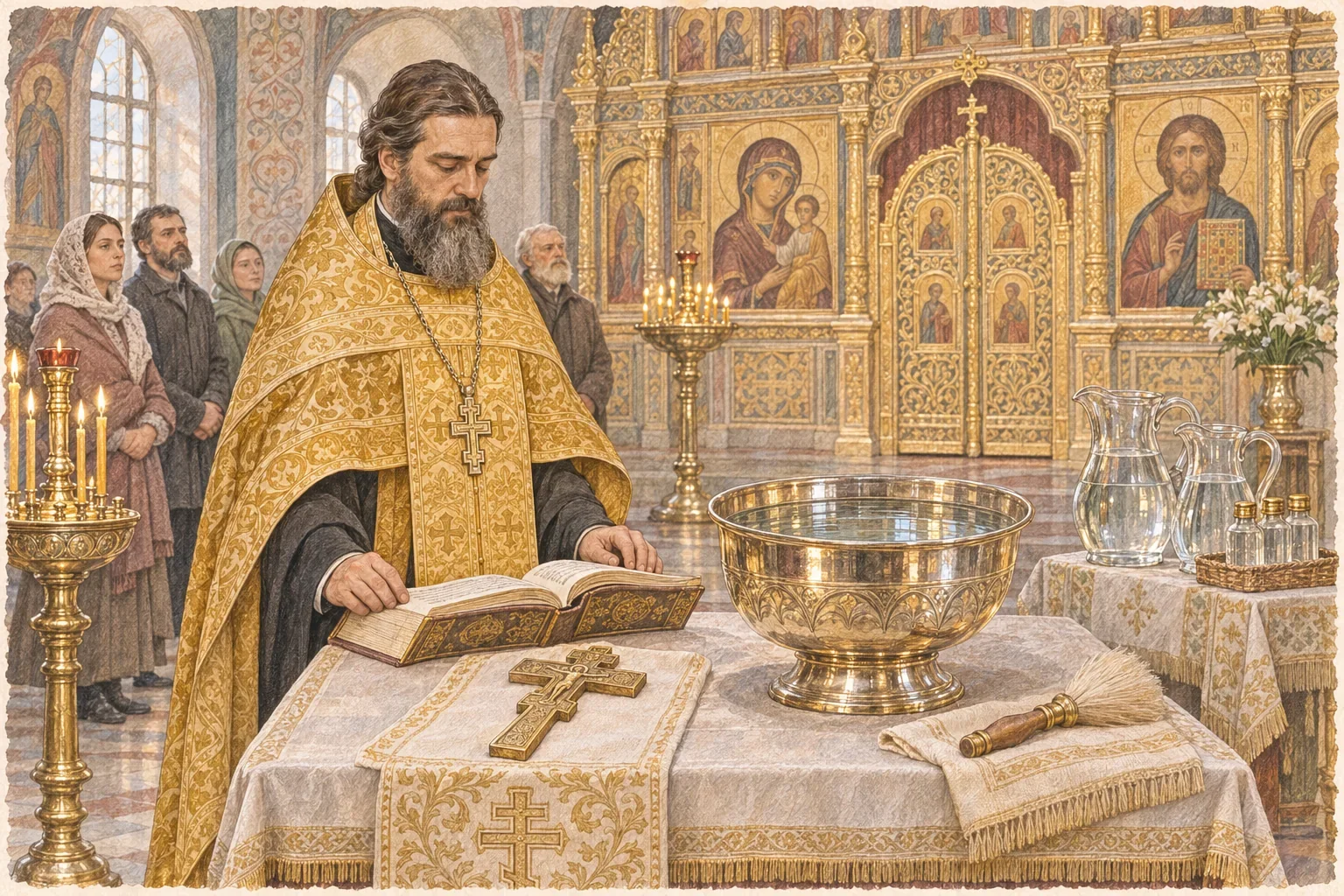
A water-blessing service is an order of prayer that includes the blessing of water. It is neither a shortened Liturgy nor a way to purchase a particular outcome. The community prays to God and receives the blessed water reverently.
The lesser blessing of water is celebrated on various occasions in church life. The great blessing is associated with Theophany. Their different rites do not create a competition between two kinds of water for usefulness or power.
Receiving water does not replace participation in the sacraments, medical care or necessary decisions. A parish is not obliged to hold a service immediately on demand. Timing and arrangements for submitting names depend on local practice.
Before visiting, check the schedule, arrangements for names and whether to bring a clean container. Attend for prayer rather than merely to collect water. Store it carefully at home without imagining that a larger bottle increases grace.
What happens during the blessing of water
The service centres on asking God to bless the water and help those who receive it with faith. Psalms, petitions and appointed prayers are heard; the priest blesses the water, while those present participate through attention and prayer. The precise contents and sequence depend on the rite being celebrated. A particular action involving the cross should not be separated from the whole service and treated as its only effective moment.
The water does not become an independent agent. Christians turn to God rather than to a substance and receive the blessed water as something sacred. Consequently, it is helpful to listen to the prayers as far as possible instead of concentrating only on obtaining a place near the container. Reading an explanation before attending can make unfamiliar words and visible actions intelligible within the Church’s prayer.
Lesser and great blessings of water
The great blessing belongs to Theophany and the commemoration of the Lord’s Baptism. The lesser blessing is celebrated on various occasions throughout the year. The distinction concerns liturgical rites, their contents and their place in the church calendar. It does not justify marketing one kind of blessed water as more powerful, or suggesting that God’s help depends entirely on the date a bottle was obtained.
A water-blessing service on an ordinary weekday is not deficient because there is no large festive crowd. Conversely, large numbers of visitors in January require patience but do not make the queue the central meaning of the feast. Check the particular parish’s timetable: the hours for collecting water may differ from the time of the blessing itself, and last year’s announcement does not establish this year’s arrangements.
Preparing to attend
Participation does not require special new clothing or an expensive vessel. A clean container that closes securely and can be carried home is sufficient. If you wish to submit names, ask beforehand where requests are accepted, which names may be included in this particular form of church commemoration and when they should be handed in. If someone’s baptismal status is uncertain, ask the priest instead of altering their name or concealing the circumstances.
Arrive a little before the announced time so practical arrangements do not occupy the entire service. Explain to a child that the visit involves prayer rather than collecting an unusual drink. An older person can choose manageable participation and request help with a heavy container. Carrying a large supply is not a demonstration of greater devotion; a small amount is easier to store carefully and use thoughtfully.
Using the water at home
Keep holy water in a clean, closed, clearly labelled container so it cannot be confused with a household liquid. Ask your parish about the customary manner of using it. An acquaintance’s account should not become a universal rule requiring an exact number of sips or a compulsory time of day. An outward practice can support reverence, but it is not a mechanism for securing a guaranteed result.
If the water develops an unusual smell or visibly changes, do not drink it as a test of faith. Ask the parish how to dispose of it respectfully. Blessing does not remove the need for clean containers and sensible storage. Where fluid intake is medically restricted, or another health issue is relevant, follow clinical advice. Church life does not require concealing illness or placing yourself at risk.
Prayer, petition and responsibility
Someone may attend because of illness, anxiety or family difficulties. These are understandable reasons to ask for help, but prayer does not cancel actions for which we remain responsible. After the service, a patient continues treatment, a debtor addresses obligations and someone involved in a quarrel seeks an honest path towards reconciliation. Blessed water accompanies a life of faith rather than replacing its moral substance.
An unwanted outcome should not be explained by claiming that someone collected the wrong water or brought too small a bottle. Such conclusions do not follow from the meaning of the service. A more useful question is what can be done today with trust in God and care for a neighbour. The first step may be seeking help from a priest, clinician or trusted person instead of remaining alone with fear.
A question for reflection
Have you confirmed the service time, or are you relying on an old announcement?