
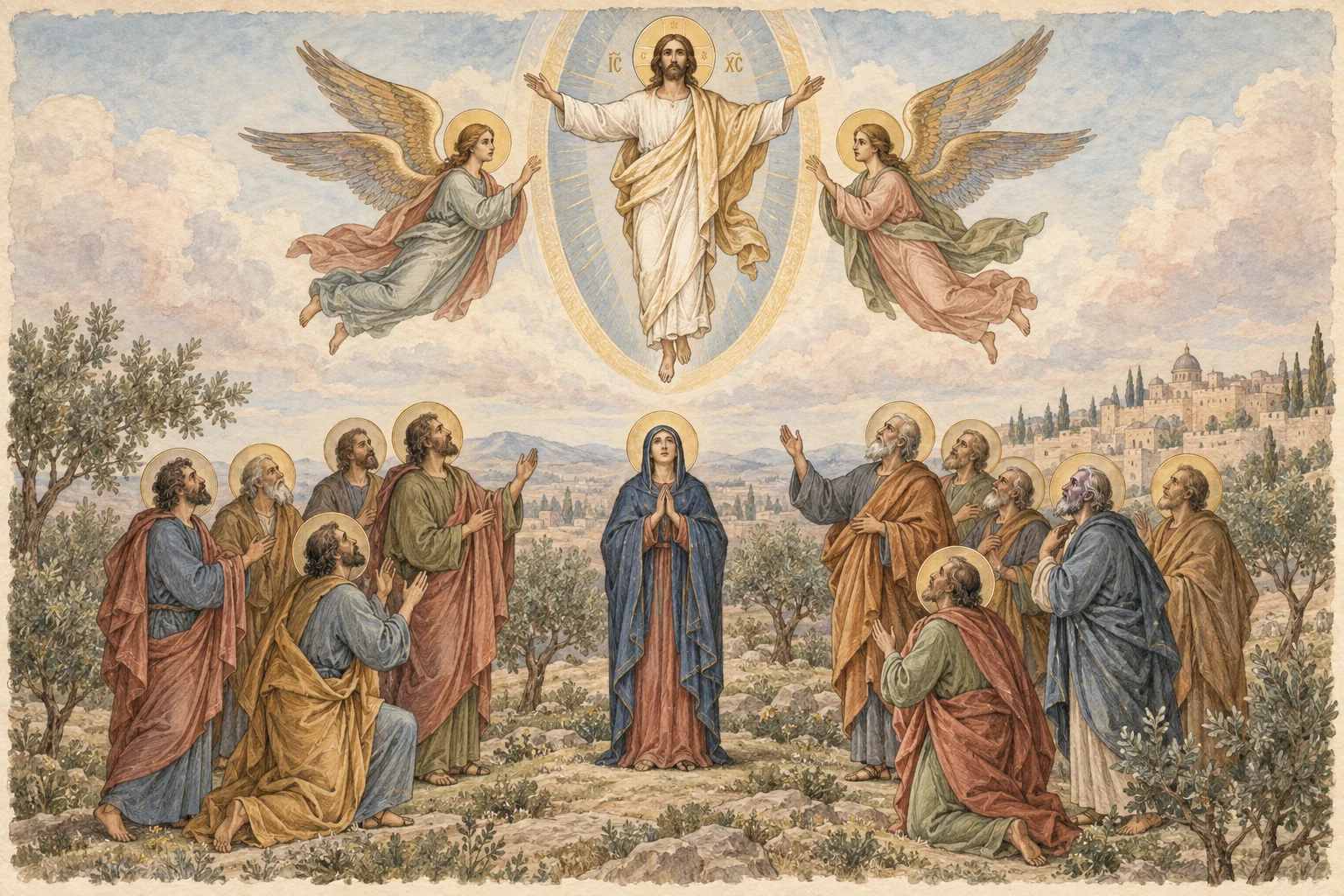
Ascension is celebrated on the fortieth day of Pascha, counting Pascha itself as the first day. It therefore always falls on a Thursday, although its civil date changes each year. The Church remembers neither Christ's disappearance nor the end of God's care for the world, but the glorification of the risen Lord and a new stage in his disciples' lives.
The Scriptural Event
The principal accounts are at the end of Luke and the beginning of Acts. Christ blesses the disciples and ascends; they receive the promise of the Holy Spirit and the commission to bear witness. In Acts, the angelic address prevents them from remaining indefinitely as spectators staring into the sky. Waiting must become a life of responding to their commission.
The forty days after the Resurrection are described as a period of appearances by the risen Christ. They are not simply a return to life before the Cross as though nothing had happened. The disciples encounter his victory over death and then learn to live through his promise and faithfulness rather than relying solely on seeing their Teacher before them.
What Heaven Means Here
Heaven should not be reduced to a distant location reached by travelling higher within the universe. The feast concerns glory with the Father. Christ does not discard his humanity as an unnecessary covering: the one who ascends is the one who truly became human, suffered, and rose. The event therefore concerns humanity's destiny, not merely an extraordinary spectacle.
This does not devalue the earthly body, ordinary work, or care for a neighbour. Human life is not a disposable stage to be despised. Caring for someone ill, exercising patience at home, and working honestly can all answer the feast, because salvation concerns the whole person and not only abstract thought.
Pascha and Pentecost
Ascension cannot be understood apart from the Resurrection: it is the risen Christ who ascends. The next major moment of the Paschal cycle, Pentecost, concerns the fulfilment of the promise of the Holy Spirit. These feasts are not competing celebrations but related events remembered within one continuing life of the Church.
Do not calculate Ascension from a baptism anniversary, from another calendar's Easter without checking, or by simply adding forty complete days after Pascha. The reference is the Orthodox Pascha observed by the community and the inclusive count. In practice, consult the parish calendar rather than attempting to derive a service time from a rough calculation.
Taking Part
Read Acts 1:1–12 beforehand and then listen for the feast's themes in its hymns. Separation from the Teacher's visible presence is not presented as hopeless abandonment. The Liturgy allows the commemoration to be experienced as the Church's shared prayer rather than merely an explanation of an isolated biblical scene.
If work makes Thursday attendance impossible, check for a service on the preceding evening or set aside time at home for reading and prayer. There is no need to invent prohibitions against ordinary work, laundry, or household care. Attention to the feast is not a search for dangerous everyday activities. Its practical question is how to live as Christ's witness without turning the expectation of heaven into indifference towards the person nearby.
With children, clarify that Ascension does not mean Christ has become too far away to hear someone. Geographical distance describes journeys; it does not determine whether God can be approached in prayer and trust.
Waiting Without Becoming Inactive
In Acts 1, the disciples ask about the restoration of the kingdom. Christ's answer turns them towards witness and the promised power of the Holy Spirit. Notice the change of focus: instead of possessing the timetable of the future, they receive a responsibility. The passage is not permission to calculate the end of the world from political events. Separate what the account says from guesses brought to it by the reader.
For reflection, make two short lists: what you want to know in advance, and what you can already do. Someone may not know how a family disagreement will end but can stop humiliating the other person. They may not know what will happen at work but can complete an assignment honestly. This does not promise success in exchange for good behaviour. It simply prevents uncertainty from becoming a reason to postpone every responsibility until the future feels secure.
Ascension and the Words of the Creed
The expression about sitting at the Father's right hand concerns Christ's glory, not the arrangement of seats somewhere in the sky. The doctrinal account of Ascension in the sources connects this image with the glorification of the incarnate Son. When saying the Creed, we are therefore not describing a map of heaven. We confess who Christ is and why his saving work did not end with his departure from the disciples' sight.
If the language is unfamiliar, discussing one expression may help more than memorising several difficult definitions. At a parish conversation, for example, ask how Christ's continuing presence in the Church relates to his Ascension. Asking is not itself unbelief. It can correct the impression that God is like someone who has travelled too far away to remain available. Understanding develops through careful questions as well as through repetition.
Explaining the Feast Without Misleading Pictures
During family reading, mark a simple sequence on paper: Pascha, Ascension, Pentecost. It shows how the events are connected, not a route along which God travels. After reading, invite everyone to identify the responsibility given to the disciples. There is no need to demand identical answers: returning to the passage is more useful than arguing about who remembers a summary best. A short prayer for courage to do the good already known to us can bring the conversation to a close without pretending every question has been resolved.
Sources
- OCA: Ascension in the Church year
- OCA: Ascension in the Creed
- Acts of the Apostles, chapter 1 (Russian)